 Add to Chrome
 Add to Firefox
 Add to Edge
Robustness Analysis of POMDP Policies to Observation Perturbations
Apr 23, 2026
Policies for Partially Observable Markov Decision Processes (POMDPs) are often designed using a nominal system model. In practice, this model can deviate from the true system during deployment due to factors such as calibration drift or sensor degradation, leading to unexpected performance degradation. This work studies policy robustness against deviations in the POMDP observation model. We introduce the Policy Observation Robustness Problem: to determine the maximum tolerable deviation in a POMDP's observation model that guarantees the policy's value remains above a specified threshold. We analyze two variants: the sticky variant, where deviations are dependent on state and actions, and the non-sticky variant, where they can be history-dependent. We show that the Policy Observation Robustness Problem can be formulated as a bi-level optimization problem in which the inner optimization is monotonic in the size of the observation deviation. This enables efficient solutions using root-finding algorithms in the outer optimization. For the non-sticky variant, we show that when policies are represented with finite-state controllers (FSCs) it is sufficient to consider observations which depend on nodes in the FSC rather than full histories. We present Robust Interval Search, an algorithm with soundness and convergence guarantees, for both the sticky and non-sticky variants. We show this algorithm has polynomial time complexity in the non-sticky variant and at most exponential time complexity in the sticky variant. We provide experimental results validating and demonstrating the scalability of implementations of Robust Interval Search to POMDP problems with tens of thousands of states. We also provide case studies from robotics and operations research which demonstrate the practical utility of the problem and algorithms.

Leveraging Counterfactual Paths for Contrastive Explanations of POMDP Policies
Mar 28, 2024
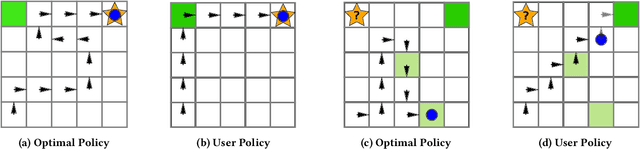

As humans come to rely on autonomous systems more, ensuring the transparency of such systems is important to their continued adoption. Explainable Artificial Intelligence (XAI) aims to reduce confusion and foster trust in systems by providing explanations of agent behavior. Partially observable Markov decision processes (POMDPs) provide a flexible framework capable of reasoning over transition and state uncertainty, while also being amenable to explanation. This work investigates the use of user-provided counterfactuals to generate contrastive explanations of POMDP policies. Feature expectations are used as a means of contrasting the performance of these policies. We demonstrate our approach in a Search and Rescue (SAR) setting. We analyze and discuss the associated challenges through two case studies.
Investigation of risk-aware MDP and POMDP contingency management autonomy for UAS
Apr 03, 2023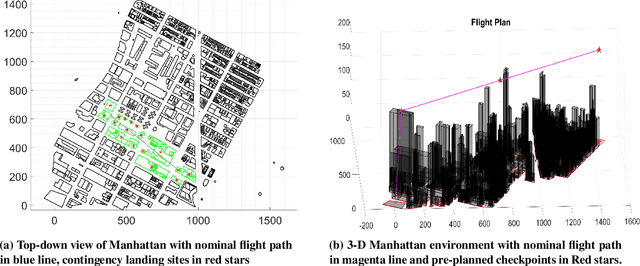
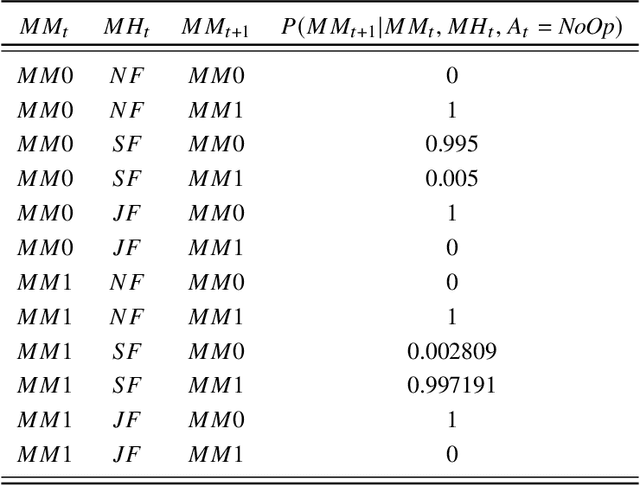
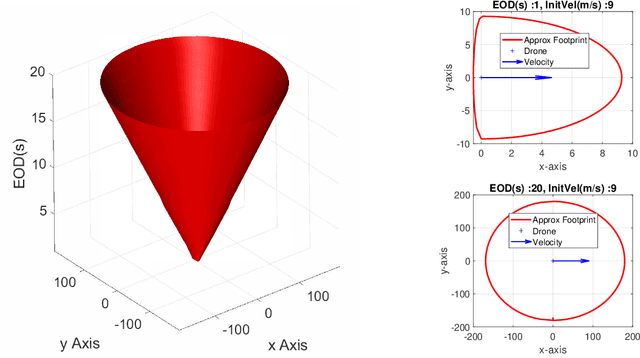
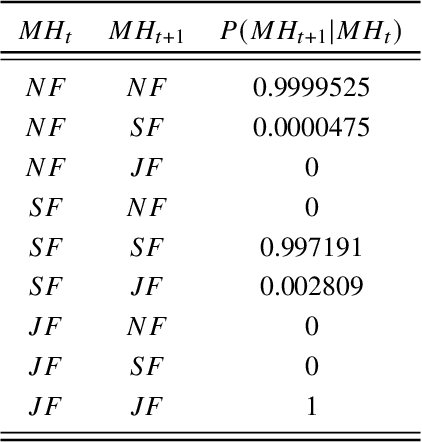
Unmanned aircraft systems (UAS) are being increasingly adopted for various applications. The risk UAS poses to people and property must be kept to acceptable levels. This paper proposes risk-aware contingency management autonomy to prevent an accident in the event of component malfunction, specifically propulsion unit failure and/or battery degradation. The proposed autonomy is modeled as a Markov Decision Process (MDP) whose solution is a contingency management policy that appropriately executes emergency landing, flight termination or continuation of planned flight actions. Motivated by the potential for errors in fault/failure indicators, partial observability of the MDP state space is investigated. The performance of optimal policies is analyzed over varying observability conditions in a high-fidelity simulator. Results indicate that both partially observable MDP (POMDP) and maximum a posteriori MDP policies performed similarly over different state observability criteria, given the nearly deterministic state transition model.