 Add to Chrome
 Add to Firefox
 Add to Edge
A Neuromorphic Trigger for Efficient Audio Event Detection
Jun 16, 2026
Efficient processing of continuous audio streams remains a key challenge for real-time and resource-constrained systems. This paper introduces a neuromorphic trigger for audio event detection, based on a spiking neural network (SNN) that selectively gates input to downstream models. The proposed trigger acts as a low-cost front-end, identifying salient audio segments and forwarding only these to a more computationally intensive model for tasks such as classification. The trigger is implemented as a lightweight fully connected SNN and evaluated on two representative tasks: Anomalous Sound Detection (ASD) and Sound Event Detection (SED). For ASD, the trigger achieves a one-second segment-based F1 score of 0.97 on a class-agnostic form of the URBAN-SED dataset, demonstrating high reliability in identifying relevant audio regions. For SED, the trigger is combined with the Dang classifier on the DCASE 2017 Challenge Task 2 dataset, showing a potential $42.6\times$ reduction in FLOPs while reducing the lower bound of the event-based error rate from 0.41 to 0.25. These results highlight the potential of neuromorphic triggers as real-time, energy-efficient front-end filters, enabling substantial reductions in computational cost.

Structured Pneumatic Fingerpads for Actively Tunable Grip Friction
Feb 02, 2025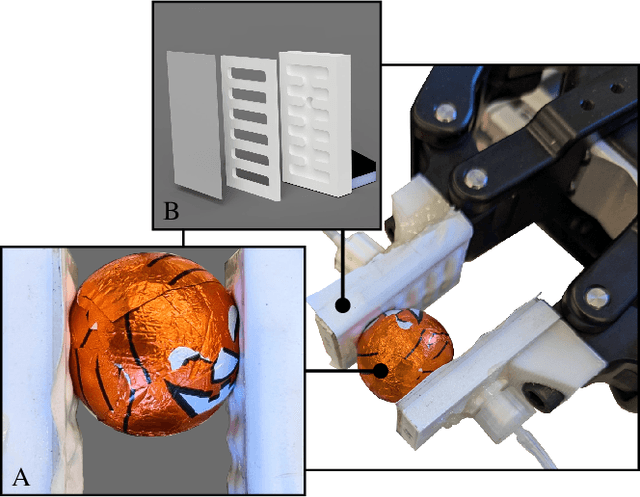
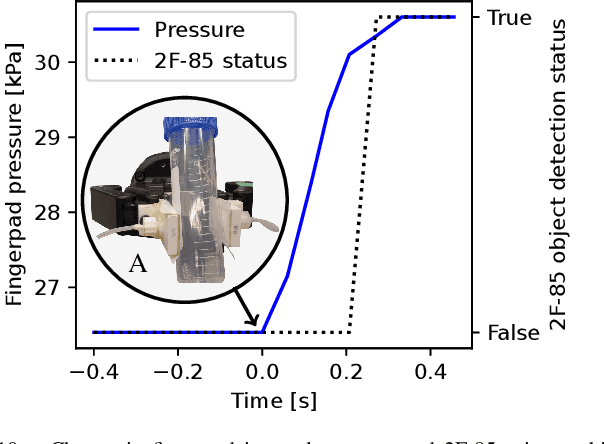
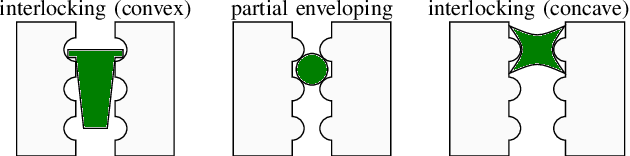
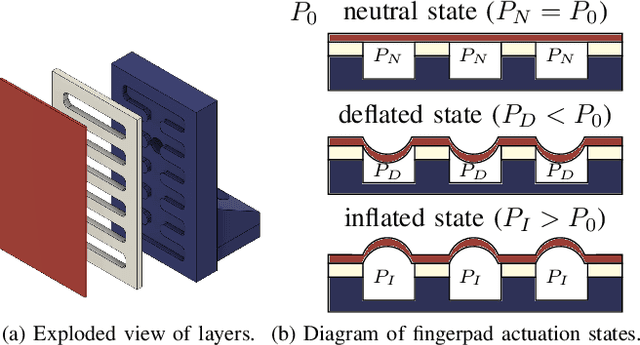
Grip surfaces with tunable friction can actively modify contact conditions, enabling transitions between higher- and lower-friction states for grasp adjustment. Friction can be increased to grip securely and then decreased to gently release (e.g., for handovers) or manipulate in-hand. Recent friction-tuning surface designs using soft pneumatic chambers show good control over grip friction; however, most require complex fabrication processes and/or custom gripper hardware. We present a practical structured fingerpad design for friction tuning that uses less than \$1 USD of materials, takes only seconds to repair, and is easily adapted to existing grippers. Our design uses surface morphology changes to tune friction. The fingerpad is actuated by pressurizing its internal chambers, thereby deflecting its flexible grip surface out from or into these chambers. We characterize the friction-tuning capabilities of our design by measuring the shear force required to pull an object from a gripper equipped with two independently actuated fingerpads. Our results show that varying actuation pressure and timing changes the magnitude of friction forces on a gripped object by up to a factor of 2.8. We demonstrate additional features including macro-scale interlocking behaviour and pressure-based object detection.