 Add to Chrome
 Add to Firefox
 Add to Edge
ProCAVE: A Self-Adaptive, Full-Lifecycle Edge Caching Framework for Video Streaming via Predictive Bandwidth Estimation and Preference-Aware Deep Reinforcement Learning
Aug 04, 2026
The growing demand for mobile video streaming requires edge delivery systems that adapt efficiently to rapid network fluctuations and diverse user preferences. Existing approaches such as FlyCache rely on reactive ABR heuristics and loosely coupled cache policies, limiting their responsiveness and coordination under real-world wireless dynamics. We propose ProCAVE (Proactive Caching with Adaptive Video Experience), a self-adaptive DRL-based framework that unifies predictive bandwidth modeling, proactive bitrate selection, and preference-aware cache control. ProCAVE employs: (i) a lightweight Transformer for short-term throughput forecasting; (ii) a PPO-driven ABR agent; and (iii) a DDPG-based continuous cache controller operating on a high-dimensional global state. Experiments using MovieLens preference traces and Ghent 4G bandwidth measurements show that ProCAVE improves byte hit rate, reduces backhaul load, and enhances QoE compared with FlyCache and other baselines. These results highlight the benefits of predictive, DRL-coordinated control for efficient and user-centric edge video delivery.

A Factor Graph Model of Trust for a Collaborative Multi-Agent System
Feb 10, 2024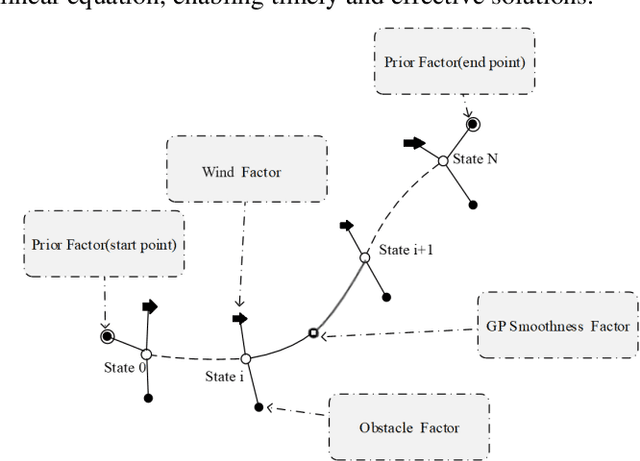
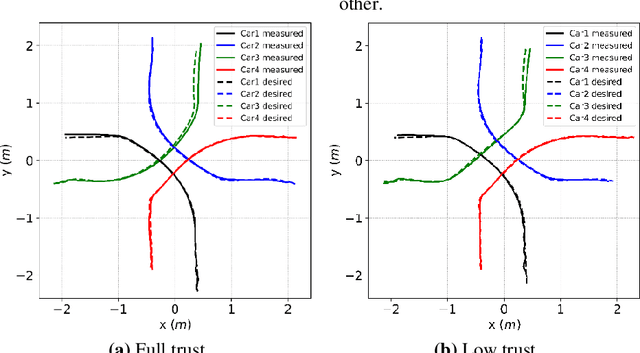
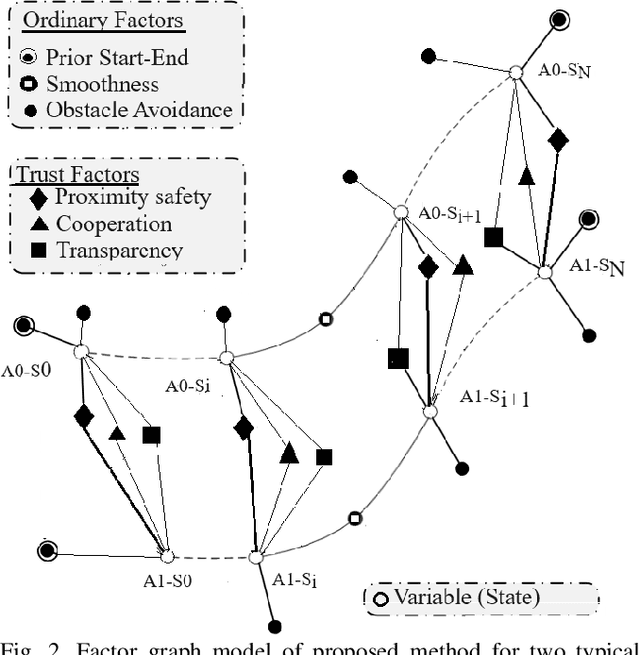
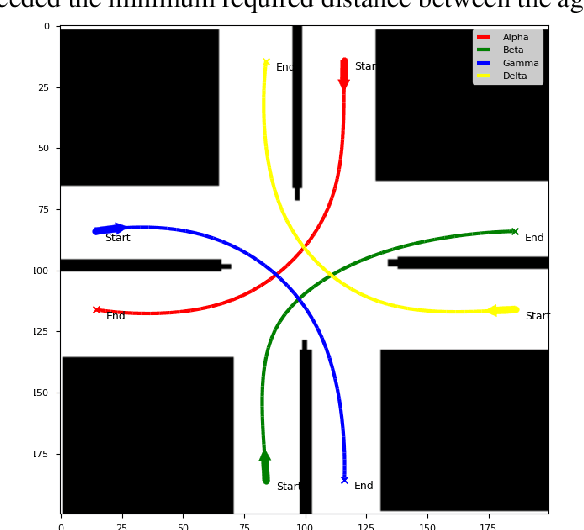
In the field of Multi-Agent Systems (MAS), known for their openness, dynamism, and cooperative nature, the ability to trust the resources and services of other agents is crucial. Trust, in this setting, is the reliance and confidence an agent has in the information, behaviors, intentions, truthfulness, and capabilities of others within the system. Our paper introduces a new graphical approach that utilizes factor graphs to represent the interdependent behaviors and trustworthiness among agents. This includes modeling the behavior of robots as a trajectory of actions using a Gaussian process factor graph, which accounts for smoothness, obstacle avoidance, and trust-related factors. Our method for evaluating trust is decentralized and considers key interdependent sub-factors such as proximity safety, consistency, and cooperation. The overall system comprises a network of factor graphs that interact through trust-related factors and employs a Bayesian inference method to dynamically assess trust-based decisions with informed consent. The effectiveness of this method is validated via simulations and empirical tests with autonomous robots navigating unsignalized intersections.
Optimized Path Planning for USVs under Ocean Currents
Jul 07, 2023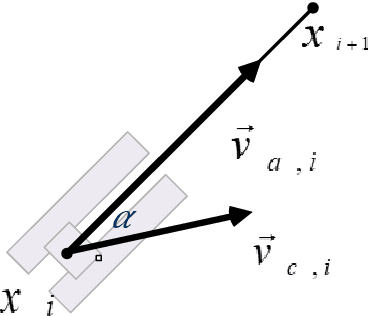
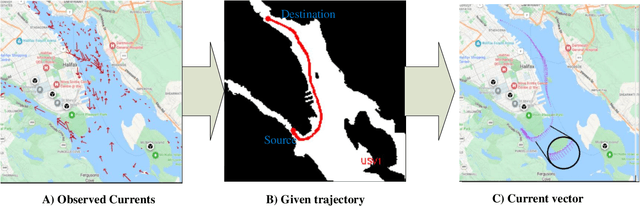
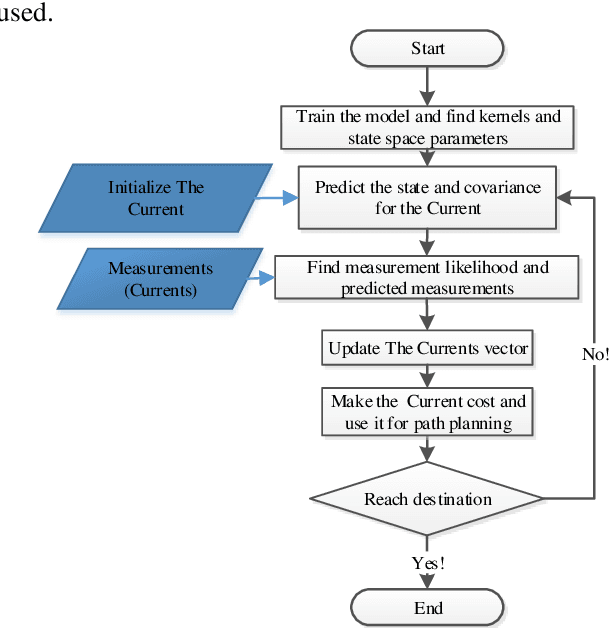
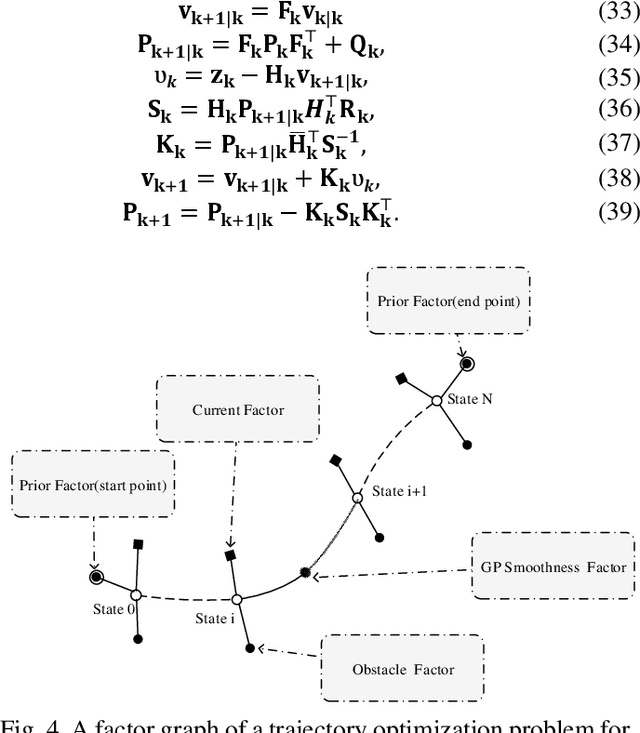
The proposed work focuses on the path planning for Unmanned Surface Vehicles (USVs) in the ocean enviroment, taking into account various spatiotemporal factors such as ocean currents and other energy consumption factors. The paper proposes the use of Gaussian Process Motion Planning (GPMP2), a Bayesian optimization method that has shown promising results in continuous and nonlinear path planning algorithms. The proposed work improves GPMP2 by incorporating a new spatiotemporal factor for tracking and predicting ocean currents using a spatiotemporal Bayesian inference. The algorithm is applied to the USV path planning and is shown to optimize for smoothness, obstacle avoidance, and ocean currents in a challenging environment. The work is relevant for practical applications in ocean scenarios where an optimal path planning for USVs is essential for minimizing costs and optimizing performance.
Role Engine Implementation for a Continuous and Collaborative Multi-Robot System
Jul 06, 2023
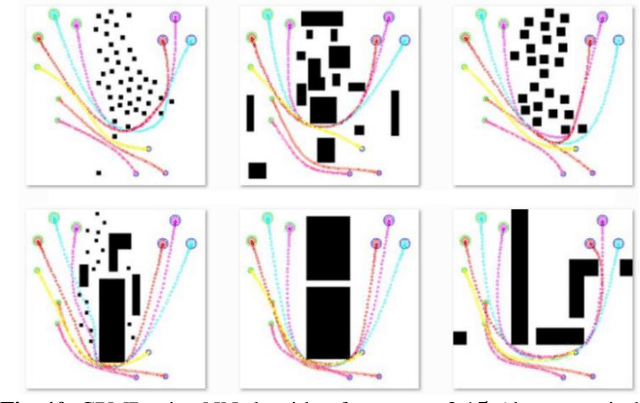
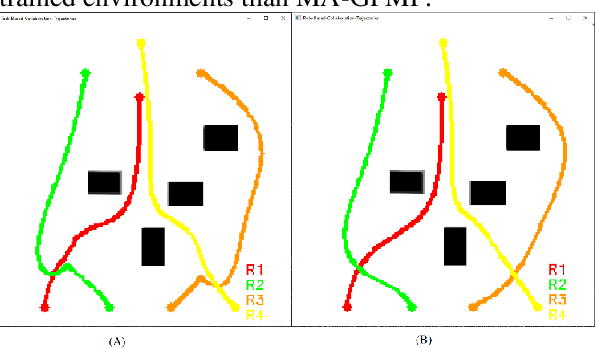
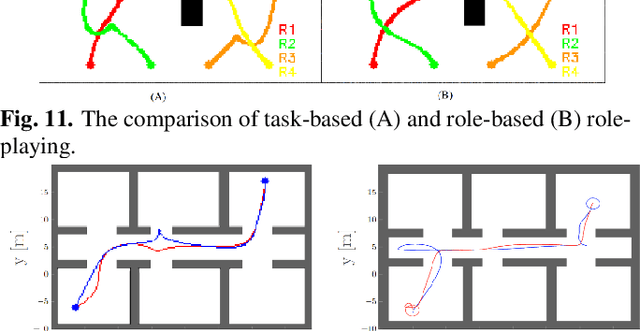
In situations involving teams of diverse robots, assigning appropriate roles to each robot and evaluating their performance is crucial. These roles define the specific characteristics of a robot within a given context. The stream actions exhibited by a robot based on its assigned role are referred to as the process role. Our research addresses the depiction of process roles using a multivariate probabilistic function. The main aim of this study is to develop a role engine for collaborative multi-robot systems and optimize the behavior of the robots. The role engine is designed to assign suitable roles to each robot, generate approximately optimal process roles, update them on time, and identify instances of robot malfunction or trigger replanning when necessary. The environment considered is dynamic, involving obstacles and other agents. The role engine operates hybrid, with central initiation and decentralized action, and assigns unlabeled roles to agents. We employ the Gaussian Process (GP) inference method to optimize process roles based on local constraints and constraints related to other agents. Furthermore, we propose an innovative approach that utilizes the environment's skeleton to address initialization and feasibility evaluation challenges. We successfully demonstrated the proposed approach's feasibility, and efficiency through simulation studies and real-world experiments involving diverse mobile robots.