 Add to Chrome
 Add to Firefox
 Add to Edge
Channel Estimation for Full-duplex Multi-tag Ambient Backscatter Communication Systems with I/Q Imbalance
Dec 14, 2025
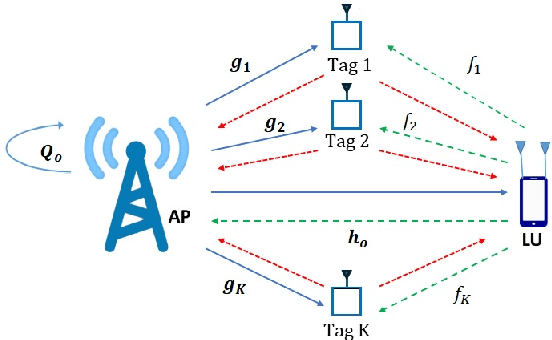
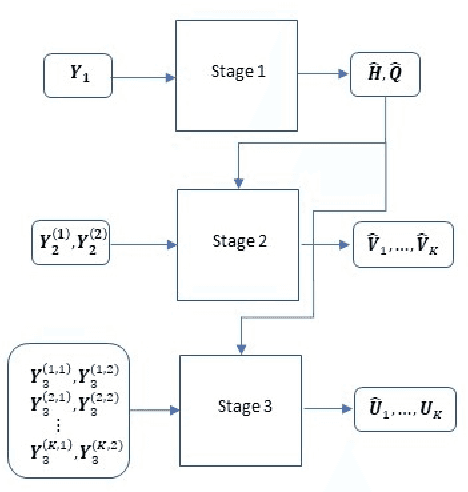
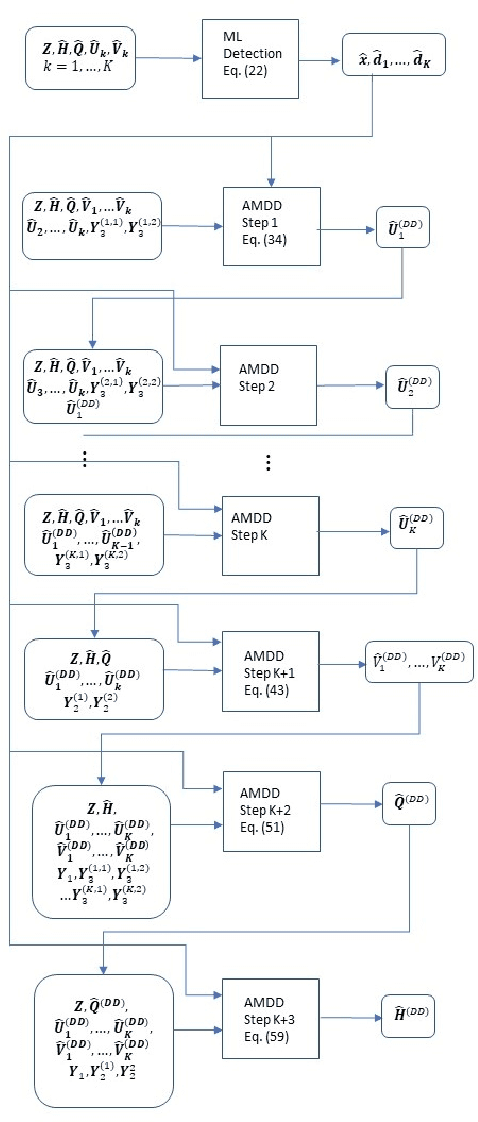
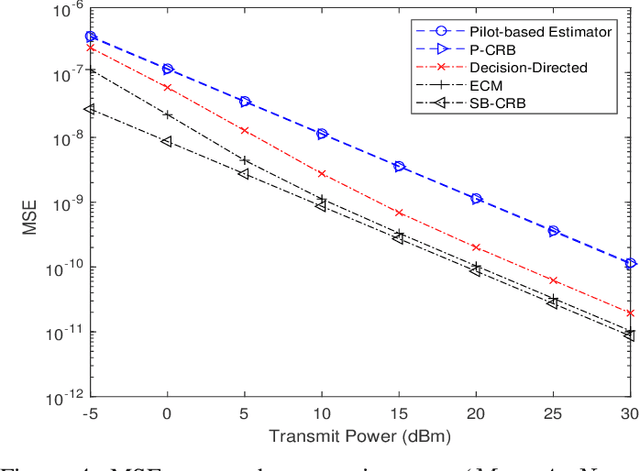
Ambient backscatter communication (AmBC) has emerged as a highly attractive paradigm for energy-efficient communication. Full-duplex multi-tag AmBC systems provide the scalability and efficient spectrum utilization essential for next generation Internet-of-Things (IoT) networks. However, the presence of multiple tags, self-interference and hardware impairments such as inphase/quadrature (I/Q) imbalance, makes accurate channel estimation indispensable for efficient interference management. The large number of channel parameters and the presence of mirror images of each signal component necessitate careful design of the channel estimation phase to prevent performance degradation. In this work, we propose a novel three-stage training protocol and pilot-based estimation scheme that ensure signal orthogonality and successfully avoid error floors. We also propose two semi-blind estimators, one based on decision-directed (DD) criterion and the other on the expectation conditional maximization (ECM) framework. By exploiting both pilots and data symbols, these two estimators achieve higher estimation accuracy than pilot-based estimation, at the cost of additional complexity. Cramer-Rao bounds (CRBs) for both types of estimation are also derived. The pilot-based estimator and the ECM estimator approach their respective CRBs, while the DD estimator performs mid-way between them. The three proposed solutions support different use cases by offering distinct tradeoffs between performance and computational complexity.

Spiking Neural Networks for Detecting Satellite-Based Internet-of-Things Signals
Apr 08, 2023With the rapid growth of IoT networks, ubiquitous coverage is becoming increasingly necessary. Low Earth Orbit (LEO) satellite constellations for IoT have been proposed to provide coverage to regions where terrestrial systems cannot. However, LEO constellations for uplink communications are severely limited by the high density of user devices, which causes a high level of co-channel interference. This research presents a novel framework that utilizes spiking neural networks (SNNs) to detect IoT signals in the presence of uplink interference. The key advantage of SNNs is the extremely low power consumption relative to traditional deep learning (DL) networks. The performance of the spiking-based neural network detectors is compared against state-of-the-art DL networks and the conventional matched filter detector. Results indicate that both DL and SNN-based receivers surpass the matched filter detector in interference-heavy scenarios, owing to their capacity to effectively distinguish target signals amidst co-channel interference. Moreover, our work highlights the ultra-low power consumption of SNNs compared to other DL methods for signal detection. The strong detection performance and low power consumption of SNNs make them particularly suitable for onboard signal detection in IoT LEO satellites, especially in high interference conditions.
HybNet: A Hybrid Deep Learning - Matched Filter Approach for IoT Signal Detection
Nov 23, 2021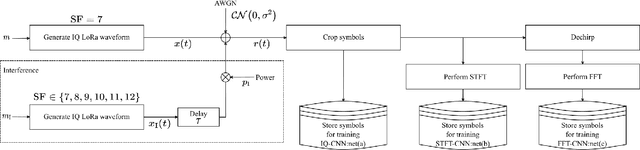
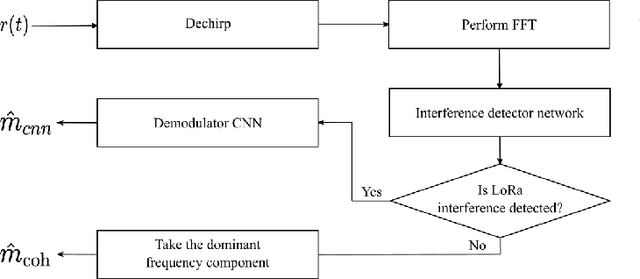
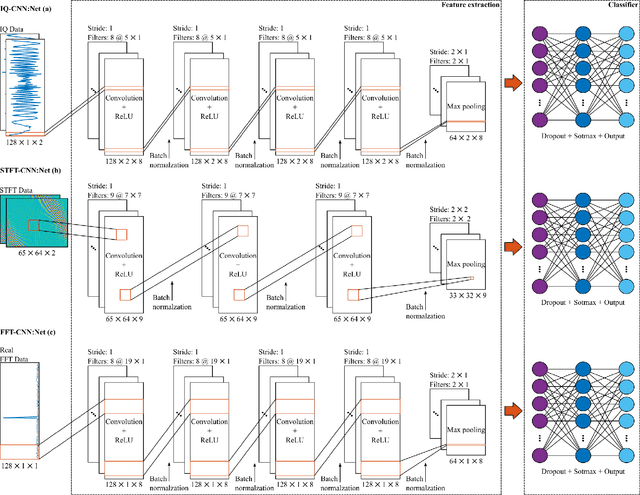
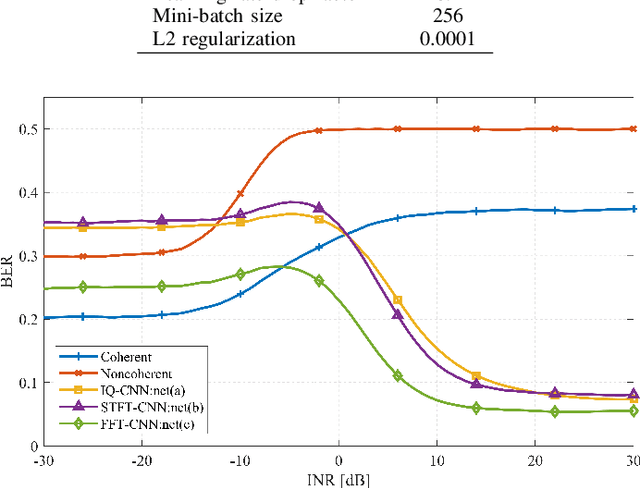
Random access schemes are widely used in IoT wireless access networks to accommodate simplicity and power consumption constraints. As a result, the interference arising from overlapping IoT transmissions is a significant issue in such networks. Traditional signal detection methods are based on the well-established matched filter using the complex conjugate of the signal, which is proven as the optimal filter under additive white Gaussian noise. However, with the colored interference arising from the overlapping IoT transmissions, deep learning approaches are being considered as a better alternative. In this paper, we present a hybrid framework, HybNet, that switches between deep learning and match filter pathways based on the detected interference level. This helps the detector work in a broader range of conditions, optimally leveraging the matched filter and deep learning robustness. We compare the performance of several possible data modalities and detection architectures concerning the interference-to-noise ratio, demonstrating that the proposed HybNet surpasses the complex conjugate matched filter performance under interference-limited scenarios.
Machine Learning Framework for Sensing and Modeling Interference in IoT Frequency Bands
Jun 10, 2021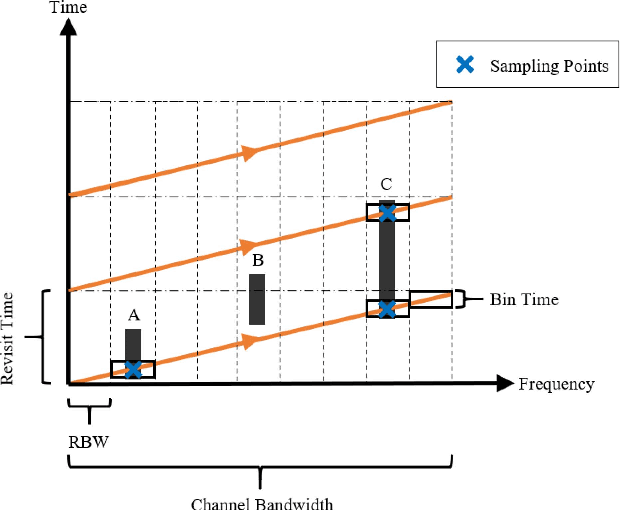
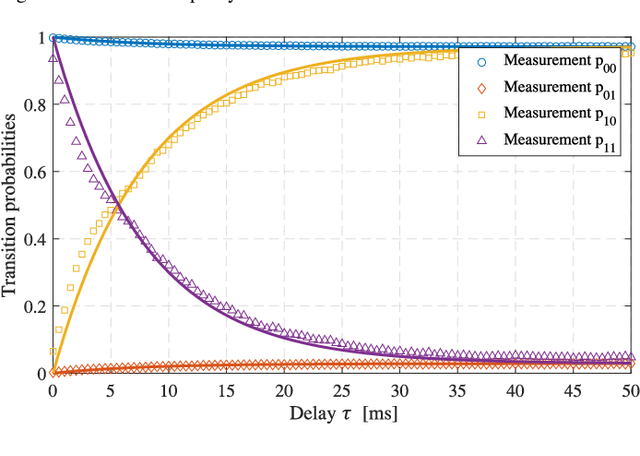
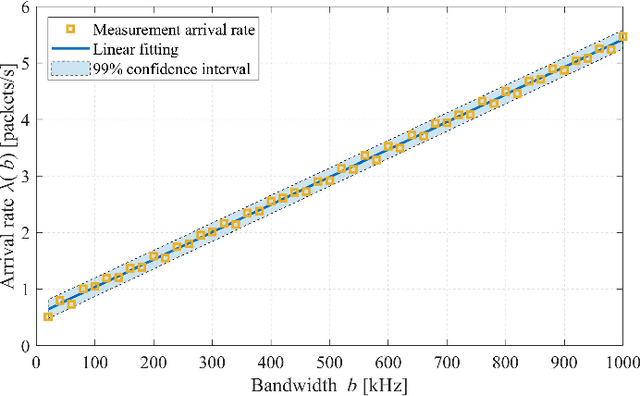
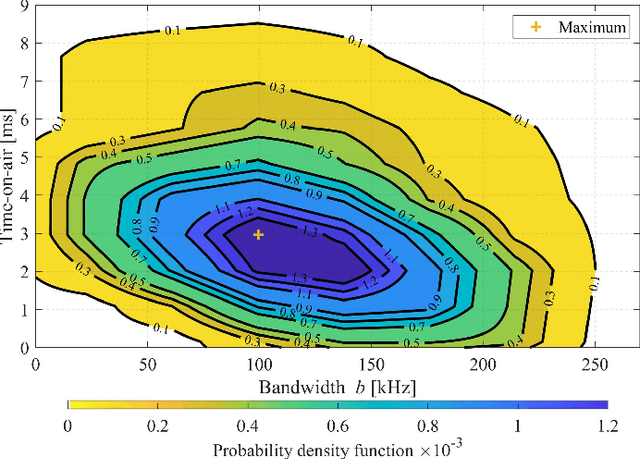
Spectrum scarcity has surfaced as a prominent concern in wireless radio communications with the emergence of new technologies over the past few years. As a result, there is growing need for better understanding of the spectrum occupancy with newly emerging access technologies supporting the Internet of Things. In this paper, we present a framework to capture and model the traffic behavior of short-time spectrum occupancy for IoT applications in the shared bands to determine the existing interference. The proposed capturing method utilizes a software defined radio to monitor the short bursts of IoT transmissions by capturing the time series data which is converted to power spectral density to extract the observed occupancy. Furthermore, we propose the use of an unsupervised machine learning technique to enhance conventionally implemented energy detection methods. Our experimental results show that the temporal and frequency behavior of the spectrum can be well-captured using the combination of two models, namely, semi-Markov chains and a Poisson-distribution arrival rate. We conduct an extensive measurement campaign in different urban environments and incorporate the spatial effect on the IoT shared spectrum.