 Add to Chrome
 Add to Firefox
 Add to Edge
Channel Estimation for Full-duplex Multi-tag Ambient Backscatter Communication Systems with I/Q Imbalance
Paper and Code
Dec 14, 2025
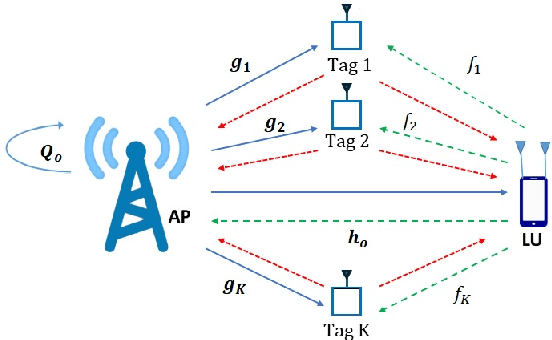
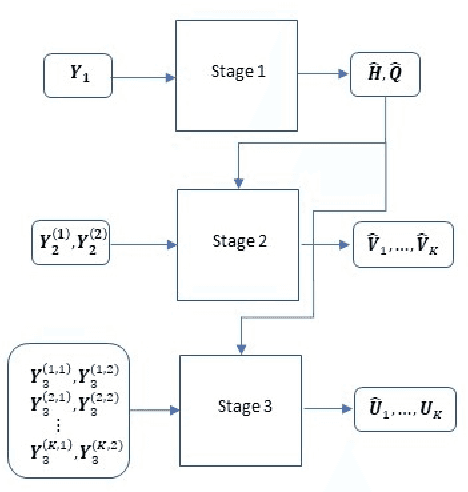
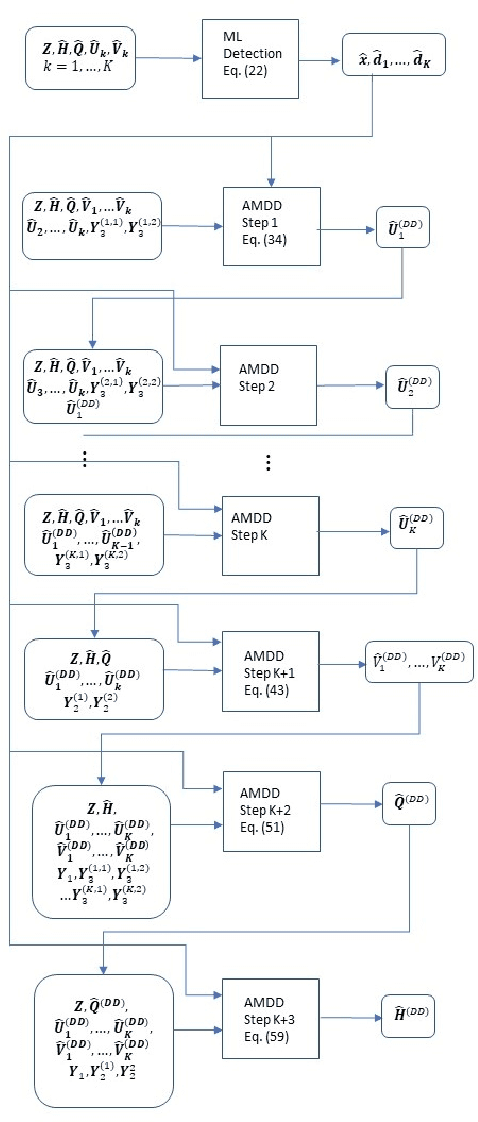
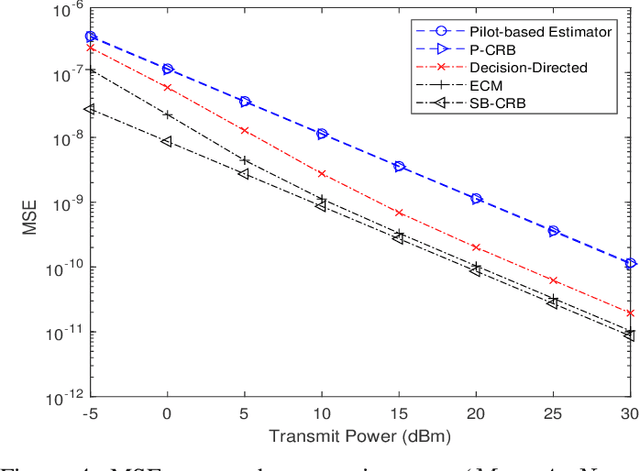
Ambient backscatter communication (AmBC) has emerged as a highly attractive paradigm for energy-efficient communication. Full-duplex multi-tag AmBC systems provide the scalability and efficient spectrum utilization essential for next generation Internet-of-Things (IoT) networks. However, the presence of multiple tags, self-interference and hardware impairments such as inphase/quadrature (I/Q) imbalance, makes accurate channel estimation indispensable for efficient interference management. The large number of channel parameters and the presence of mirror images of each signal component necessitate careful design of the channel estimation phase to prevent performance degradation. In this work, we propose a novel three-stage training protocol and pilot-based estimation scheme that ensure signal orthogonality and successfully avoid error floors. We also propose two semi-blind estimators, one based on decision-directed (DD) criterion and the other on the expectation conditional maximization (ECM) framework. By exploiting both pilots and data symbols, these two estimators achieve higher estimation accuracy than pilot-based estimation, at the cost of additional complexity. Cramer-Rao bounds (CRBs) for both types of estimation are also derived. The pilot-based estimator and the ECM estimator approach their respective CRBs, while the DD estimator performs mid-way between them. The three proposed solutions support different use cases by offering distinct tradeoffs between performance and computational complexity.
