 Add to Chrome
 Add to Firefox
 Add to Edge
Dataset-Aware Cold-Start Active Learning for Annotation-Efficient 3D Medical Image Segmentation
Jun 18, 2026
Deep learning for 3D medical image segmentation requires extensive manual annotations, a major bottleneck in volumetric medical imaging. Active learning aims to reduce this burden by selecting informative samples for annotation, but most methods assume that an initial labeled set is already available. This leaves the cold-start problem largely unresolved: how to select the first volumes from a fully unlabeled pool before any task-specific model is trained. We propose CSCS, a Curriculum-Stratified Cold-Start framework that adapts initial sample selection to the structure of the unlabeled dataset. CSCS combines two self-supervised, label-free signals: local typicality, measuring representativeness in the embedding space, and reconstruction-based uncertainty, used as a proxy for sample difficulty. These signals are combined through a weighted geometric score, where the weighting is determined by a closed-form pacing rule based on the effective annotation budget and the Difficulty-Coverage Ratio, a pool-level statistic measuring the alignment between difficulty and representativeness. We evaluate CSCS on four 3D medical image segmentation benchmarks: BraTS, FeTA, Spleen, and an in-house fetal MRI dataset. Using nnU-Net as downstream segmentation model, CSCS shows consistently competitive performance across datasets and annotation budgets, with the strongest gains in low-to-mid annotation regimes. These results suggest that dataset-aware cold-start initialization can improve the robustness of active learning for 3D medical image segmentation by adapting sample selection to the geometry of the unlabeled pool.

Deep Reinforcement Learning for Flipper Control of Tracked Robots
Jun 17, 2023
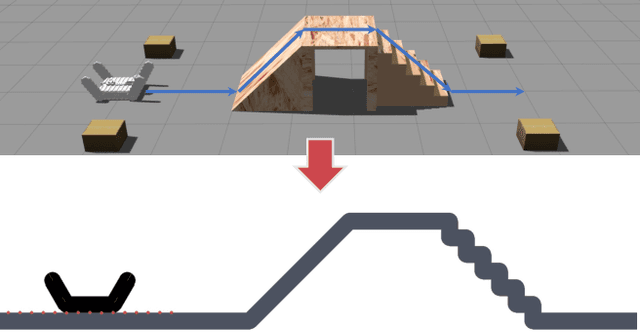


The autonomous control of flippers plays an important role in enhancing the intelligent operation of tracked robots within complex environments. While existing methods mainly rely on hand-crafted control models, in this paper, we introduce a novel approach that leverages deep reinforcement learning (DRL) techniques for autonomous flipper control in complex terrains. Specifically, we propose a new DRL network named AT-D3QN, which ensures safe and smooth flipper control for tracked robots. It comprises two modules, a feature extraction and fusion module for extracting and integrating robot and environment state features, and a deep Q-Learning control generation module for incorporating expert knowledge to obtain a smooth and efficient control strategy. To train the network, a novel reward function is proposed, considering both learning efficiency and passing smoothness. A simulation environment is constructed using the Pymunk physics engine for training. We then directly apply the trained model to a more realistic Gazebo simulation for quantitative analysis. The consistently high performance of the proposed approach validates its superiority over manual teleoperation.