 Add to Chrome
 Add to Firefox
 Add to Edge
Indexing Multimodal Language Models for Large-scale Image Retrieval
Apr 14, 2026
Multimodal Large Language Models (MLLMs) have demonstrated strong cross-modal reasoning capabilities, yet their potential for vision-only tasks remains underexplored. We investigate MLLMs as training-free similarity estimators for instance-level image-to-image retrieval. Our approach prompts the model with paired images and converts next-token probabilities into similarity scores, enabling zero-shot re-ranking within large-scale retrieval pipelines. This design avoids specialized architectures and fine-tuning, leveraging the rich visual discrimination learned during multimodal pre-training. We address scalability by combining MLLMs with memory-efficient indexing and top-$k$ candidate re-ranking. Experiments across diverse benchmarks show that MLLMs outperform task-specific re-rankers outside their native domains and exhibit superior robustness to clutter, occlusion, and small objects. Despite strong results, we identify failure modes under severe appearance changes, highlighting opportunities for future research. Our findings position MLLMs as a promising alternative for open-world large-scale image retrieval.

Language and Planning in Robotic Navigation: A Multilingual Evaluation of State-of-the-Art Models
Jan 07, 2025
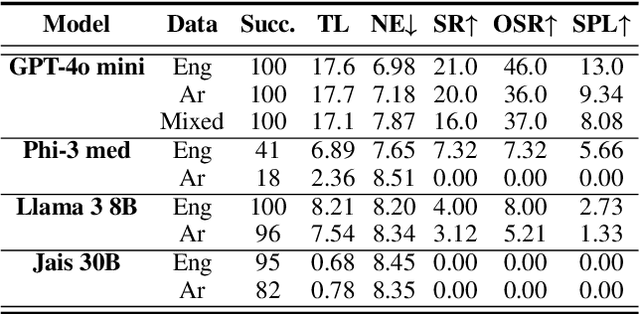
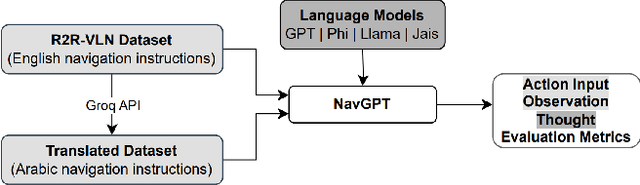
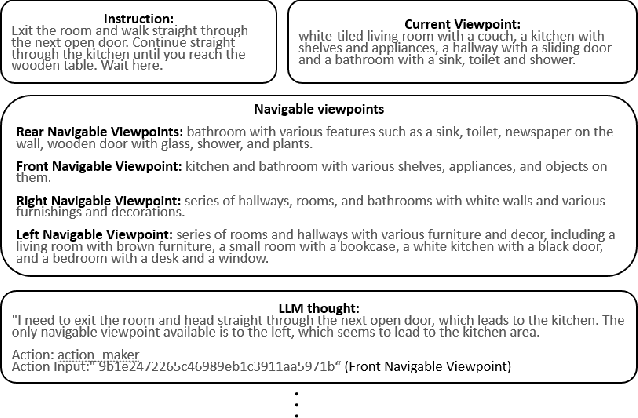
Large Language Models (LLMs) such as GPT-4, trained on huge amount of datasets spanning multiple domains, exhibit significant reasoning, understanding, and planning capabilities across various tasks. This study presents the first-ever work in Arabic language integration within the Vision-and-Language Navigation (VLN) domain in robotics, an area that has been notably underexplored in existing research. We perform a comprehensive evaluation of state-of-the-art multi-lingual Small Language Models (SLMs), including GPT-4o mini, Llama 3 8B, and Phi-3 medium 14B, alongside the Arabic-centric LLM, Jais. Our approach utilizes the NavGPT framework, a pure LLM-based instruction-following navigation agent, to assess the impact of language on navigation reasoning through zero-shot sequential action prediction using the R2R dataset. Through comprehensive experiments, we demonstrate that our framework is capable of high-level planning for navigation tasks when provided with instructions in both English and Arabic. However, certain models struggled with reasoning and planning in the Arabic language due to inherent limitations in their capabilities, sub-optimal performance, and parsing issues. These findings highlight the importance of enhancing planning and reasoning capabilities in language models for effective navigation, emphasizing this as a key area for further development while also unlocking the potential of Arabic-language models for impactful real-world applications.