 Add to Chrome
 Add to Firefox
 Add to Edge
Temporal Blind Spots in Large Language Models
Jan 22, 2024
Large language models (LLMs) have recently gained significant attention due to their unparalleled ability to perform various natural language processing tasks. These models, benefiting from their advanced natural language understanding capabilities, have demonstrated impressive zero-shot performance. However, the pre-training data utilized in LLMs is often confined to a specific corpus, resulting in inherent freshness and temporal scope limitations. Consequently, this raises concerns regarding the effectiveness of LLMs for tasks involving temporal intents. In this study, we aim to investigate the underlying limitations of general-purpose LLMs when deployed for tasks that require a temporal understanding. We pay particular attention to handling factual temporal knowledge through three popular temporal QA datasets. Specifically, we observe low performance on detailed questions about the past and, surprisingly, for rather new information. In manual and automatic testing, we find multiple temporal errors and characterize the conditions under which QA performance deteriorates. Our analysis contributes to understanding LLM limitations and offers valuable insights into developing future models that can better cater to the demands of temporally-oriented tasks. The code is available\footnote{https://github.com/jwallat/temporalblindspots}.

Data Augmentation for Sample Efficient and Robust Document Ranking
Nov 26, 2023Contextual ranking models have delivered impressive performance improvements over classical models in the document ranking task. However, these highly over-parameterized models tend to be data-hungry and require large amounts of data even for fine-tuning. In this paper, we propose data-augmentation methods for effective and robust ranking performance. One of the key benefits of using data augmentation is in achieving sample efficiency or learning effectively when we have only a small amount of training data. We propose supervised and unsupervised data augmentation schemes by creating training data using parts of the relevant documents in the query-document pairs. We then adapt a family of contrastive losses for the document ranking task that can exploit the augmented data to learn an effective ranking model. Our extensive experiments on subsets of the MS MARCO and TREC-DL test sets show that data augmentation, along with the ranking-adapted contrastive losses, results in performance improvements under most dataset sizes. Apart from sample efficiency, we conclusively show that data augmentation results in robust models when transferred to out-of-domain benchmarks. Our performance improvements in in-domain and more prominently in out-of-domain benchmarks show that augmentation regularizes the ranking model and improves its robustness and generalization capability.
Efficient Neural Ranking using Forward Indexes and Lightweight Encoders
Nov 02, 2023Dual-encoder-based dense retrieval models have become the standard in IR. They employ large Transformer-based language models, which are notoriously inefficient in terms of resources and latency. We propose Fast-Forward indexes -- vector forward indexes which exploit the semantic matching capabilities of dual-encoder models for efficient and effective re-ranking. Our framework enables re-ranking at very high retrieval depths and combines the merits of both lexical and semantic matching via score interpolation. Furthermore, in order to mitigate the limitations of dual-encoders, we tackle two main challenges: Firstly, we improve computational efficiency by either pre-computing representations, avoiding unnecessary computations altogether, or reducing the complexity of encoders. This allows us to considerably improve ranking efficiency and latency. Secondly, we optimize the memory footprint and maintenance cost of indexes; we propose two complementary techniques to reduce the index size and show that, by dynamically dropping irrelevant document tokens, the index maintenance efficiency can be improved substantially. We perform evaluation to show the effectiveness and efficiency of Fast-Forward indexes -- our method has low latency and achieves competitive results without the need for hardware acceleration, such as GPUs.
In-Context Ability Transfer for Question Decomposition in Complex QA
Oct 26, 2023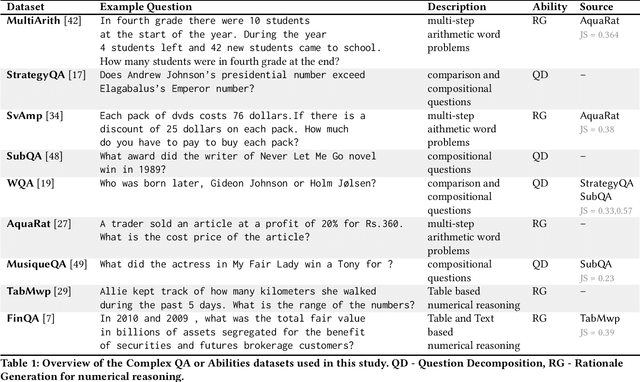
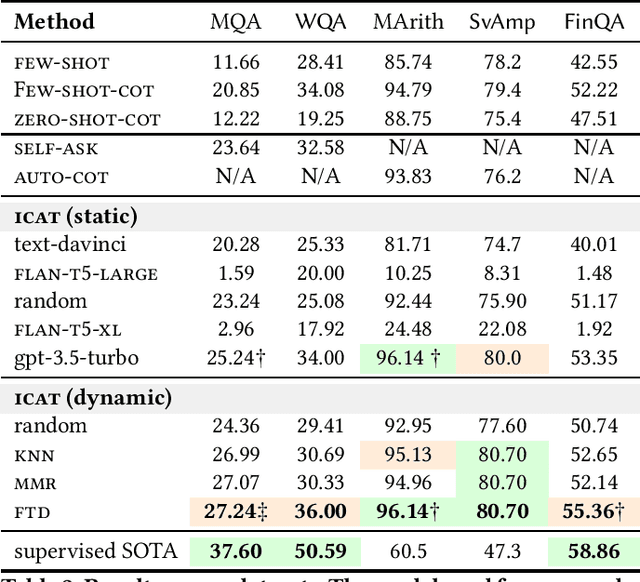
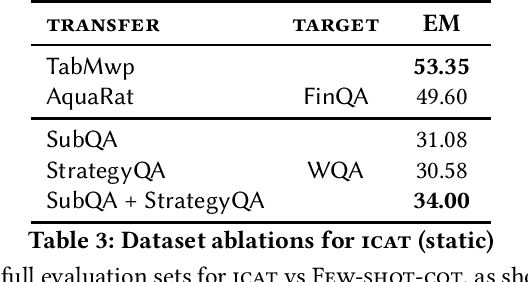
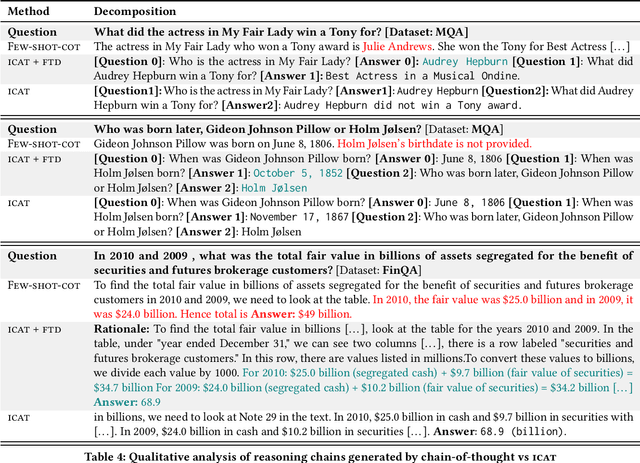
Answering complex questions is a challenging task that requires question decomposition and multistep reasoning for arriving at the solution. While existing supervised and unsupervised approaches are specialized to a certain task and involve training, recently proposed prompt-based approaches offer generalizable solutions to tackle a wide variety of complex question-answering (QA) tasks. However, existing prompt-based approaches that are effective for complex QA tasks involve expensive hand annotations from experts in the form of rationales and are not generalizable to newer complex QA scenarios and tasks. We propose, icat (In-Context Ability Transfer) which induces reasoning capabilities in LLMs without any LLM fine-tuning or manual annotation of in-context samples. We transfer the ability to decompose complex questions to simpler questions or generate step-by-step rationales to LLMs, by careful selection from available data sources of related tasks. We also propose an automated uncertainty-aware exemplar selection approach for selecting examples from transfer data sources. Finally, we conduct large-scale experiments on a variety of complex QA tasks involving numerical reasoning, compositional complex QA, and heterogeneous complex QA which require decomposed reasoning. We show that ICAT convincingly outperforms existing prompt-based solutions without involving any model training, showcasing the benefits of re-using existing abilities.
DINE: Dimensional Interpretability of Node Embeddings
Oct 02, 2023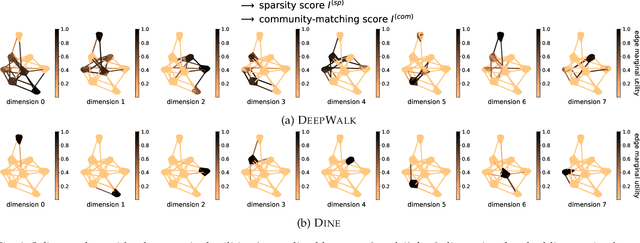
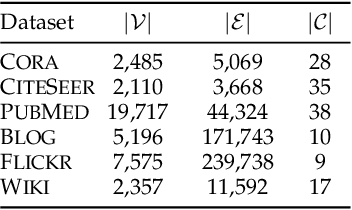

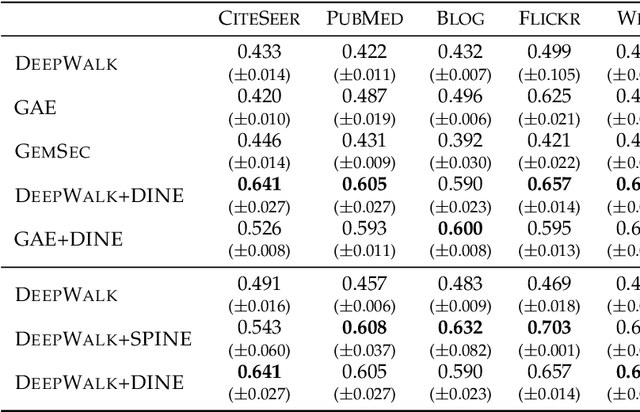
Graphs are ubiquitous due to their flexibility in representing social and technological systems as networks of interacting elements. Graph representation learning methods, such as node embeddings, are powerful approaches to map nodes into a latent vector space, allowing their use for various graph tasks. Despite their success, only few studies have focused on explaining node embeddings locally. Moreover, global explanations of node embeddings remain unexplored, limiting interpretability and debugging potentials. We address this gap by developing human-understandable explanations for dimensions in node embeddings. Towards that, we first develop new metrics that measure the global interpretability of embedding vectors based on the marginal contribution of the embedding dimensions to predicting graph structure. We say that an embedding dimension is more interpretable if it can faithfully map to an understandable sub-structure in the input graph - like community structure. Having observed that standard node embeddings have low interpretability, we then introduce DINE (Dimension-based Interpretable Node Embedding), a novel approach that can retrofit existing node embeddings by making them more interpretable without sacrificing their task performance. We conduct extensive experiments on synthetic and real-world graphs and show that we can simultaneously learn highly interpretable node embeddings with effective performance in link prediction.
Context Aware Query Rewriting for Text Rankers using LLM
Aug 31, 2023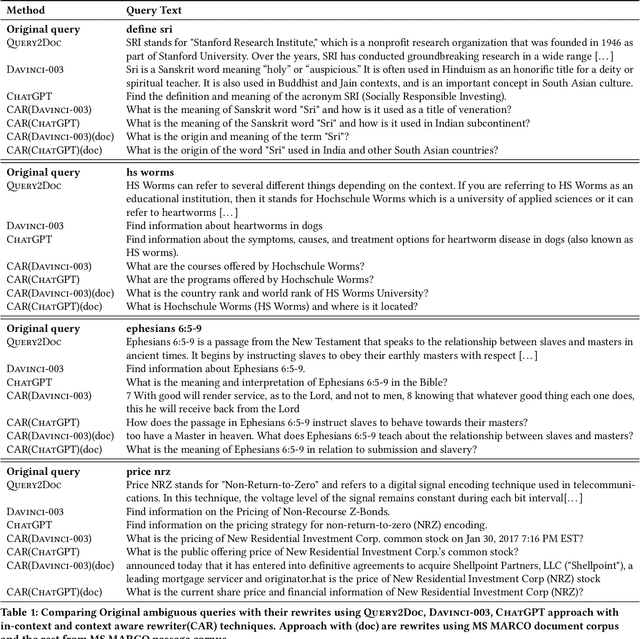
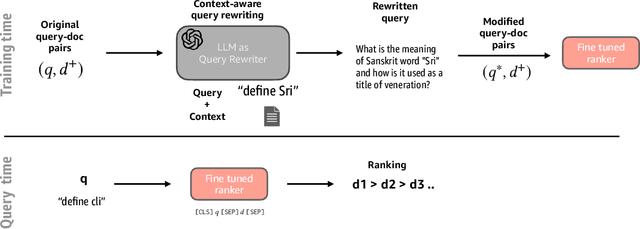
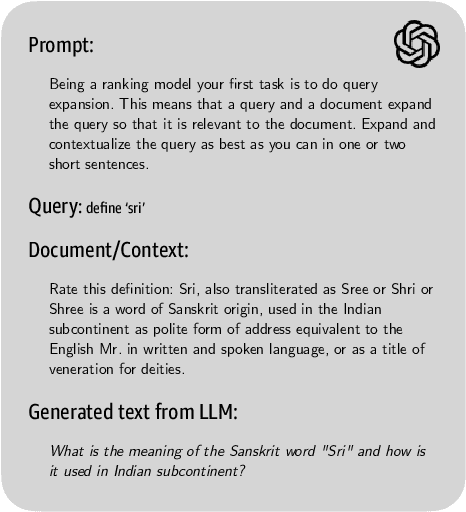
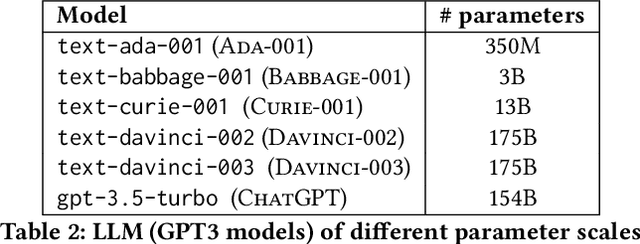
Query rewriting refers to an established family of approaches that are applied to underspecified and ambiguous queries to overcome the vocabulary mismatch problem in document ranking. Queries are typically rewritten during query processing time for better query modelling for the downstream ranker. With the advent of large-language models (LLMs), there have been initial investigations into using generative approaches to generate pseudo documents to tackle this inherent vocabulary gap. In this work, we analyze the utility of LLMs for improved query rewriting for text ranking tasks. We find that there are two inherent limitations of using LLMs as query re-writers -- concept drift when using only queries as prompts and large inference costs during query processing. We adopt a simple, yet surprisingly effective, approach called context aware query rewriting (CAR) to leverage the benefits of LLMs for query understanding. Firstly, we rewrite ambiguous training queries by context-aware prompting of LLMs, where we use only relevant documents as context.Unlike existing approaches, we use LLM-based query rewriting only during the training phase. Eventually, a ranker is fine-tuned on the rewritten queries instead of the original queries during training. In our extensive experiments, we find that fine-tuning a ranker using re-written queries offers a significant improvement of up to 33% on the passage ranking task and up to 28% on the document ranking task when compared to the baseline performance of using original queries.
Query Understanding in the Age of Large Language Models
Jun 28, 2023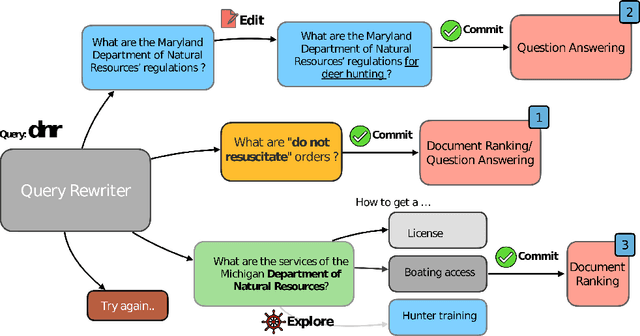
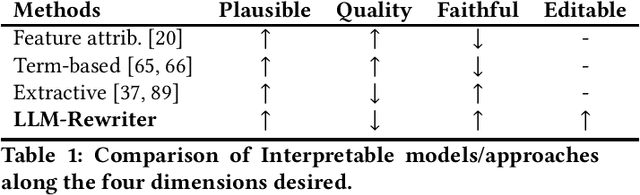
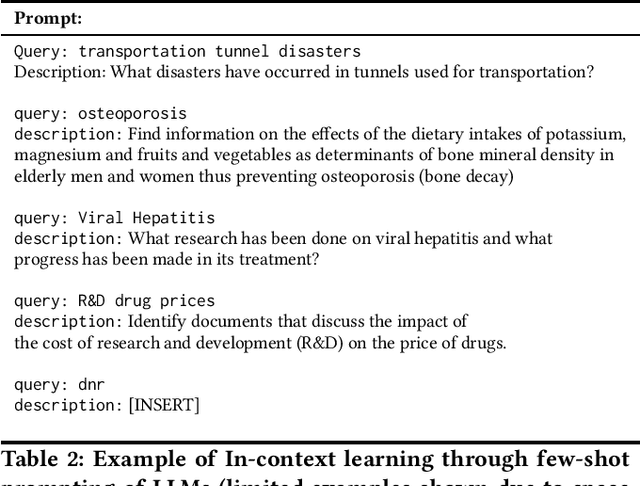
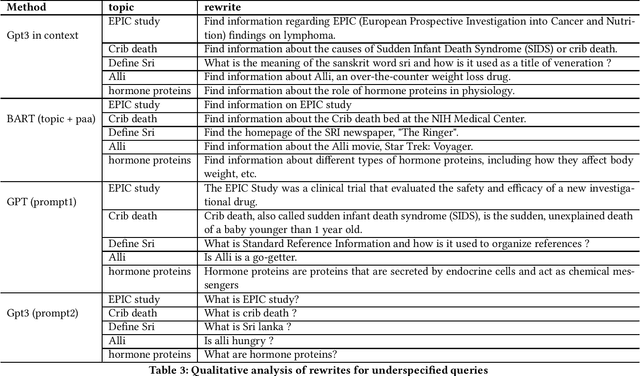
Querying, conversing, and controlling search and information-seeking interfaces using natural language are fast becoming ubiquitous with the rise and adoption of large-language models (LLM). In this position paper, we describe a generic framework for interactive query-rewriting using LLMs. Our proposal aims to unfold new opportunities for improved and transparent intent understanding while building high-performance retrieval systems using LLMs. A key aspect of our framework is the ability of the rewriter to fully specify the machine intent by the search engine in natural language that can be further refined, controlled, and edited before the final retrieval phase. The ability to present, interact, and reason over the underlying machine intent in natural language has profound implications on transparency, ranking performance, and a departure from the traditional way in which supervised signals were collected for understanding intents. We detail the concept, backed by initial experiments, along with open questions for this interactive query understanding framework.
The Effect of Masking Strategies on Knowledge Retention by Language Models
Jun 12, 2023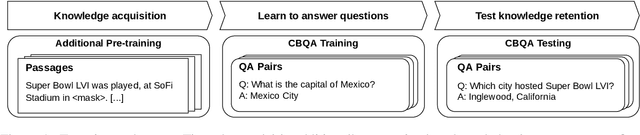
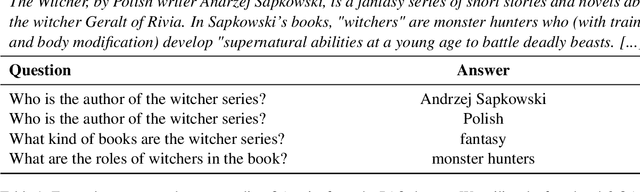
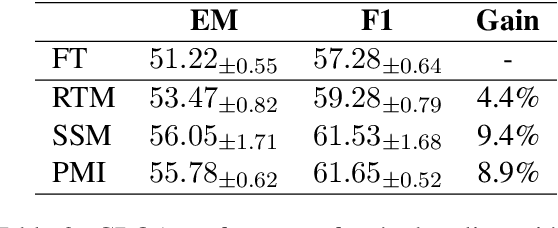
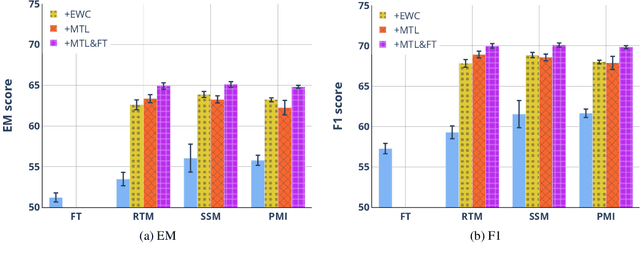
Language models retain a significant amount of world knowledge from their pre-training stage. This allows knowledgeable models to be applied to knowledge-intensive tasks prevalent in information retrieval, such as ranking or question answering. Understanding how and which factual information is acquired by our models is necessary to build responsible models. However, limited work has been done to understand the effect of pre-training tasks on the amount of knowledge captured and forgotten by language models during pre-training. Building a better understanding of knowledge acquisition is the goal of this paper. Therefore, we utilize a selection of pre-training tasks to infuse knowledge into our model. In the following steps, we test the model's knowledge retention by measuring its ability to answer factual questions. Our experiments show that masking entities and principled masking of correlated spans based on pointwise mutual information lead to more factual knowledge being retained than masking random tokens. Our findings demonstrate that, like the ability to perform a task, the (factual) knowledge acquired from being trained on that task is forgotten when a model is trained to perform another task (catastrophic forgetting) and how to prevent this phenomenon. To foster reproducibility, the code, as well as the data used in this paper, are openly available.
Distribution-Aligned Fine-Tuning for Efficient Neural Retrieval
Nov 09, 2022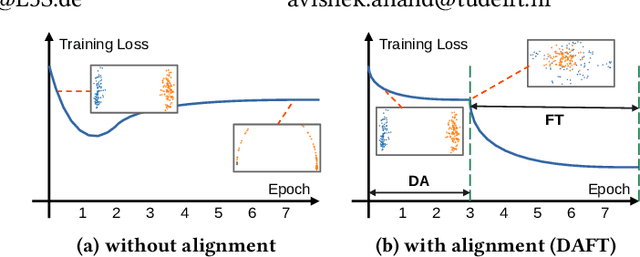
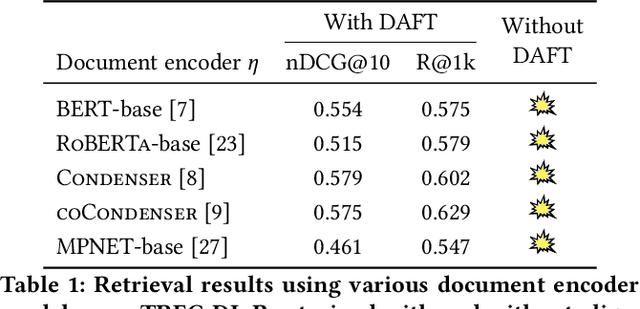

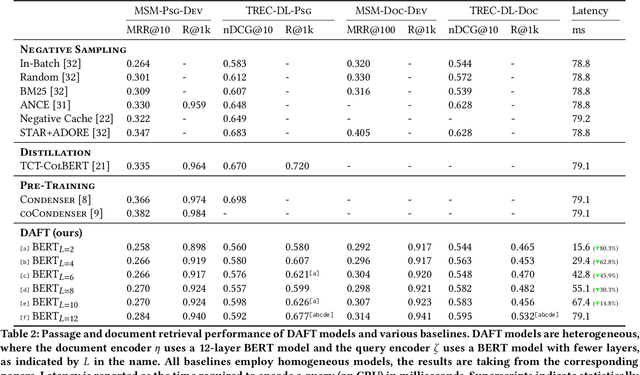
Dual-encoder-based neural retrieval models achieve appreciable performance and complement traditional lexical retrievers well due to their semantic matching capabilities, which makes them a common choice for hybrid IR systems. However, these models exhibit a performance bottleneck in the online query encoding step, as the corresponding query encoders are usually large and complex Transformer models. In this paper we investigate heterogeneous dual-encoder models, where the two encoders are separate models that do not share parameters or initializations. We empirically show that heterogeneous dual-encoders are susceptible to collapsing representations, causing them to output constant trivial representations when they are fine-tuned using a standard contrastive loss due to a distribution mismatch. We propose DAFT, a simple two-stage fine-tuning approach that aligns the two encoders in order to prevent them from collapsing. We further demonstrate how DAFT can be used to train efficient heterogeneous dual-encoder models using lightweight query encoders.
Explainable Information Retrieval: A Survey
Nov 04, 2022Explainable information retrieval is an emerging research area aiming to make transparent and trustworthy information retrieval systems. Given the increasing use of complex machine learning models in search systems, explainability is essential in building and auditing responsible information retrieval models. This survey fills a vital gap in the otherwise topically diverse literature of explainable information retrieval. It categorizes and discusses recent explainability methods developed for different application domains in information retrieval, providing a common framework and unifying perspectives. In addition, it reflects on the common concern of evaluating explanations and highlights open challenges and opportunities.