 Add to Chrome
 Add to Firefox
 Add to Edge
Foundation Model Priors Enhance Object Focus in Feature Space for Source-Free Object Detection
Dec 24, 2025
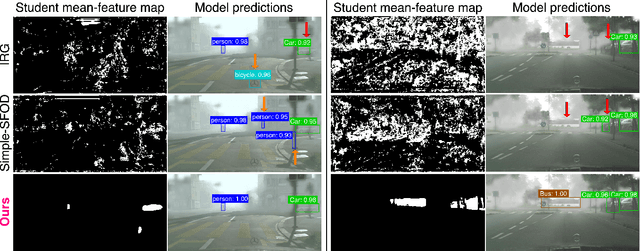
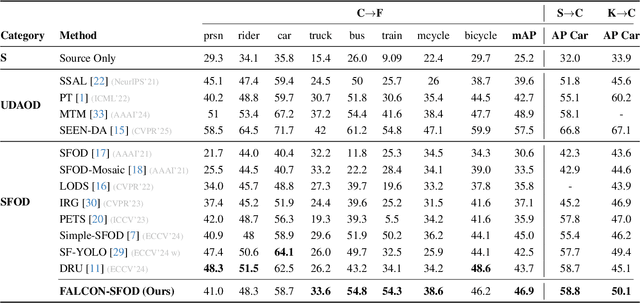
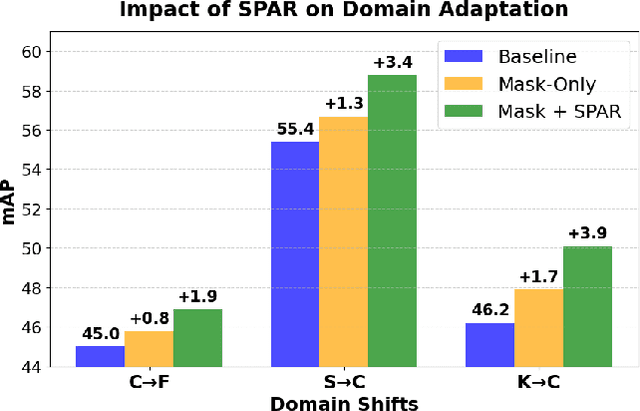
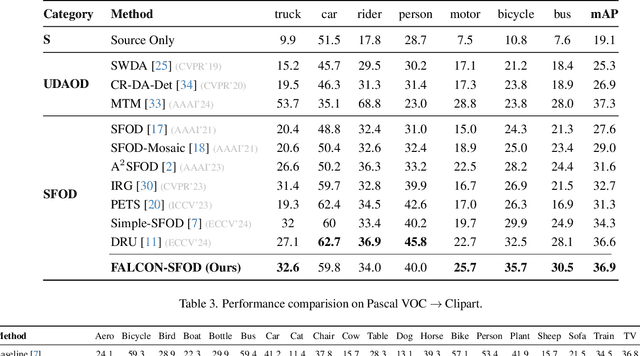
Current state-of-the-art approaches in Source-Free Object Detection (SFOD) typically rely on Mean-Teacher self-labeling. However, domain shift often reduces the detector's ability to maintain strong object-focused representations, causing high-confidence activations over background clutter. This weak object focus results in unreliable pseudo-labels from the detection head. While prior works mainly refine these pseudo-labels, they overlook the underlying need to strengthen the feature space itself. We propose FALCON-SFOD (Foundation-Aligned Learning with Clutter suppression and Noise robustness), a framework designed to enhance object-focused adaptation under domain shift. It consists of two complementary components. SPAR (Spatial Prior-Aware Regularization) leverages the generalization strength of vision foundation models to regularize the detector's feature space. Using class-agnostic binary masks derived from OV-SAM, SPAR promotes structured and foreground-focused activations by guiding the network toward object regions. IRPL (Imbalance-aware Noise Robust Pseudo-Labeling) complements SPAR by promoting balanced and noise-tolerant learning under severe foreground-background imbalance. Guided by a theoretical analysis that connects these designs to tighter localization and classification error bounds, FALCON-SFOD achieves competitive performance across SFOD benchmarks.

MADG: Margin-based Adversarial Learning for Domain Generalization
Nov 14, 2023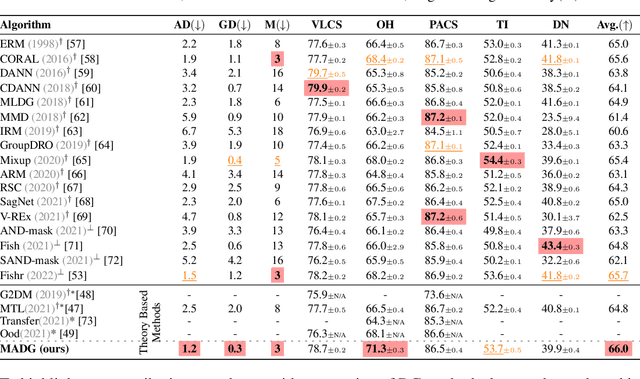

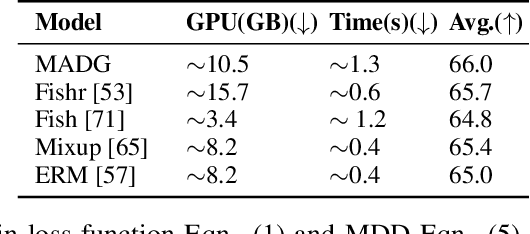
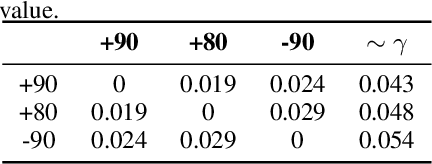
Domain Generalization (DG) techniques have emerged as a popular approach to address the challenges of domain shift in Deep Learning (DL), with the goal of generalizing well to the target domain unseen during the training. In recent years, numerous methods have been proposed to address the DG setting, among which one popular approach is the adversarial learning-based methodology. The main idea behind adversarial DG methods is to learn domain-invariant features by minimizing a discrepancy metric. However, most adversarial DG methods use 0-1 loss based $\mathcal{H}\Delta\mathcal{H}$ divergence metric. In contrast, the margin loss-based discrepancy metric has the following advantages: more informative, tighter, practical, and efficiently optimizable. To mitigate this gap, this work proposes a novel adversarial learning DG algorithm, MADG, motivated by a margin loss-based discrepancy metric. The proposed MADG model learns domain-invariant features across all source domains and uses adversarial training to generalize well to the unseen target domain. We also provide a theoretical analysis of the proposed MADG model based on the unseen target error bound. Specifically, we construct the link between the source and unseen domains in the real-valued hypothesis space and derive the generalization bound using margin loss and Rademacher complexity. We extensively experiment with the MADG model on popular real-world DG datasets, VLCS, PACS, OfficeHome, DomainNet, and TerraIncognita. We evaluate the proposed algorithm on DomainBed's benchmark and observe consistent performance across all the datasets.