 Add to Chrome
 Add to Firefox
 Add to Edge
EVENT5Ws: A Large Dataset for Open-Domain Event Extraction from Documents
Apr 23, 2026
Event extraction identifies the central aspects of events from text. It supports event understanding and analysis, which is crucial for tasks such as informed decision-making in emergencies. Therefore, it is necessary to develop automated event extraction approaches. However, existing datasets for algorithm development have limitations, including limited coverage of event types in closed-domain settings and a lack of large, manually verified dataset in open-domain settings. To address these limitations, we create EVENT5Ws , a large, manually annotated, and statistically verified open-domain event extraction dataset. We design a systematic annotation pipeline to create the dataset and provide empirical insights into annotation complexity. Using EVENT5Ws, we evaluate state-of-the-art pre-trained large language models and establish a benchmark for future research. We further show that models trained on EVENT5Ws generalize effectively to datasets from different geographical contexts, which demonstrates its potential for developing generalizable algorithms. Finally, we summarize the lessons learned during the dataset development and provide recommendations to support future large-scale dataset development.

Label distribution based facial attractiveness computation by deep residual learning
Sep 07, 2016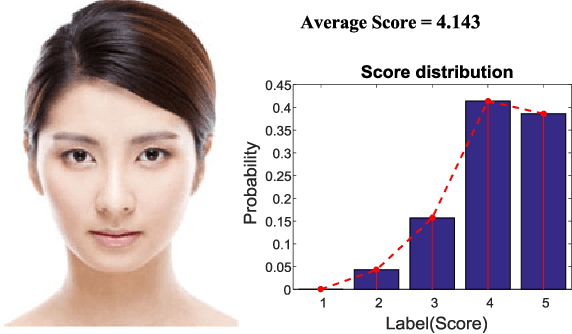
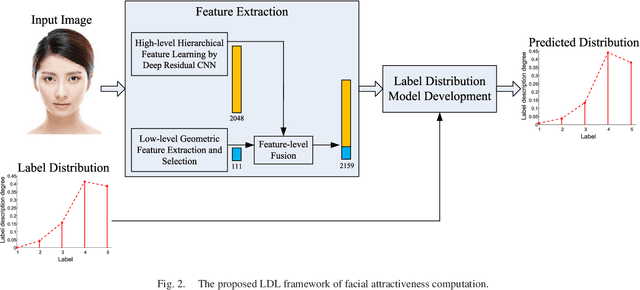
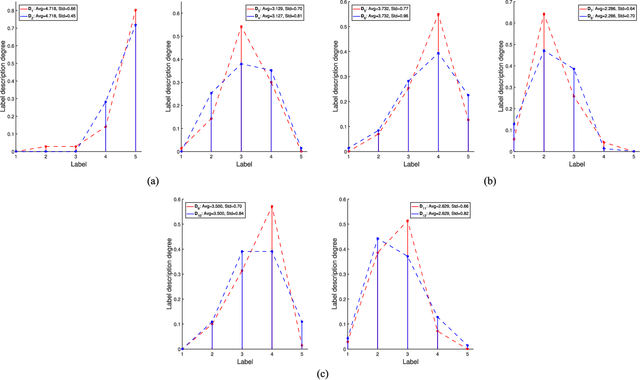
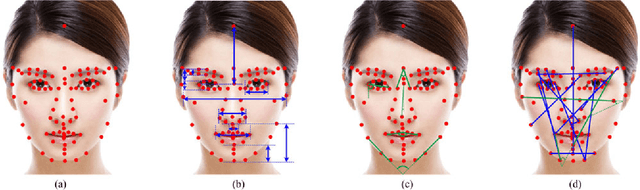
Two challenges lie in the facial attractiveness computation research: the lack of true attractiveness labels (scores), and the lack of an accurate face representation. In order to address the first challenge, this paper recasts facial attractiveness computation as a label distribution learning (LDL) problem rather than a traditional single-label supervised learning task. In this way, the negative influence of the label incomplete problem can be reduced. Inspired by the recent promising work in face recognition using deep neural networks to learn effective features, the second challenge is expected to be solved from a deep learning point of view. A very deep residual network is utilized to enable automatic learning of hierarchical aesthetics representation. Integrating these two ideas, an end-to-end deep learning framework is established. Our approach achieves the best results on a standard benchmark SCUT-FBP dataset compared with other state-of-the-art work.