 Add to Chrome
 Add to Firefox
 Add to Edge
Same Outcomes, Different Journeys: A Trace-Level Framework for Comparing Human and GUI-Agent Behavior in Production Search Systems
Apr 09, 2026
LLM-driven GUI agents are increasingly used in production systems to automate workflows and simulate users for evaluation and optimization. Yet most GUI-agent evaluations emphasize task success and provide limited evidence on whether agents interact in human-like ways. We present a trace-level evaluation framework that compares human and agent behavior across (i) task outcome and effort, (ii) query formulation, and (iii) navigation across interface states. We instantiate the framework in a controlled study in a production audio-streaming search application, where 39 participants and a state-of-the-art GUI agent perform ten multi-hop search tasks. The agent achieves task success comparable to participants and generates broadly aligned queries, but follows systematically different navigation strategies: participants exhibit content-centric, exploratory behavior, while the agent is more search-centric and low-branching. These results show that outcome and query alignment do not imply behavioral alignment, motivating trace-level diagnostics when deploying GUI agents as proxies for users in production search systems.

The Impact of Steering Large Language Models with Persona Vectors in Educational Applications
Apr 08, 2026Activation-based steering can personalize large language models at inference time, but its effects in educational settings remain unclear. We study persona vectors for seven character traits in short-answer generation and automated scoring on the ASAP-SAS benchmark across three models spanning two architectures. Persona steering lowers answer quality overall, with much larger effects on open-ended English Language Arts (ELA) prompts than on factual science prompts; interpretive and argumentative tasks are up to 11x more sensitive. On the scoring side, we observe predictable valence-aligned calibration shifts: evil and impolite scorers grade more harshly, while good and optimistic scorers grade more leniently. ELA tasks are 2.5-3x more susceptible to scorer personalization than science tasks, and the Mixture-of-Experts model shows roughly 6x larger calibration shifts than the dense models. To our knowledge, this is the first study to systematically examine the effects of activation-steered persona traits in educational generation and scoring, and the results highlight the need for task-aware and architecture-aware calibration when deploying steered models in educational settings.
RAG-E: Quantifying Retriever-Generator Alignment and Failure Modes
Jan 29, 2026Retrieval-Augmented Generation (RAG) systems combine dense retrievers and language models to ground LLM outputs in retrieved documents. However, the opacity of how these components interact creates challenges for deployment in high-stakes domains. We present RAG-E, an end-to-end explainability framework that quantifies retriever-generator alignment through mathematically grounded attribution methods. Our approach adapts Integrated Gradients for retriever analysis, introduces PMCSHAP, a Monte Carlo-stabilized Shapley Value approximation, for generator attribution, and introduces the Weighted Attribution-Relevance Gap (WARG) metric to measure how well a generator's document usage aligns with a retriever's ranking. Empirical analysis on TREC CAsT and FoodSafeSum reveals critical misalignments: for 47.4% to 66.7% of queries, generators ignore the retriever's top-ranked documents, while 48.1% to 65.9% rely on documents ranked as less relevant. These failure modes demonstrate that RAG output quality depends not solely on individual component performance but on their interplay, which can be audited via RAG-E.
SemEval-2025 Task 9: The Food Hazard Detection Challenge
Mar 25, 2025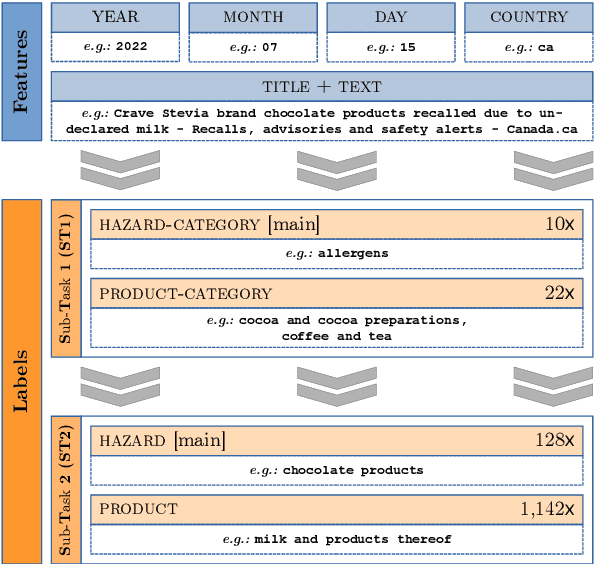
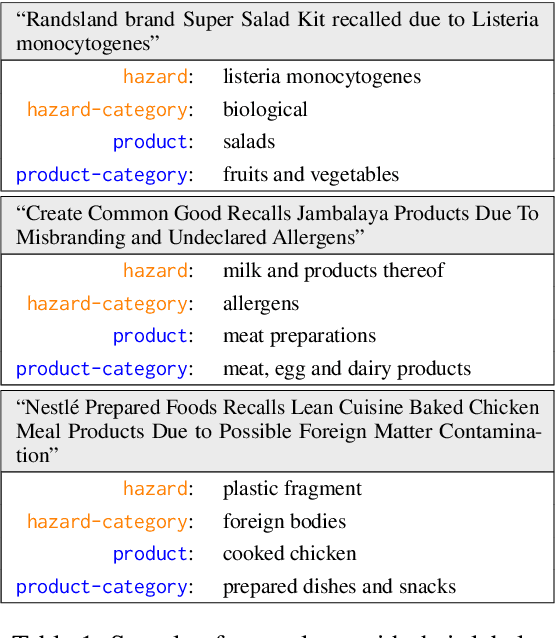
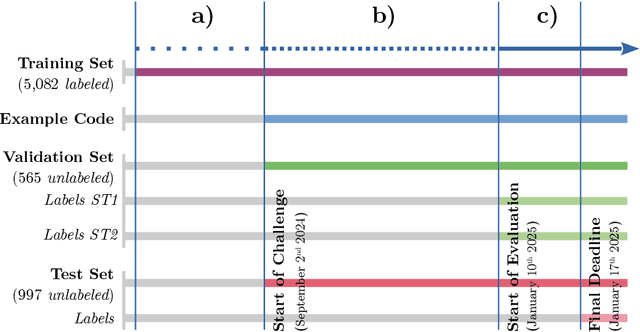
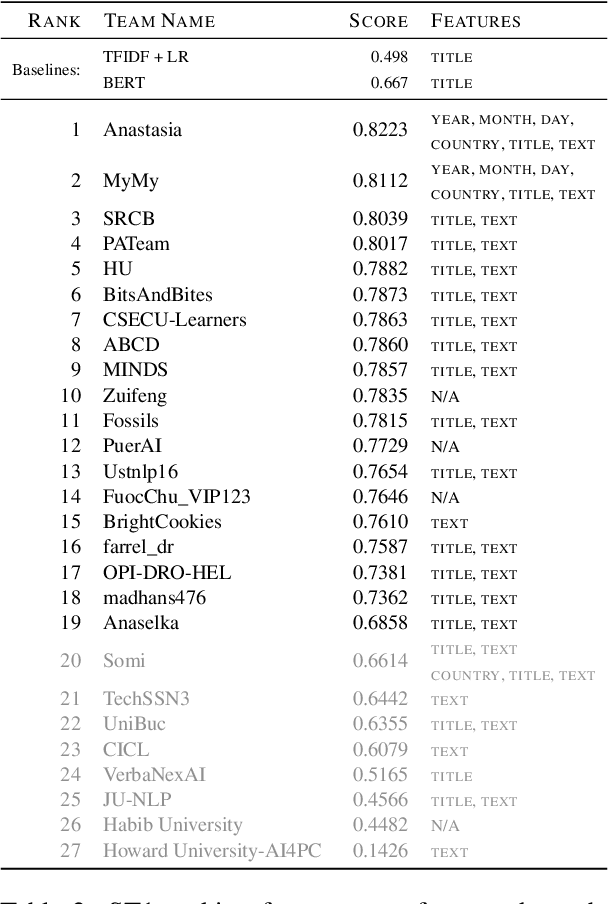
In this challenge, we explored text-based food hazard prediction with long tail distributed classes. The task was divided into two subtasks: (1) predicting whether a web text implies one of ten food-hazard categories and identifying the associated food category, and (2) providing a more fine-grained classification by assigning a specific label to both the hazard and the product. Our findings highlight that large language model-generated synthetic data can be highly effective for oversampling long-tail distributions. Furthermore, we find that fine-tuned encoder-only, encoder-decoder, and decoder-only systems achieve comparable maximum performance across both subtasks. During this challenge, we gradually released (under CC BY-NC-SA 4.0) a novel set of 6,644 manually labeled food-incident reports.
Data-Constrained Synthesis of Training Data for De-Identification
Feb 21, 2025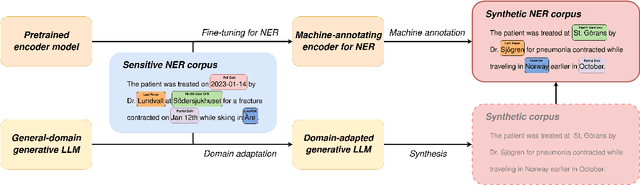
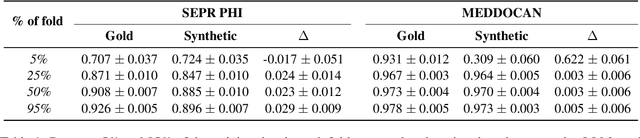
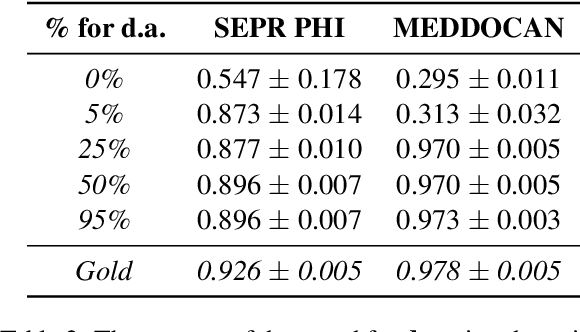
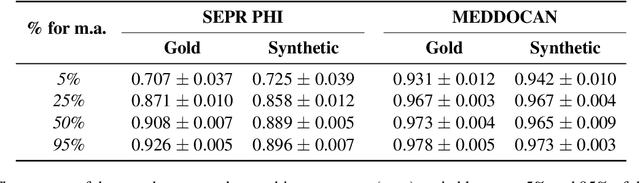
Many sensitive domains -- such as the clinical domain -- lack widely available datasets due to privacy risks. The increasing generative capabilities of large language models (LLMs) have made synthetic datasets a viable path forward. In this study, we domain-adapt LLMs to the clinical domain and generate synthetic clinical texts that are machine-annotated with tags for personally identifiable information using capable encoder-based NER models. The synthetic corpora are then used to train synthetic NER models. The results show that training NER models using synthetic corpora incurs only a small drop in predictive performance. The limits of this process are investigated in a systematic ablation study -- using both Swedish and Spanish data. Our analysis shows that smaller datasets can be sufficient for domain-adapting LLMs for data synthesis. Instead, the effectiveness of this process is almost entirely contingent on the performance of the machine-annotating NER models trained using the original data.
Evaluating the Reliability of Self-Explanations in Large Language Models
Jul 19, 2024This paper investigates the reliability of explanations generated by large language models (LLMs) when prompted to explain their previous output. We evaluate two kinds of such self-explanations - extractive and counterfactual - using three state-of-the-art LLMs (2B to 8B parameters) on two different classification tasks (objective and subjective). Our findings reveal, that, while these self-explanations can correlate with human judgement, they do not fully and accurately follow the model's decision process, indicating a gap between perceived and actual model reasoning. We show that this gap can be bridged because prompting LLMs for counterfactual explanations can produce faithful, informative, and easy-to-verify results. These counterfactuals offer a promising alternative to traditional explainability methods (e.g. SHAP, LIME), provided that prompts are tailored to specific tasks and checked for validity.
CICLe: Conformal In-Context Learning for Largescale Multi-Class Food Risk Classification
Mar 18, 2024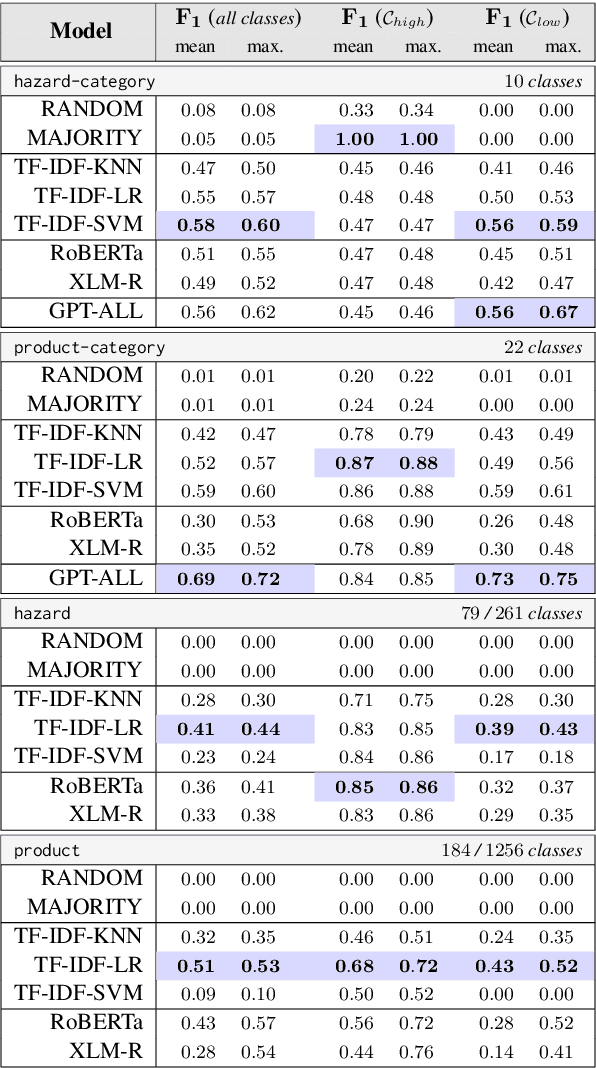
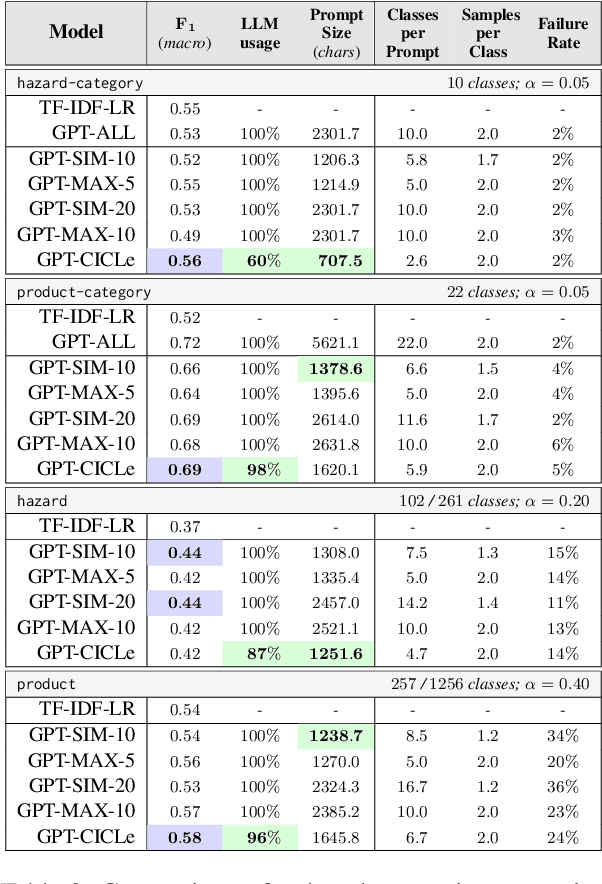
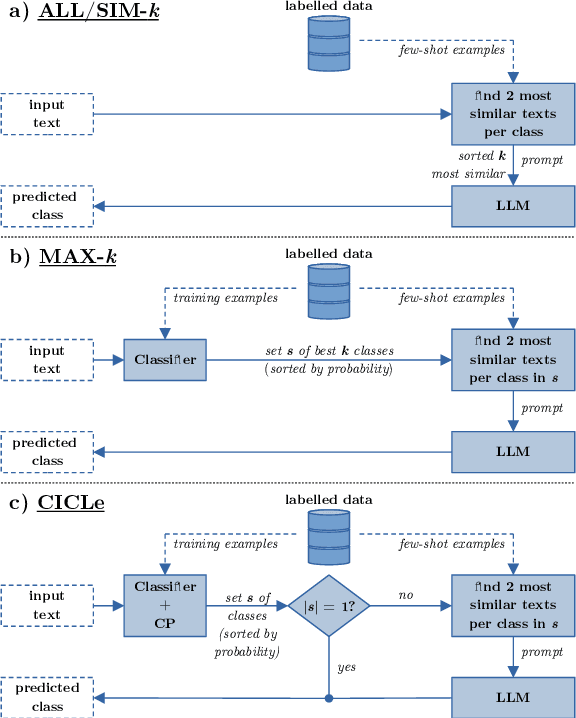
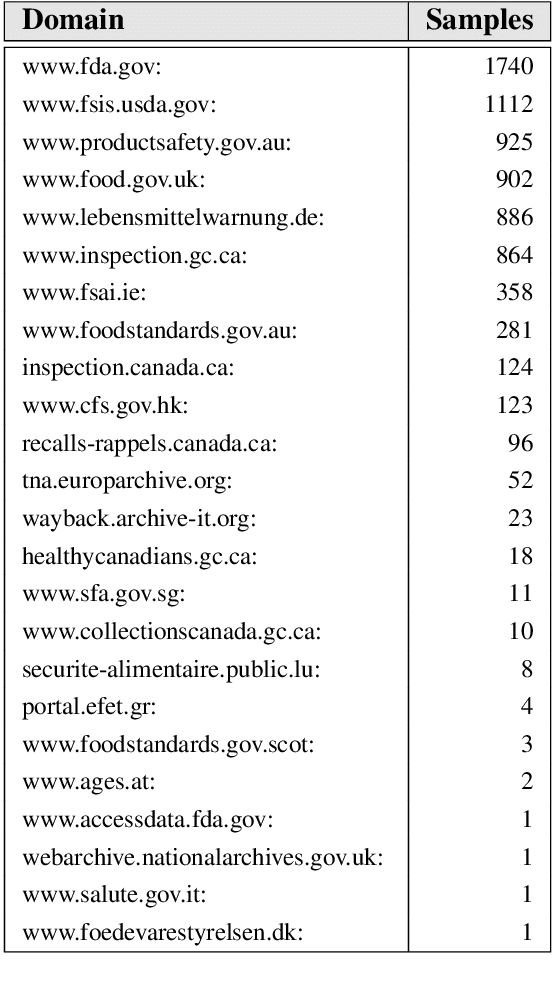
Contaminated or adulterated food poses a substantial risk to human health. Given sets of labeled web texts for training, Machine Learning and Natural Language Processing can be applied to automatically detect such risks. We publish a dataset of 7,546 short texts describing public food recall announcements. Each text is manually labeled, on two granularity levels (coarse and fine), for food products and hazards that the recall corresponds to. We describe the dataset and benchmark naive, traditional, and Transformer models. Based on our analysis, Logistic Regression based on a tf-idf representation outperforms RoBERTa and XLM-R on classes with low support. Finally, we discuss different prompting strategies and present an LLM-in-the-loop framework, based on Conformal Prediction, which boosts the performance of the base classifier while reducing energy consumption compared to normal prompting.