 Add to Chrome
 Add to Firefox
 Add to Edge
Persistence-Augmented Neural Networks
Apr 09, 2026
Topological Data Analysis (TDA) provides tools to describe the shape of data, but integrating topological features into deep learning pipelines remains challenging, especially when preserving local geometric structure rather than summarizing it globally. We propose a persistence-based data augmentation framework that encodes local gradient flow regions and their hierarchical evolution using the Morse-Smale complex. This representation, compatible with both convolutional and graph neural networks, retains spatially localized topological information across multiple scales. Importantly, the augmentation procedure itself is efficient, with computational complexity $O(n \log n)$, making it practical for large datasets. We evaluate our method on histopathology image classification and 3D porous material regression, where it consistently outperforms baselines and global TDA descriptors such as persistence images and landscapes. We also show that pruning the base level of the hierarchy reduces memory usage while maintaining competitive performance. These results highlight the potential of local, structured topological augmentation for scalable and interpretable learning across data modalities.

On Neural Scaling Laws for Weather Emulation through Continual Training
Mar 26, 2026Neural scaling laws, which in some domains can predict the performance of large neural networks as a function of model, data, and compute scale, are the cornerstone of building foundation models in Natural Language Processing and Computer Vision. We study neural scaling in Scientific Machine Learning, focusing on models for weather forecasting. To analyze scaling behavior in as simple a setting as possible, we adopt a minimal, scalable, general-purpose Swin Transformer architecture, and we use continual training with constant learning rates and periodic cooldowns as an efficient training strategy. We show that models trained in this minimalist way follow predictable scaling trends and even outperform standard cosine learning rate schedules. Cooldown phases can be re-purposed to improve downstream performance, e.g., enabling accurate multi-step rollouts over longer forecast horizons as well as sharper predictions through spectral loss adjustments. We also systematically explore a wide range of model and dataset sizes under various compute budgets to construct IsoFLOP curves, and we identify compute-optimal training regimes. Extrapolating these trends to larger scales highlights potential performance limits, demonstrating that neural scaling can serve as an important diagnostic for efficient resource allocation. We open-source our code for reproducibility.
Robustifying State-space Models for Long Sequences via Approximate Diagonalization
Oct 02, 2023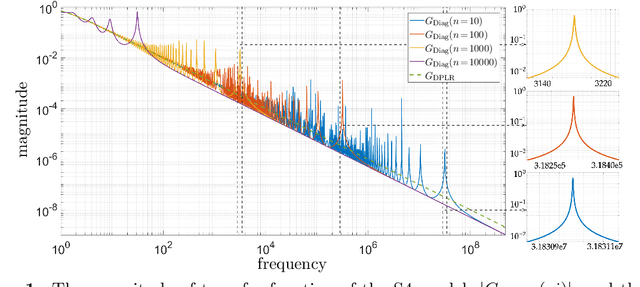
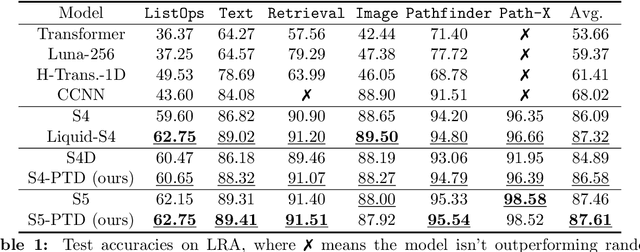
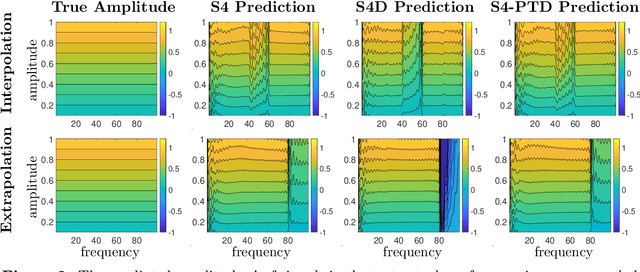
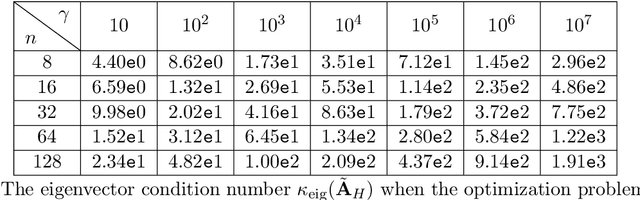
State-space models (SSMs) have recently emerged as a framework for learning long-range sequence tasks. An example is the structured state-space sequence (S4) layer, which uses the diagonal-plus-low-rank structure of the HiPPO initialization framework. However, the complicated structure of the S4 layer poses challenges; and, in an effort to address these challenges, models such as S4D and S5 have considered a purely diagonal structure. This choice simplifies the implementation, improves computational efficiency, and allows channel communication. However, diagonalizing the HiPPO framework is itself an ill-posed problem. In this paper, we propose a general solution for this and related ill-posed diagonalization problems in machine learning. We introduce a generic, backward-stable "perturb-then-diagonalize" (PTD) methodology, which is based on the pseudospectral theory of non-normal operators, and which may be interpreted as the approximate diagonalization of the non-normal matrices defining SSMs. Based on this, we introduce the S4-PTD and S5-PTD models. Through theoretical analysis of the transfer functions of different initialization schemes, we demonstrate that the S4-PTD/S5-PTD initialization strongly converges to the HiPPO framework, while the S4D/S5 initialization only achieves weak convergences. As a result, our new models show resilience to Fourier-mode noise-perturbed inputs, a crucial property not achieved by the S4D/S5 models. In addition to improved robustness, our S5-PTD model averages 87.6% accuracy on the Long-Range Arena benchmark, demonstrating that the PTD methodology helps to improve the accuracy of deep learning models.
Topological Regularization via Persistence-Sensitive Optimization
Nov 10, 2020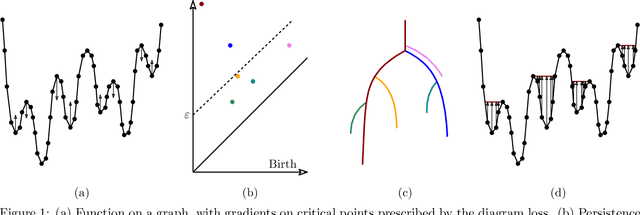
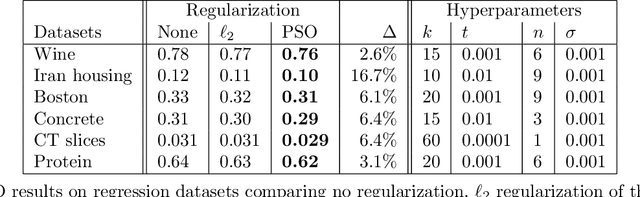
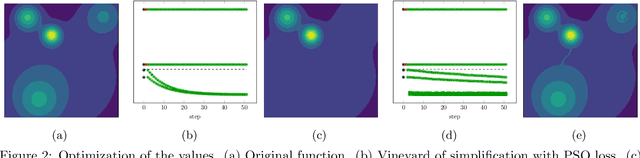
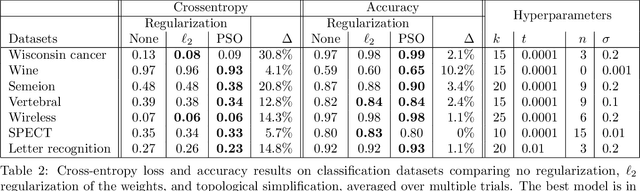
Optimization, a key tool in machine learning and statistics, relies on regularization to reduce overfitting. Traditional regularization methods control a norm of the solution to ensure its smoothness. Recently, topological methods have emerged as a way to provide a more precise and expressive control over the solution, relying on persistent homology to quantify and reduce its roughness. All such existing techniques back-propagate gradients through the persistence diagram, which is a summary of the topological features of a function. Their downside is that they provide information only at the critical points of the function. We propose a method that instead builds on persistence-sensitive simplification and translates the required changes to the persistence diagram into changes on large subsets of the domain, including both critical and regular points. This approach enables a faster and more precise topological regularization, the benefits of which we illustrate with experimental evidence.