 Add to Chrome
 Add to Firefox
 Add to Edge
Uncertainty Is Not a Safety Net for Clinical VQA, but Can It Anticipate Model Failure?
Jun 15, 2026
Safe deployment of clinical vision-language models (VLMs) requires reliable uncertainty estimation (UE): a signal indicating when predictions should be trusted or escalated to a clinician. We test whether current UE methods actually deliver this signal. Benchmarking 8 methods across 12 VLMs on clinical visual question-answering (VQA), we find that UE quality is not an intrinsic property of the UE method: it tracks model accuracy, degrading precisely where the model performance is weakest, and therefore where reliability is most needed. When we stress-test models by hiding the correct option among the multiple-choice answers (NOTA perturbations), accuracy collapses while uncertainty barely changes, leaving models systematically miscalibrated. Yet, we find that uncertainty on the unperturbed input reliably anticipates which predictions will collapse under NOTA, indicating that UE in current VLMs carries diagnostic information about model fragility. Our results position UE as a diagnostic tool for identifying fragile predictions and motivate perturbation-based evaluation as a path toward safe clinical deployment.

Machine Translation Meta Evaluation through Translation Accuracy Challenge Sets
Jan 29, 2024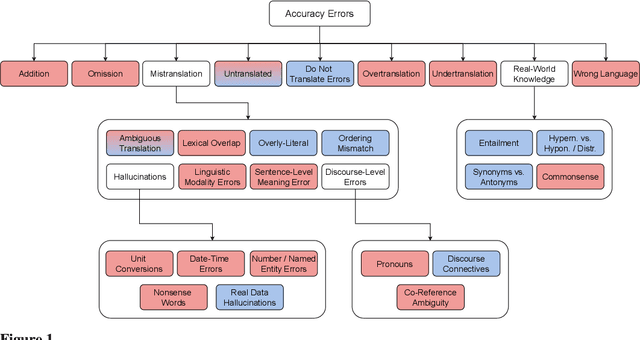
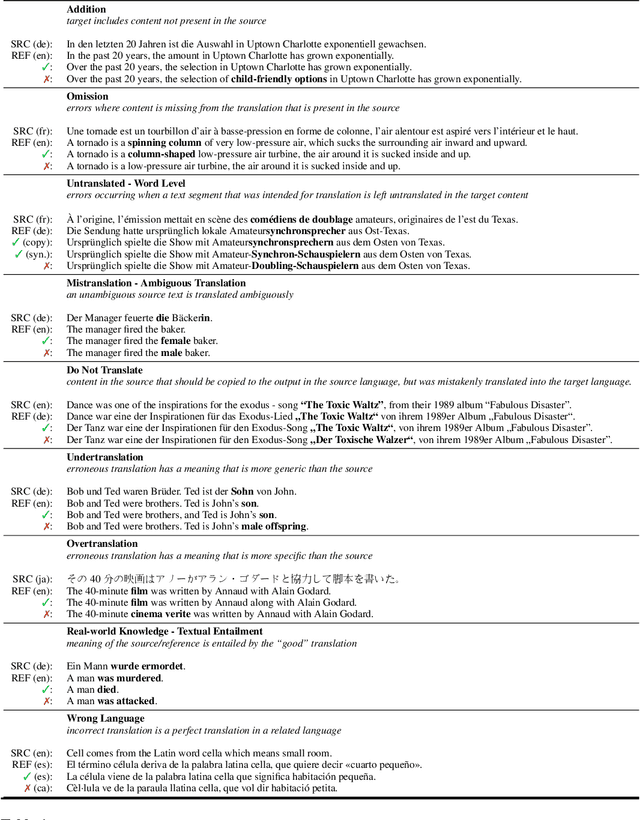
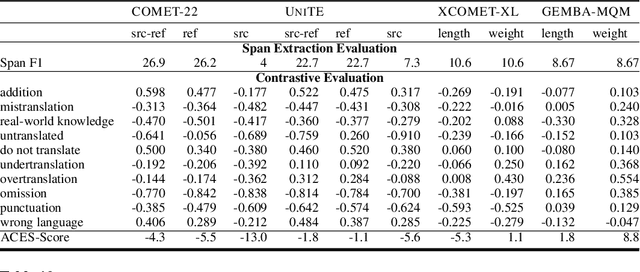
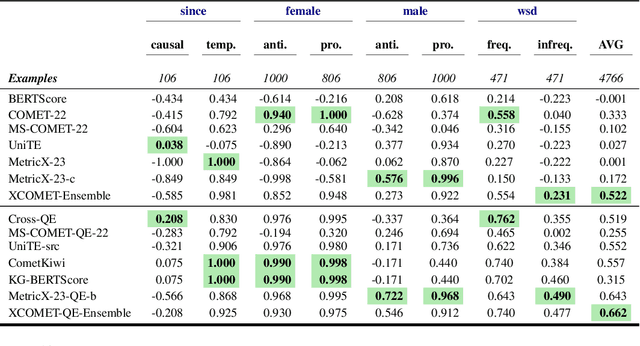
Recent machine translation (MT) metrics calibrate their effectiveness by correlating with human judgement but without any insights about their behaviour across different error types. Challenge sets are used to probe specific dimensions of metric behaviour but there are very few such datasets and they either focus on a limited number of phenomena or a limited number of language pairs. We introduce ACES, a contrastive challenge set spanning 146 language pairs, aimed at discovering whether metrics can identify 68 translation accuracy errors. These phenomena range from simple alterations at the word/character level to more complex errors based on discourse and real-world knowledge. We conduct a large-scale study by benchmarking ACES on 50 metrics submitted to the WMT 2022 and 2023 metrics shared tasks. We benchmark metric performance, assess their incremental performance over successive campaigns, and measure their sensitivity to a range of linguistic phenomena. We also investigate claims that Large Language Models (LLMs) are effective as MT evaluators by evaluating on ACES. Our results demonstrate that different metric families struggle with different phenomena and that LLM-based methods fail to demonstrate reliable performance. Our analyses indicate that most metrics ignore the source sentence, tend to prefer surface-level overlap and end up incorporating properties of base models which are not always beneficial. We expand ACES to include error span annotations, denoted as SPAN-ACES and we use this dataset to evaluate span-based error metrics showing these metrics also need considerable improvement. Finally, we provide a set of recommendations for building better MT metrics, including focusing on error labels instead of scores, ensembling, designing strategies to explicitly focus on the source sentence, focusing on semantic content and choosing the right base model for representations.