 Add to Chrome
 Add to Firefox
 Add to Edge
dnaHNet: A Scalable and Hierarchical Foundation Model for Genomic Sequence Learning
Feb 14, 2026
Genomic foundation models have the potential to decode DNA syntax, yet face a fundamental tradeoff in their input representation. Standard fixed-vocabulary tokenizers fragment biologically meaningful motifs such as codons and regulatory elements, while nucleotide-level models preserve biological coherence but incur prohibitive computational costs for long contexts. We introduce dnaHNet, a state-of-the-art tokenizer-free autoregressive model that segments and models genomic sequences end-to-end. Using a differentiable dynamic chunking mechanism, dnaHNet compresses raw nucleotides into latent tokens adaptively, balancing compression with predictive accuracy. Pretrained on prokaryotic genomes, dnaHNet outperforms leading architectures including StripedHyena2 in scaling and efficiency. This recursive chunking yields quadratic FLOP reductions, enabling $>3 \times$ inference speedup over Transformers. On zero-shot tasks, dnaHNet achieves superior performance in predicting protein variant fitness and gene essentiality, while automatically discovering hierarchical biological structures without supervision. These results establish dnaHNet as a scalable, interpretable framework for next-generation genomic modeling.

BioReason: Incentivizing Multimodal Biological Reasoning within a DNA-LLM Model
May 29, 2025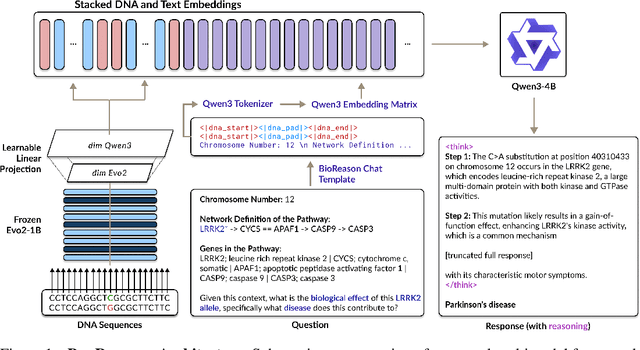
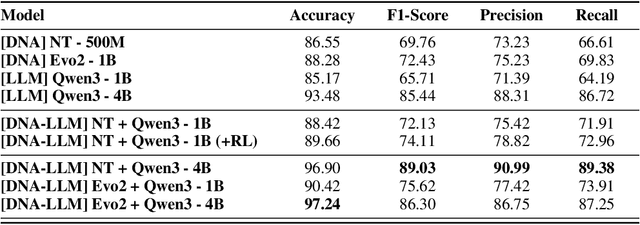
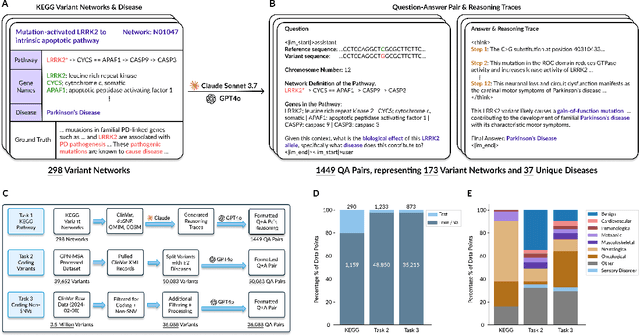
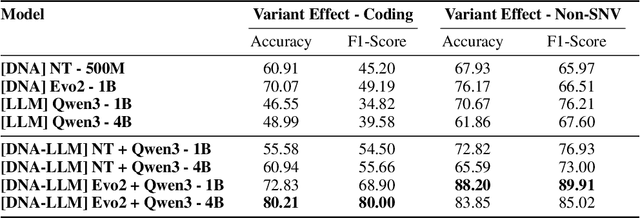
Unlocking deep, interpretable biological reasoning from complex genomic data is a major AI challenge hindering scientific discovery. Current DNA foundation models, despite strong sequence representation, struggle with multi-step reasoning and lack inherent transparent, biologically intuitive explanations. We introduce BioReason, a pioneering architecture that, for the first time, deeply integrates a DNA foundation model with a Large Language Model (LLM). This novel connection enables the LLM to directly process and reason with genomic information as a fundamental input, fostering a new form of multimodal biological understanding. BioReason's sophisticated multi-step reasoning is developed through supervised fine-tuning and targeted reinforcement learning, guiding the system to generate logical, biologically coherent deductions. On biological reasoning benchmarks including KEGG-based disease pathway prediction - where accuracy improves from 88% to 97% - and variant effect prediction, BioReason demonstrates an average 15% performance gain over strong single-modality baselines. BioReason reasons over unseen biological entities and articulates decision-making through interpretable, step-by-step biological traces, offering a transformative approach for AI in biology that enables deeper mechanistic insights and accelerates testable hypothesis generation from genomic data. Data, code, and checkpoints are publicly available at https://github.com/bowang-lab/BioReason