 Add to Chrome
 Add to Firefox
 Add to Edge
Rethinking Visual Information Processing in Multimodal LLMs
Nov 13, 2025
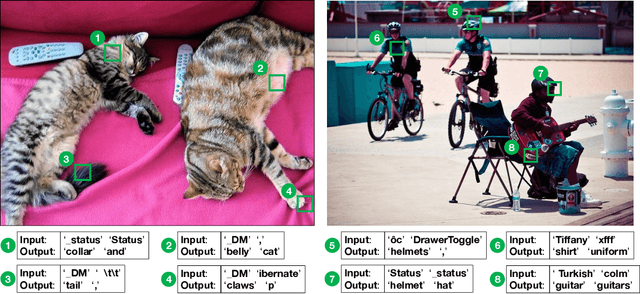
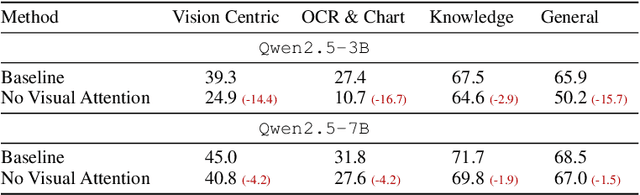
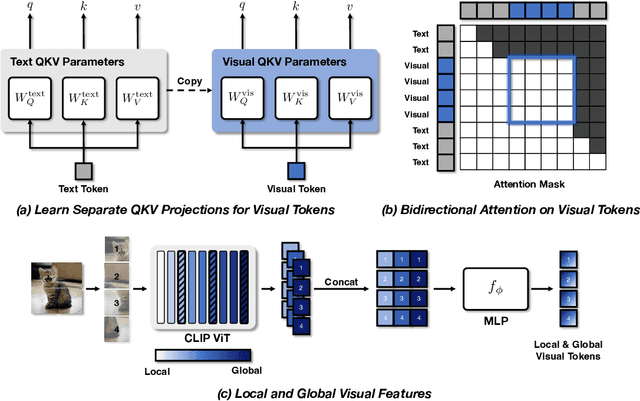
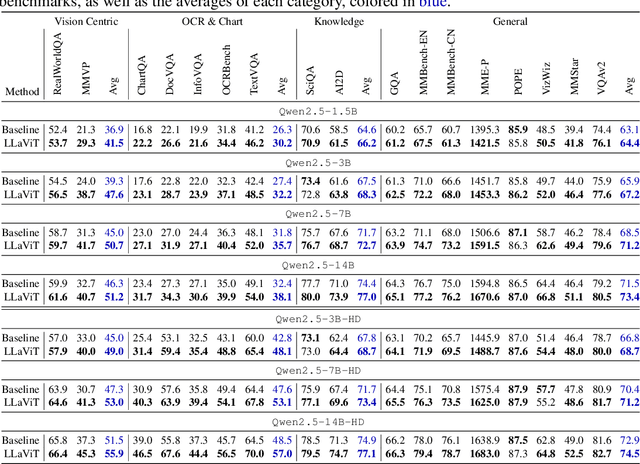
Despite the remarkable success of the LLaVA architecture for vision-language tasks, its design inherently struggles to effectively integrate visual features due to the inherent mismatch between text and vision modalities. We tackle this issue from a novel perspective in which the LLM not only serves as a language model but also a powerful vision encoder. To this end, we present LLaViT - Large Language Models as extended Vision Transformers - which enables the LLM to simultaneously function as a vision encoder through three key modifications: (1) learning separate QKV projections for vision modality, (2) enabling bidirectional attention on visual tokens, and (3) incorporating both global and local visual representations. Through extensive controlled experiments on a wide range of LLMs, we demonstrate that LLaViT significantly outperforms the baseline LLaVA method on a multitude of benchmarks, even surpassing models with double its parameter count, establishing a more effective approach to vision-language modeling.

Bringing Multimodality to Amazon Visual Search System
Dec 17, 2024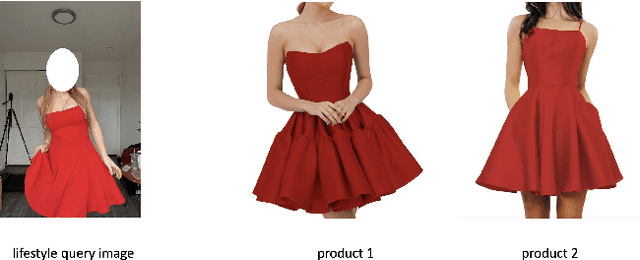


Image to image matching has been well studied in the computer vision community. Previous studies mainly focus on training a deep metric learning model matching visual patterns between the query image and gallery images. In this study, we show that pure image-to-image matching suffers from false positives caused by matching to local visual patterns. To alleviate this issue, we propose to leverage recent advances in vision-language pretraining research. Specifically, we introduce additional image-text alignment losses into deep metric learning, which serve as constraints to the image-to-image matching loss. With additional alignments between the text (e.g., product title) and image pairs, the model can learn concepts from both modalities explicitly, which avoids matching low-level visual features. We progressively develop two variants, a 3-tower and a 4-tower model, where the latter takes one more short text query input. Through extensive experiments, we show that this change leads to a substantial improvement to the image to image matching problem. We further leveraged this model for multimodal search, which takes both image and reformulation text queries to improve search quality. Both offline and online experiments show strong improvements on the main metrics. Specifically, we see 4.95% relative improvement on image matching click through rate with the 3-tower model and 1.13% further improvement from the 4-tower model.
ProcSim: Proxy-based Confidence for Robust Similarity Learning
Nov 01, 2023Deep Metric Learning (DML) methods aim at learning an embedding space in which distances are closely related to the inherent semantic similarity of the inputs. Previous studies have shown that popular benchmark datasets often contain numerous wrong labels, and DML methods are susceptible to them. Intending to study the effect of realistic noise, we create an ontology of the classes in a dataset and use it to simulate semantically coherent labeling mistakes. To train robust DML models, we propose ProcSim, a simple framework that assigns a confidence score to each sample using the normalized distance to its class representative. The experimental results show that the proposed method achieves state-of-the-art performance on the DML benchmark datasets injected with uniform and the proposed semantically coherent noise.