 Add to Chrome
 Add to Firefox
 Add to Edge
Training and Evaluating Diffusion Policies with Long Context Lengths
Jun 15, 2026
Imitation learning has enabled highly-dexterous robotic manipulation from RGB observations. Policies trained with these methods, however, typically condition robot actions on only a short history of observations. These policies cannot solve tasks that require memory and can get stuck repeatedly executing the same failing motions. In this work, we first benchmark policy performance as context length is incrementally increased from short to long, across a spectrum of tasks with varying local stability and memory requirements, and in multiple data regimes. To our knowledge, this is the first study to investigate context length in imitation learning at this level of detail. Our results challenge prior claims: naively scaling context length is not as brittle as advertised in literature. With an appropriate conditioning method and denoising backbone (UNet+Cross-Attention), single-task policies achieve high success rates on many tasks in the usual data regime even with naive scaling. Next, we propose a training algorithm to jointly train policies at multiple context lengths, further reducing the sample complexity of long-context learning. Finally, we apply our findings to re-evaluate some previously proposed solutions to long-context imitation learning.

Gradient dynamics for low-rank fine-tuning beyond kernels
Nov 23, 2024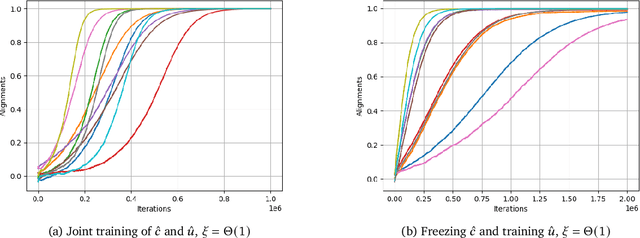
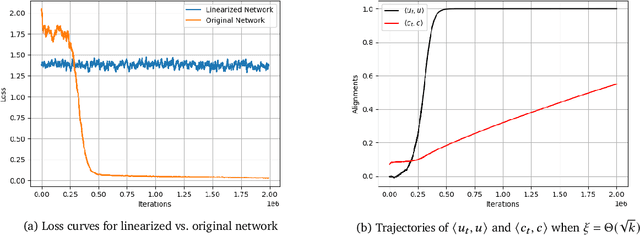


LoRA has emerged as one of the de facto methods for fine-tuning foundation models with low computational cost and memory footprint. The idea is to only train a low-rank perturbation to the weights of a pre-trained model, given supervised data for a downstream task. Despite its empirical sucess, from a mathematical perspective it remains poorly understood what learning mechanisms ensure that gradient descent converges to useful low-rank perturbations. In this work we study low-rank fine-tuning in a student-teacher setting. We are given the weights of a two-layer base model $f$, as well as i.i.d. samples $(x,f^*(x))$ where $x$ is Gaussian and $f^*$ is the teacher model given by perturbing the weights of $f$ by a rank-1 matrix. This generalizes the setting of generalized linear model (GLM) regression where the weights of $f$ are zero. When the rank-1 perturbation is comparable in norm to the weight matrix of $f$, the training dynamics are nonlinear. Nevertheless, in this regime we prove under mild assumptions that a student model which is initialized at the base model and trained with online gradient descent will converge to the teacher in $dk^{O(1)}$ iterations, where $k$ is the number of neurons in $f$. Importantly, unlike in the GLM setting, the complexity does not depend on fine-grained properties of the activation's Hermite expansion. We also prove that in our setting, learning the teacher model "from scratch'' can require significantly more iterations.