 Add to Chrome
 Add to Firefox
 Add to Edge
Sexualised synthetic personas encode and amplify gendered power asymmetries through voice
Jun 23, 2026
This work examines sexualised AI-generated English-speaking voices offered by a popular commercial platform. New technologies may enable sexual empowerment and greater diversity in gender expression, yet toxic masculinity, heteronormativity, and the abuse of women and LGBTQ+ people remain pervasive online. Drawing on a Feminist HCI perspective, we examine how commercial voice AI systems reproduce and circulate particular performances of gender. We conducted a listening experiment with a diverse group of listeners, combining quantitative adjective selection, qualitative free-text responses, and acoustic analysis. Participants evaluated male- and female-coded voices presented with either sexualised scripts or neutral text. Results reveal a narrow range of gender expression, largely binary and heteronormative. Female-coded voices are more frequently described using sexualised and submissive terms, while male-coded voices are more often associated with dominance and positive traits.

An Evaluation Framework for Text-to-Speech Voice Reconstruction
Jun 19, 2026Voice reconstruction using Text-to-Speech (TTS) offers a communication method for people with speech disorders, which aims to retain their speaker identity while improving intelligibility. Previous work generally relies on Mean Opinion Score (MOS) to evaluate naturalness and speaker similarity, but this has limited sensitivity and reliability. We propose an evaluation framework with subjective and objective components. Subjectively, we evaluate perceived intelligibility and speaker identity using Best Worst Scaling (BWS) with situational framing. Objectively, we demonstrate that standard measures fail to predict reconstruction success for highly unintelligible speakers, so we introduce a novel dual-reference distributional measure to assess the trade-off between intelligibility and speaker identity. By evaluating the output of 17 zero-shot TTS systems for 193 speakers, we show that our framework provides a reliable and task-aligned approach for assessing voice reconstruction.
Can we reconstruct a dysarthric voice with the large speech model Parler TTS?
Jun 04, 2025Speech disorders can make communication hard or even impossible for those who develop them. Personalised Text-to-Speech is an attractive option as a communication aid. We attempt voice reconstruction using a large speech model, with which we generate an approximation of a dysarthric speaker's voice prior to the onset of their condition. In particular, we investigate whether a state-of-the-art large speech model, Parler TTS, can generate intelligible speech while maintaining speaker identity. We curate a dataset and annotate it with relevant speaker and intelligibility information, and use this to fine-tune the model. Our results show that the model can indeed learn to generate from the distribution of this challenging data, but struggles to control intelligibility and to maintain consistent speaker identity. We propose future directions to improve controllability of this class of model, for the voice reconstruction task.
Unify and Conquer: How Phonetic Feature Representation Affects Polyglot Text-To-Speech (TTS)
Jul 04, 2022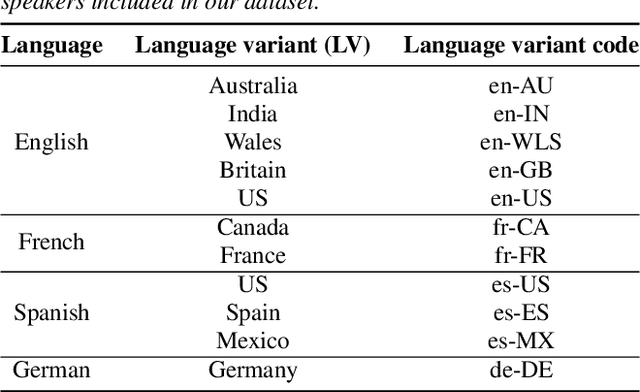
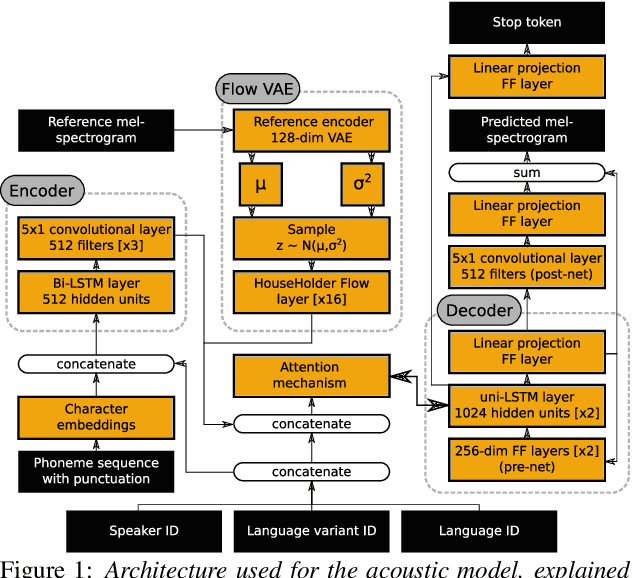
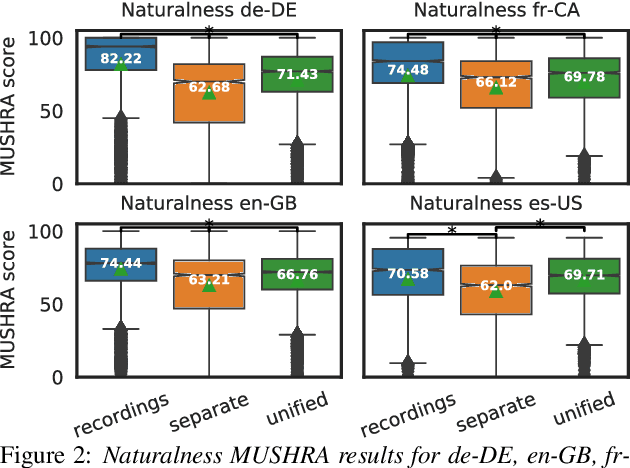
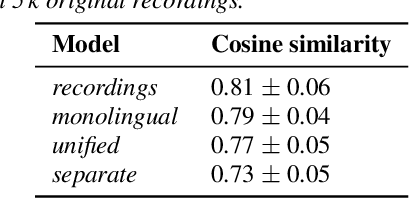
An essential design decision for multilingual Neural Text-To-Speech (NTTS) systems is how to represent input linguistic features within the model. Looking at the wide variety of approaches in the literature, two main paradigms emerge, unified and separate representations. The former uses a shared set of phonetic tokens across languages, whereas the latter uses unique phonetic tokens for each language. In this paper, we conduct a comprehensive study comparing multilingual NTTS systems models trained with both representations. Our results reveal that the unified approach consistently achieves better cross-lingual synthesis with respect to both naturalness and accent. Separate representations tend to have an order of magnitude more tokens than unified ones, which may affect model capacity. For this reason, we carry out an ablation study to understand the interaction of the representation type with the size of the token embedding. We find that the difference between the two paradigms only emerges above a certain threshold embedding size. This study provides strong evidence that unified representations should be the preferred paradigm when building multilingual NTTS systems.
Mix and Match: An Empirical Study on Training Corpus Composition for Polyglot Text-To-Speech
Jul 04, 2022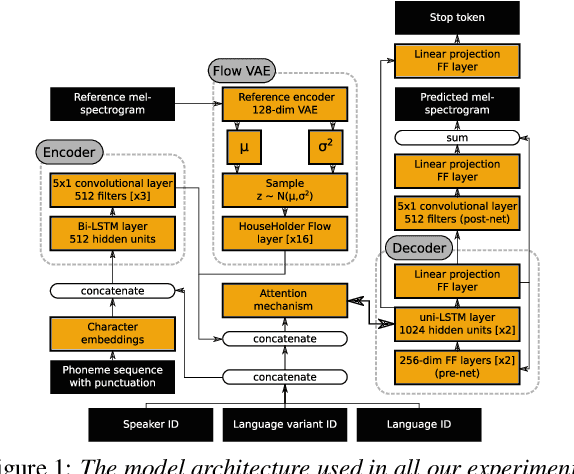
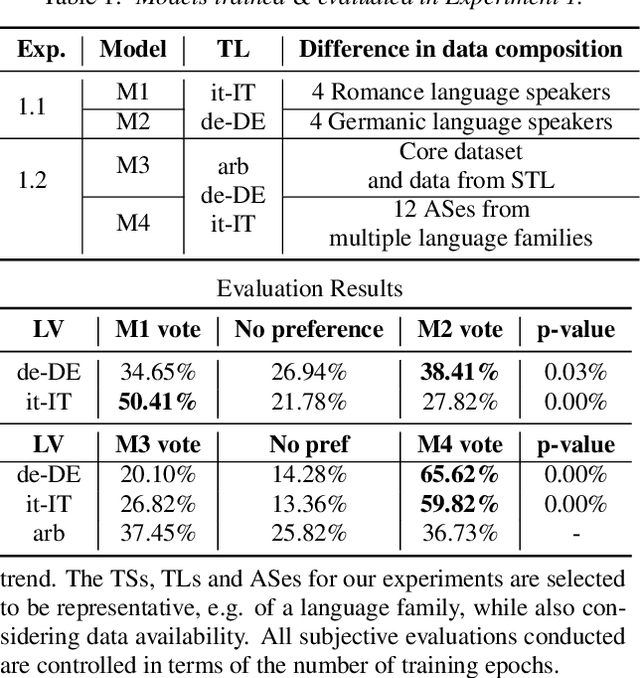
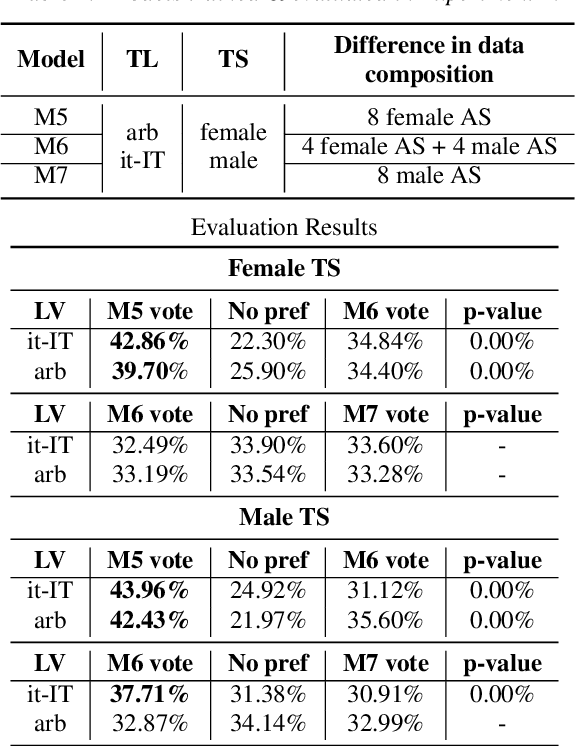
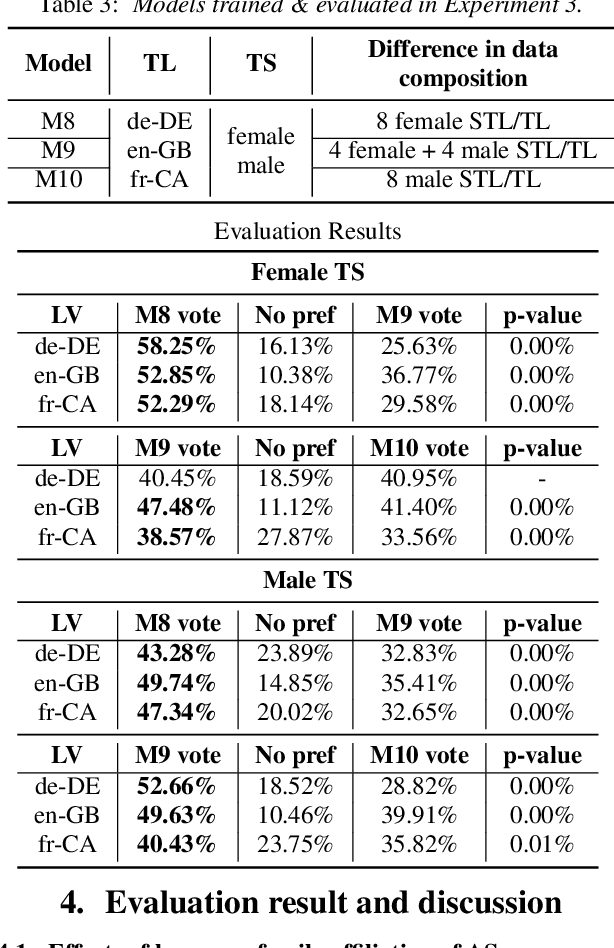
Training multilingual Neural Text-To-Speech (NTTS) models using only monolingual corpora has emerged as a popular way for building voice cloning based Polyglot NTTS systems. In order to train these models, it is essential to understand how the composition of the training corpora affects the quality of multilingual speech synthesis. In this context, it is common to hear questions such as "Would including more Spanish data help my Italian synthesis, given the closeness of both languages?". Unfortunately, we found existing literature on the topic lacking in completeness in this regard. In the present work, we conduct an extensive ablation study aimed at understanding how various factors of the training corpora, such as language family affiliation, gender composition, and the number of speakers, contribute to the quality of Polyglot synthesis. Our findings include the observation that female speaker data are preferred in most scenarios, and that it is not always beneficial to have more speakers from the target language variant in the training corpus. The findings herein are informative for the process of data procurement and corpora building.