 Add to Chrome
 Add to Firefox
 Add to Edge
Open Problems in Constitutional Preference Reconstruction
Jun 29, 2026
Pairwise preference data is widely used for training and evaluating language models (e.g., RLHF), but each datapoint records a \emph{choice}, not the rationale behind it. Methods such as Inverse Constitutional AI (ICAI) attempt to improve interpretability by compressing datasets into short ``constitutions'' of natural-language principles. We argue this framing is under-specified: a flat list of principles is not yet an executable decision rule because it leaves principle composition implicit. We use the pairwise setting as a testbed to empirically characterize three open problems in constitutional methods. First, principle quality is hard to measure: coverage and accuracy are useful but incomplete proxies for end-to-end reconstruction. Second, \emph{composition is ambiguous}: holding principles fixed, different executors (LLM judge versus majority vote) agree only $73\%$ of the time. Third, \emph{constitutions differ between LLMs}: cross-model vote agreement is $73\%$, whereas intra-model agreement is $81\%$. Across PRISM, AlpacaEval, and Chatbot Arena, we show that principle refinement (ICAI+) may be a first step towards ameliorating these problems: inter-executor agreement rises to $78\%$, and transparent executors match LLM judge accuracy ($66\%$ vs.\ $67\%$). Our results highlight that constitutions should be evaluated as \emph{constitution--executor systems}, with implications for LLMs-as-a-judge broadly.

LLMs Contain Multitudes: How Deployment Context Reshapes Model-Level Preferences and Values
Jun 11, 2026Large language models (LLMs) are increasingly characterised in recent evaluation work as having stable, model-level preference and value systems. However, accompanying robustness checks are limited to incidental prompt perturbations such as syntax variation and option reordering. This leaves open whether the measured properties survive when the surrounding task context changes, as it does in most real deployments. We test this directly across two established pairwise paradigms: ranking country preferences and eliciting utility judgements. In both, we make the deployment context -- the high-level task the model is performing while making concrete value-dependent choices -- our controlled variable, varied across framings such as writing a Reddit post or a news article. Across five LLMs and over 1.2M pairwise decisions, deployment context produces variation far larger than prompt paraphrasing and temperature controls. In country preference rankings over 15 countries, context induces widespread, statistically significant rank shifts; the aggregate Global North favouritism reported in prior work is itself context-dependent, with each model's bias shifting systematically across contexts. In utility elicitation over 50 outcomes, broad cross-category ordering is preserved, but fine-grained rankings within domains vary substantially, and cardinal exchange rates between outcomes (e.g. how many lives in one region equal one in another) shift by a factor of 2.47 at the median. Reported model-level preferences and utilities are therefore better understood as context-conditioned measurements than fixed model-level properties: safety guarantees obtained under one framing provide limited assurance in another.
Can External Validation Tools Improve Annotation Quality for LLM-as-a-Judge?
Jul 22, 2025Pairwise preferences over model responses are widely collected to evaluate and provide feedback to large language models (LLMs). Given two alternative model responses to the same input, a human or AI annotator selects the "better" response. This approach can provide feedback for domains where other hard-coded metrics are difficult to obtain (e.g., chat response quality), thereby helping model evaluation or training. However, for some domains high-quality pairwise comparisons can be tricky to obtain - from AI and humans. For example, for responses with many factual statements, annotators may disproportionately weigh writing quality rather than underlying facts. In this work, we explore augmenting standard AI annotator systems with additional tools to improve performance on three challenging response domains: long-form factual, math and code tasks. We propose a tool-using agentic system to provide higher quality feedback on these domains. Our system uses web-search and code execution to ground itself based on external validation, independent of the LLM's internal knowledge and biases. We provide extensive experimental results evaluating our method across the three targeted response domains as well as general annotation tasks, using RewardBench (incl. AlpacaEval and LLMBar), RewardMath, as well as three new datasets for domains with saturated pre-existing datasets. Our results indicate that external tools can indeed improve performance in many, but not all, cases. More generally, our experiments highlight the sensitivity of performance to simple parameters (e.g., prompt) and the need for improved (non-saturated) annotator benchmarks. We share our code at https://github.com/apple/ml-agent-evaluator.
Inverse Constitutional AI: Compressing Preferences into Principles
Jun 02, 2024
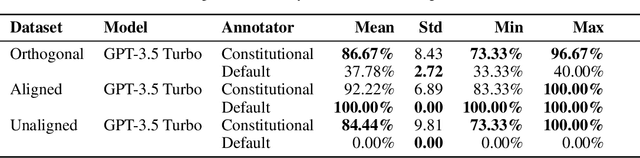
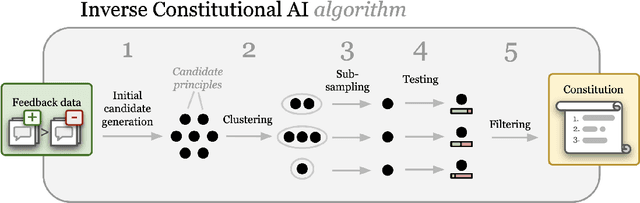
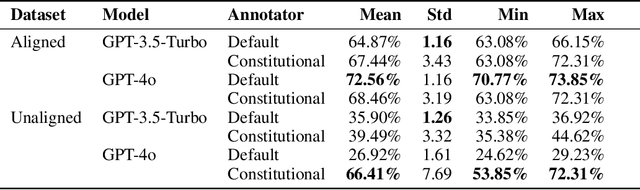
Feedback data plays an important role in fine-tuning and evaluating state-of-the-art AI models. Often pairwise text preferences are used: given two texts, human (or AI) annotators select the "better" one. Such feedback data is widely used to align models to human preferences (e.g., reinforcement learning from human feedback), or to rank models according to human preferences (e.g., Chatbot Arena). Despite its wide-spread use, prior work has demonstrated that human-annotated pairwise text preference data often exhibits unintended biases. For example, human annotators have been shown to prefer assertive over truthful texts in certain contexts. Models trained or evaluated on this data may implicitly encode these biases in a manner hard to identify. In this paper, we formulate the interpretation of existing pairwise text preference data as a compression task: the Inverse Constitutional AI (ICAI) problem. In constitutional AI, a set of principles (or constitution) is used to provide feedback and fine-tune AI models. The ICAI problem inverts this process: given a dataset of feedback, we aim to extract a constitution that best enables a large language model (LLM) to reconstruct the original annotations. We propose a corresponding initial ICAI algorithm and validate its generated constitutions quantitatively based on reconstructed annotations. Generated constitutions have many potential use-cases -- they may help identify undesirable biases, scale feedback to unseen data or assist with adapting LLMs to individual user preferences. We demonstrate our approach on a variety of datasets: (a) synthetic feedback datasets with known underlying principles; (b) the AlpacaEval dataset of cross-annotated human feedback; and (c) the crowdsourced Chatbot Arena data set. We release the code for our algorithm and experiments at https://github.com/rdnfn/icai .