 Add to Chrome
 Add to Firefox
 Add to Edge
Rethinking Global Average Pooling: Your Classifier Is Secretly a Multi-Instance Learner
Jun 12, 2026
Modern image classifiers widely adopt global average pooling (GAP) followed by a linear classification head. This linearity ensures that the image-level logits equal the average of logits obtained by applying the classification head pointwise to the feature grid prior to GAP. Consequently, standard classifiers may inherently retain spatial class evidence that remains recoverable even when the image-level prediction is incorrect. This structure naturally suggests a multiple-instance learning (MIL) interpretation, where an image is viewed as a bag of spatial instances. Within this formulation, we demonstrate that standard classifiers trained with a single label per image can still learn the intended classification task in multi-object scenes. We further exploit this property to decompose image-level logits into a prediction grid, providing a post-hoc diagnostic to extract spatial class evidence that GAP otherwise obscures. Our systematic evaluation reveals that off-the-shelf models consistently recover the ground-truth class within foreground regions. The MIL interpretation further suggests that common classifier failures reflect known limitations of mean aggregation.

LaFAM: Unsupervised Feature Attribution with Label-free Activation Maps
Jul 09, 2024Convolutional Neural Networks (CNNs) are known for their ability to learn hierarchical structures, naturally developing detectors for objects, and semantic concepts within their deeper layers. Activation maps (AMs) reveal these saliency regions, which are crucial for many Explainable AI (XAI) methods. However, the direct exploitation of raw AMs in CNNs for feature attribution remains underexplored in literature. This work revises Class Activation Map (CAM) methods by introducing the Label-free Activation Map (LaFAM), a streamlined approach utilizing raw AMs for feature attribution without reliance on labels. LaFAM presents an efficient alternative to conventional CAM methods, demonstrating particular effectiveness in saliency map generation for self-supervised learning while maintaining applicability in supervised learning scenarios.
Recommendations on test datasets for evaluating AI solutions in pathology
Apr 21, 2022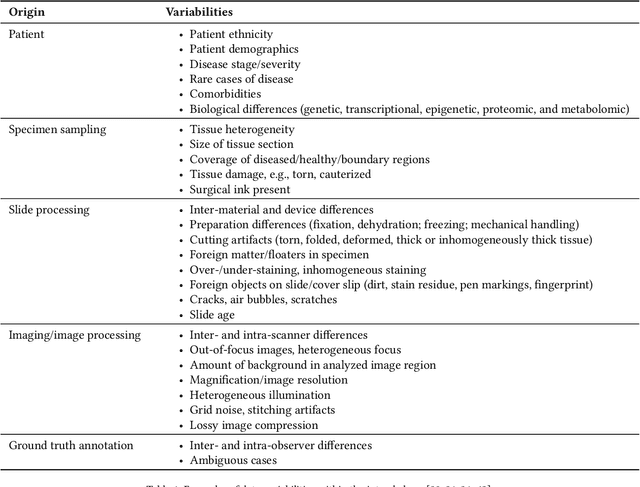
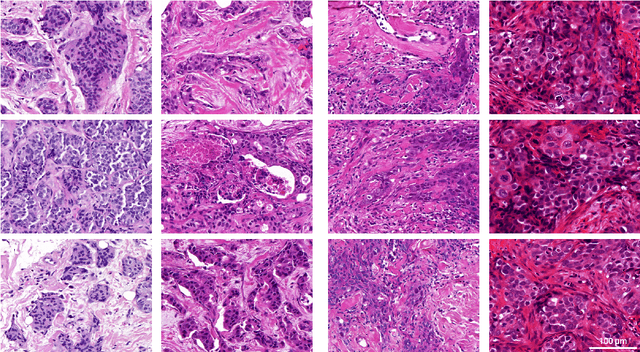
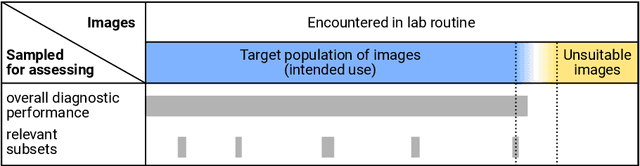
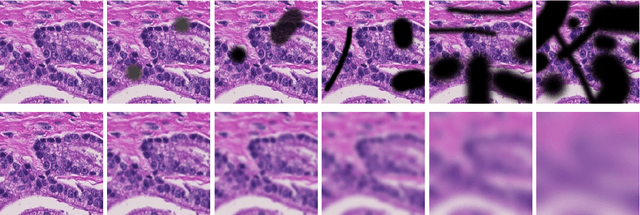
Artificial intelligence (AI) solutions that automatically extract information from digital histology images have shown great promise for improving pathological diagnosis. Prior to routine use, it is important to evaluate their predictive performance and obtain regulatory approval. This assessment requires appropriate test datasets. However, compiling such datasets is challenging and specific recommendations are missing. A committee of various stakeholders, including commercial AI developers, pathologists, and researchers, discussed key aspects and conducted extensive literature reviews on test datasets in pathology. Here, we summarize the results and derive general recommendations for the collection of test datasets. We address several questions: Which and how many images are needed? How to deal with low-prevalence subsets? How can potential bias be detected? How should datasets be reported? What are the regulatory requirements in different countries? The recommendations are intended to help AI developers demonstrate the utility of their products and to help regulatory agencies and end users verify reported performance measures. Further research is needed to formulate criteria for sufficiently representative test datasets so that AI solutions can operate with less user intervention and better support diagnostic workflows in the future.