 Add to Chrome
 Add to Firefox
 Add to Edge
When Labels Have Structure: Improving Image Classification with Hierarchy-Aware Cross-Entropy
May 07, 2026
Standard cross-entropy is the default classification loss across virtually all of machine learning, yet it treats all misclassifications equally, ignoring the semantic distances that a class hierarchy encodes. We propose Hierarchy-Aware Cross-Entropy (HACE), a drop-in replacement for standard cross-entropy that incorporates a known class hierarchy directly into the loss. HACE combines two components: prediction aggregation, which propagates the model's probability mass upward through the class hierarchy to ensure that parent nodes accumulate the confidence of their children; and ancestral label smoothing, which distributes the ground-truth signal along the path from the true class to the root. We evaluate HACE on CIFAR-100, FGVC Aircraft, and NABirds in two regimes: end-to-end training across six architectures spanning convolutional and attention-based designs, and linear probing on frozen DINOv2-Large features. In end-to-end training, HACE improves accuracy over standard cross-entropy in 15 out of 18 architecture--dataset pairs, with a mean gain of 4.66\%. In linear probing on frozen DINOv2-Large features, HACE outperforms all competing methods on all three datasets, with a mean improvement of 2.18\% over the next best baseline.

Reconciling Reality through Simulation: A Real-to-Sim-to-Real Approach for Robust Manipulation
Mar 06, 2024

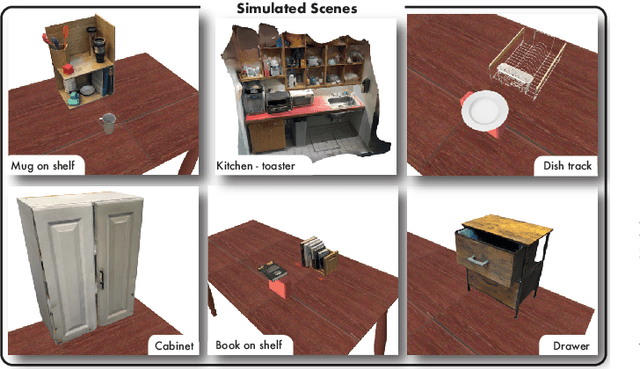

Imitation learning methods need significant human supervision to learn policies robust to changes in object poses, physical disturbances, and visual distractors. Reinforcement learning, on the other hand, can explore the environment autonomously to learn robust behaviors but may require impractical amounts of unsafe real-world data collection. To learn performant, robust policies without the burden of unsafe real-world data collection or extensive human supervision, we propose RialTo, a system for robustifying real-world imitation learning policies via reinforcement learning in "digital twin" simulation environments constructed on the fly from small amounts of real-world data. To enable this real-to-sim-to-real pipeline, RialTo proposes an easy-to-use interface for quickly scanning and constructing digital twins of real-world environments. We also introduce a novel "inverse distillation" procedure for bringing real-world demonstrations into simulated environments for efficient fine-tuning, with minimal human intervention and engineering required. We evaluate RialTo across a variety of robotic manipulation problems in the real world, such as robustly stacking dishes on a rack, placing books on a shelf, and six other tasks. RialTo increases (over 67%) in policy robustness without requiring extensive human data collection. Project website and videos at https://real-to-sim-to-real.github.io/RialTo/