 Add to Chrome
 Add to Firefox
 Add to Edge
BiMol-Diff: A Unified Diffusion Framework for Molecular Generation and Captioning
Apr 27, 2026
Bridging molecular structures and natural language is essential for controllable design. Autoregressive models struggle with long-range dependencies, while standard diffusion processes apply uniform corruption across positions, which can distort structurally informative tokens. We present BiMol-Diff, a unified diffusion framework for the paired tasks of text-conditioned molecule generation and molecule captioning. Our key component is a token-aware noise schedule that assigns position-dependent corruption based on token recovery difficulty, preserving harder-to-recover substructures during the forward process. On ChEBI-20 and M3-20M, BiMol-Diff improves molecule reconstruction with a 15.4% relative gain in Exact Match and achieves strong captioning results, attaining best BLEU and BERTScore among compared baselines. These results indicate token-aware noising improves fidelity in molecular structure-language modelling.

Factual and Edit-Sensitive Graph-to-Sequence Generation via Graph-Aware Adaptive Noising
Apr 27, 2026Fine-tuned autoregressive models for graph-to-sequence generation (G2S) often struggle with factual grounding and edit sensitivity. To tackle these issues, we propose a non-autoregressive diffusion framework that generates text by iterative refinement conditioned on an input graph, named as Diffusion Language Model for Graphs (DLM4G). By aligning graph components (entities/relations) with their corresponding sequence tokens, DLM4G employs an adaptive noising strategy. The proposed strategy uses per-token denoising error as a signal to adaptively modulate noise on entity and relation tokens, improving preservation of graph structure and enabling localized updates under graph edits. Evaluated on three datasets, DLM4G consistently outperforms competitive G2S diffusion baselines trained on identical splits across both surface-form and embedding-based metrics. DLM4G further exceeds fine-tuned autoregressive baselines up to 12x larger (e.g., T5-Large) and is competitive with zero-shot LLM transfer baselines up to 127x larger. Relative to the strongest fine-tuned PLM baseline, DLM4G improves factual grounding (FGT@0.5) by +5.16% and edit sensitivity (ESR) by +7.9%; compared to the best diffusion baseline, it yields gains of +3.75% in FGT@0.5 and +23.6% in ESR. We additionally demonstrate applicability beyond textual graphs through experiments on molecule captioning, indicating the method's generality for scientific G2S generation.
Enhancing Robustness of Graph Neural Networks through p-Laplacian
Sep 27, 2024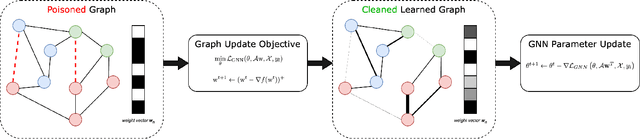
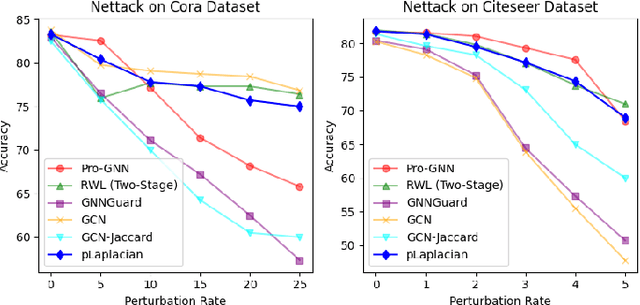
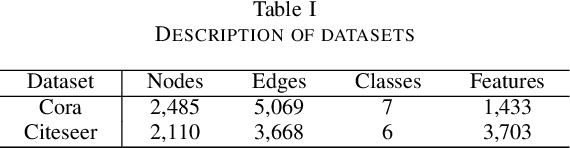
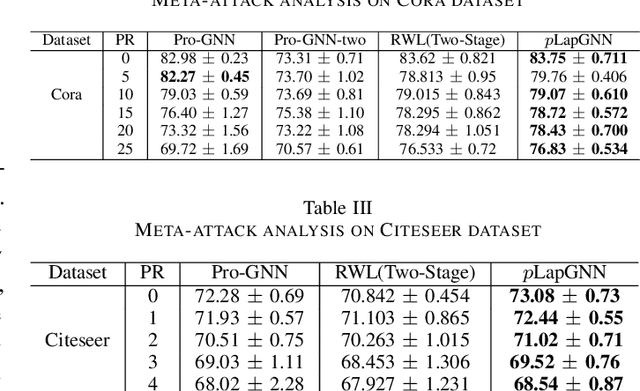
With the increase of data in day-to-day life, businesses and different stakeholders need to analyze the data for better predictions. Traditionally, relational data has been a source of various insights, but with the increase in computational power and the need to understand deeper relationships between entities, the need to design new techniques has arisen. For this graph data analysis has become an extraordinary tool for understanding the data, which reveals more realistic and flexible modelling of complex relationships. Recently, Graph Neural Networks (GNNs) have shown great promise in various applications, such as social network analysis, recommendation systems, drug discovery, and more. However, many adversarial attacks can happen over the data, whether during training (poisoning attack) or during testing (evasion attack), which can adversely manipulate the desired outcome from the GNN model. Therefore, it is crucial to make the GNNs robust to such attacks. The existing robustness methods are computationally demanding and perform poorly when the intensity of attack increases. This paper presents a computationally efficient framework, namely, pLapGNN, based on weighted p-Laplacian for making GNNs robust. Empirical evaluation on real datasets establishes the efficacy and efficiency of the proposed method.
GRAPHGINI: Fostering Individual and Group Fairness in Graph Neural Networks
Feb 20, 2024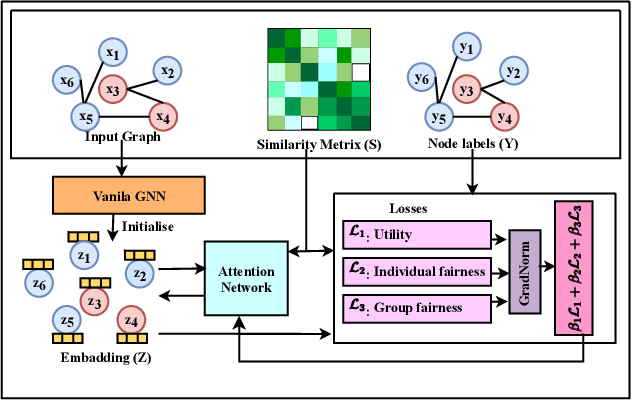


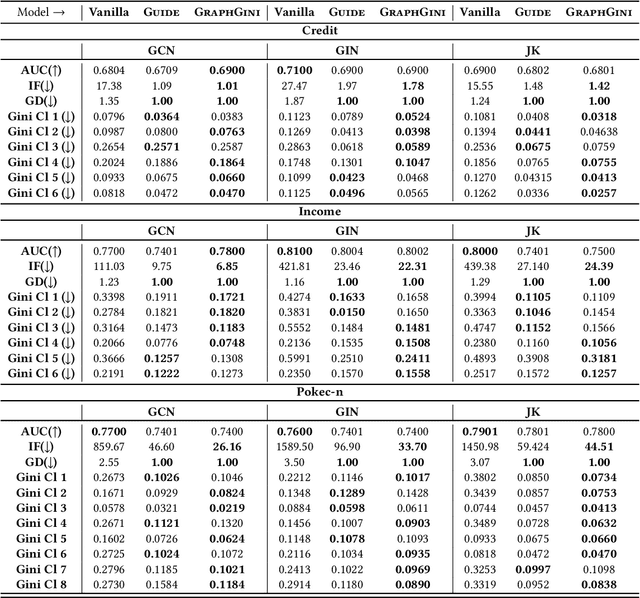
We address the growing apprehension that GNNs, in the absence of fairness constraints, might produce biased decisions that disproportionately affect underprivileged groups or individuals. Departing from previous work, we introduce for the first time a method for incorporating the Gini coefficient as a measure of fairness to be used within the GNN framework. Our proposal, GRAPHGINI, works with the two different goals of individual and group fairness in a single system, while maintaining high prediction accuracy. GRAPHGINI enforces individual fairness through learnable attention scores that help in aggregating more information through similar nodes. A heuristic-based maximum Nash social welfare constraint ensures the maximum possible group fairness. Both the individual fairness constraint and the group fairness constraint are stated in terms of a differentiable approximation of the Gini coefficient. This approximation is a contribution that is likely to be of interest even beyond the scope of the problem studied in this paper. Unlike other state-of-the-art, GRAPHGINI automatically balances all three optimization objectives (utility, individual, and group fairness) of the GNN and is free from any manual tuning of weight parameters. Extensive experimentation on real-world datasets showcases the efficacy of GRAPHGINI in making significant improvements in individual fairness compared to all currently available state-of-the-art methods while maintaining utility and group equality.
No prejudice! Fair Federated Graph Neural Networks for Personalized Recommendation
Dec 20, 2023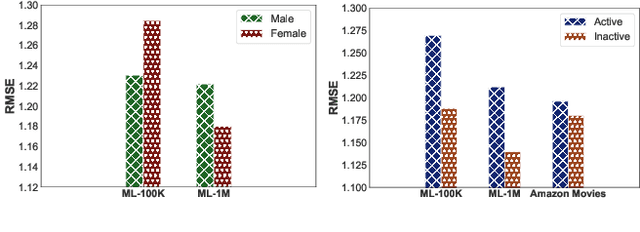


Ensuring fairness in Recommendation Systems (RSs) across demographic groups is critical due to the increased integration of RSs in applications such as personalized healthcare, finance, and e-commerce. Graph-based RSs play a crucial role in capturing intricate higher-order interactions among entities. However, integrating these graph models into the Federated Learning (FL) paradigm with fairness constraints poses formidable challenges as this requires access to the entire interaction graph and sensitive user information (such as gender, age, etc.) at the central server. This paper addresses the pervasive issue of inherent bias within RSs for different demographic groups without compromising the privacy of sensitive user attributes in FL environment with the graph-based model. To address the group bias, we propose F2PGNN (Fair Federated Personalized Graph Neural Network), a novel framework that leverages the power of Personalized Graph Neural Network (GNN) coupled with fairness considerations. Additionally, we use differential privacy techniques to fortify privacy protection. Experimental evaluation on three publicly available datasets showcases the efficacy of F2PGNN in mitigating group unfairness by 47% - 99% compared to the state-of-the-art while preserving privacy and maintaining the utility. The results validate the significance of our framework in achieving equitable and personalized recommendations using GNN within the FL landscape.