 Add to Chrome
 Add to Firefox
 Add to Edge
Which Algorithms Can Graph Neural Networks Learn?
Feb 13, 2026
In recent years, there has been growing interest in understanding neural architectures' ability to learn to execute discrete algorithms, a line of work often referred to as neural algorithmic reasoning. The goal is to integrate algorithmic reasoning capabilities into larger neural pipelines. Many such architectures are based on (message-passing) graph neural networks (MPNNs), owing to their permutation equivariance and ability to deal with sparsity and variable-sized inputs. However, existing work is either largely empirical and lacks formal guarantees or it focuses solely on expressivity, leaving open the question of when and how such architectures generalize beyond a finite training set. In this work, we propose a general theoretical framework that characterizes the sufficient conditions under which MPNNs can learn an algorithm from a training set of small instances and provably approximate its behavior on inputs of arbitrary size. Our framework applies to a broad class of algorithms, including single-source shortest paths, minimum spanning trees, and general dynamic programming problems, such as the $0$-$1$ knapsack problem. In addition, we establish impossibility results for a wide range of algorithmic tasks, showing that standard MPNNs cannot learn them, and we derive more expressive MPNN-like architectures that overcome these limitations. Finally, we refine our analysis for the Bellman-Ford algorithm, yielding a substantially smaller required training set and significantly extending the recent work of Nerem et al. [2025] by allowing for a differentiable regularization loss. Empirical results largely support our theoretical findings.

Position: Message-passing and spectral GNNs are two sides of the same coin
Feb 10, 2026Graph neural networks (GNNs) are commonly divided into message-passing neural networks (MPNNs) and spectral graph neural networks, reflecting two largely separate research traditions in machine learning and signal processing. This paper argues that this divide is mostly artificial, hindering progress in the field. We propose a viewpoint in which both MPNNs and spectral GNNs are understood as different parametrizations of permutation-equivariant operators acting on graph signals. From this perspective, many popular architectures are equivalent in expressive power, while genuine gaps arise only in specific regimes. We further argue that MPNNs and spectral GNNs offer complementary strengths. That is, MPNNs provide a natural language for discrete structure and expressivity analysis using tools from logic and graph isomorphism research, while the spectral perspective provides principled tools for understanding smoothing, bottlenecks, stability, and community structure. Overall, we posit that progress in graph learning will be accelerated by clearly understanding the key similarities and differences between these two types of GNNs, and by working towards unifying these perspectives within a common theoretical and conceptual framework rather than treating them as competing paradigms.
Understanding Generalization in Node and Link Prediction
Jul 01, 2025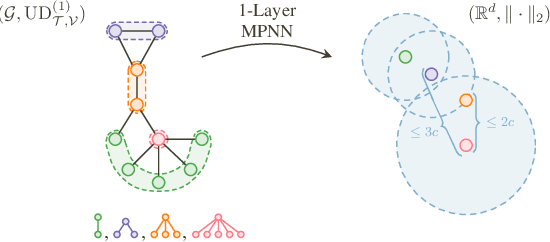
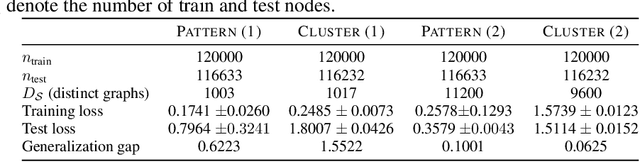

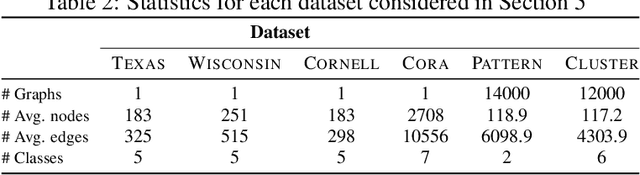
Using message-passing graph neural networks (MPNNs) for node and link prediction is crucial in various scientific and industrial domains, which has led to the development of diverse MPNN architectures. Besides working well in practical settings, their ability to generalize beyond the training set remains poorly understood. While some studies have explored MPNNs' generalization in graph-level prediction tasks, much less attention has been given to node- and link-level predictions. Existing works often rely on unrealistic i.i.d.\@ assumptions, overlooking possible correlations between nodes or links, and assuming fixed aggregation and impractical loss functions while neglecting the influence of graph structure. In this work, we introduce a unified framework to analyze the generalization properties of MPNNs in inductive and transductive node and link prediction settings, incorporating diverse architectural parameters and loss functions and quantifying the influence of graph structure. Additionally, our proposed generalization framework can be applied beyond graphs to any classification task under the inductive or transductive setting. Our empirical study supports our theoretical insights, deepening our understanding of MPNNs' generalization capabilities in these tasks.
Survey on Generalization Theory for Graph Neural Networks
Mar 19, 2025
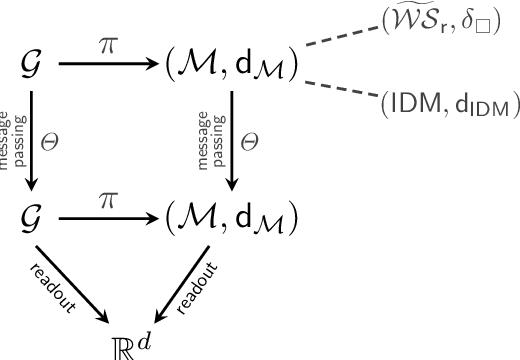
Message-passing graph neural networks (MPNNs) have emerged as the leading approach for machine learning on graphs, attracting significant attention in recent years. While a large set of works explored the expressivity of MPNNs, i.e., their ability to separate graphs and approximate functions over them, comparatively less attention has been directed toward investigating their generalization abilities, i.e., making meaningful predictions beyond the training data. Here, we systematically review the existing literature on the generalization abilities of MPNNs. We analyze the strengths and limitations of various studies in these domains, providing insights into their methodologies and findings. Furthermore, we identify potential avenues for future research, aiming to deepen our understanding of the generalization abilities of MPNNs.
Covered Forest: Fine-grained generalization analysis of graph neural networks
Dec 10, 2024The expressive power of message-passing graph neural networks (MPNNs) is reasonably well understood, primarily through combinatorial techniques from graph isomorphism testing. However, MPNNs' generalization abilities -- making meaningful predictions beyond the training set -- remain less explored. Current generalization analyses often overlook graph structure, limit the focus to specific aggregation functions, and assume the impractical, hard-to-optimize $0$-$1$ loss function. Here, we extend recent advances in graph similarity theory to assess the influence of graph structure, aggregation, and loss functions on MPNNs' generalization abilities. Our empirical study supports our theoretical insights, improving our understanding of MPNNs' generalization properties.