 Add to Chrome
 Add to Firefox
 Add to Edge
Pattern over Pixels: Measuring Pattern Completion Bias in Multimodal Code Generation
Aug 04, 2026
Multimodal large language models (MLLMs) are increasingly used to translate webpage screenshots into front-end code, but repeated UI patterns may sway them toward visually incorrect yet pattern-consistent outputs. In this work, we test how repeated webpage patterns hurt MLLM accuracy on an objective screenshot-to-code fill-in-the-blank task. We introduce the first benchmark for visual pattern-completion bias, where one localized element in a repeated UI pattern is perturbed and the model must recover the masked width or font-size value from the screenshot and HTML context. Starting from 30 webpages curated from the Design2Code dataset, we build 1,440 evaluated screenshots spanning structural card and text-style patterns under standard and noise-overlaid conditions. We evaluate five frontier MLLMs and find that all are strongly biased toward the repeated baseline. Mean bias rate reaches 69.78% on card-width perturbations and 80.22% on text font-size perturbations, while mean accuracy is only 21.17% and 7.89%, respectively. Codex-5.3 performs best but still drops from 68.61% accuracy on cards to 13.89% on text, while Flash-3.0 reaches 96.11% bias on text. Noise, subtler perturbations, and boundary positions further increase bias rate. Reasoning analysis further shows that greater reasoning effort correlates with lower bias, yet qualitative evidence reveals that models can identify the anomalous element and still override it with the pattern-consistent answer. Our results identify a concrete failure mode in multimodal code generation and show that its severity is strongly associated with visual saliency

Large Language Models for Code Generation from Multilingual Prompts: A Curated Benchmark and a Study on Code Quality
Jul 16, 2026Large Language Models (LLMs) perform differently on identical programming tasks when prompted in different natural languages, a phenomenon known as language bias. While this behavior has been widely studied for general text generation, its impact on code generation quality and programming conventions remains largely unexplored. We investigate how the language used to describe programming tasks affects the source code generated by GPT-4o mini, DeepSeek, and Claude. Our study comprises 460 coding tasks spanning Python (230) and Java (230). We translate and manually curate the original English prompts into Chinese, Hindi, Spanish, and Italian while preserving their technical meaning. We evaluate the generated code using multiple dimensions, including functional correctness through test pass rates, structural quality using established code metrics, issues detected by static analysis tools, and lexical characteristics such as the language used in identifiers and comments. Our results show that (i) English prompts do not consistently produce the best functional correctness or code quality, (ii) the impact of prompt language depends on both the programming language and the LLM, and (iii) generated code frequently mixes English with the prompt language in comments and string literals. These findings provide the first curated multilingual benchmark for studying language bias in code generation and offer insights for developing more robust multilingual code generation systems.
Quantize with Confidence? An Empirical Study of Quantization for Code Generation
Jul 15, 2026The growing adoption of local inference frameworks such as Ollama has made it increasingly common for developers to run large code models on laptops and other resource-constrained hardware. In these settings, post-training quantization is essential for reducing memory footprint and enabling practical deployment, yet its impact on generated code remains insufficiently understood. We empirically evaluate six state-of-the-art quantization methods (GPTQ, AWQ, QuIP#, AQLM, BitsAndBytes, and GGUF) on two representative large code model families, Qwen2.5-Coder and CodeLlama, using the multilingual McEval and CoderEval benchmarks for Python and Java. We assess functional correctness (pass@1) together with maintainability, reliability, security, and structural complexity. We also introduce a novel analysis of robustness under varying prompt complexity, characterized by Shannon entropy and token length. Our results show that quantization techniques differ meaningfully in their impact on correctness and code quality. AQLM consistently matches or exceeds the full-precision baseline, whereas QuIP# exhibits the largest correctness degradation, particularly on complex prompts. Security attributes remain stable across models, benchmarks, and programming languages, while robustness to prompt complexity varies across techniques. These findings provide practical guidance for selecting quantization strategies for deploying large code models on resource-constrained hardware and highlight the importance of evaluating quantized models beyond functional correctness.
Prior Bias in Vision Language Models on UML Diagram Interpretation
Jul 03, 2026Vision Language Models (VLMs) are increasingly applied to software engineering artifacts, especially UML class diagrams whose meaning depends on visual notation. Yet, it is unclear whether VLMs actually read such diagrams or instead answer from pretrained priors about how classes typically relate. We introduce a controlled UML benchmark in which each prior-conforming diagram is paired with its prior-conflicting counterpart that (1) preserves the same class names and layout while (2) reverses only the relation arrow. We evaluate eight open-source VLMs from two model families, InternVL3.5 and Qwen3, alongside two closed-source frontier models GPT-5.4 and GPT-5.4 Mini. Across the eight open-source models, reversing the arrow reduces relation-direction accuracy by 33.48% on average, while GPT-5.4 Mini retains a 10% gap. In the harder three-class condition, accuracy drops sharply by 45.28% for open-source models, and even 18.62% for the GPT-5.4 family on average. Scaling provides only limited improvements and is family-dependent. Our benchmark presents a diagnostic prior-driven failure in diagram-grounded software understanding. Our artifact is available at https://anonymous.4open.science/r/UMLKnowledgeConflict-8461.
Towards Comprehensive Benchmarking Infrastructure for LLMs In Software Engineering
Jan 28, 2026Large language models for code are advancing fast, yet our ability to evaluate them lags behind. Current benchmarks focus on narrow tasks and single metrics, which hide critical gaps in robustness, interpretability, fairness, efficiency, and real-world usability. They also suffer from inconsistent data engineering practices, limited software engineering context, and widespread contamination issues. To understand these problems and chart a path forward, we combined an in-depth survey of existing benchmarks with insights gathered from a dedicated community workshop. We identified three core barriers to reliable evaluation: the absence of software-engineering-rich datasets, overreliance on ML-centric metrics, and the lack of standardized, reproducible data pipelines. Building on these findings, we introduce BEHELM, a holistic benchmarking infrastructure that unifies software-scenario specification with multi-metric evaluation. BEHELM provides a structured way to assess models across tasks, languages, input and output granularities, and key quality dimensions. Our goal is to reduce the overhead currently required to construct benchmarks while enabling a fair, realistic, and future-proof assessment of LLMs in software engineering.
* Short paper from bechmarking for software engineering workshop FSE2025
Toward Explaining Large Language Models in Software Engineering Tasks
Dec 23, 2025Recent progress in Large Language Models (LLMs) has substantially advanced the automation of software engineering (SE) tasks, enabling complex activities such as code generation and code summarization. However, the black-box nature of LLMs remains a major barrier to their adoption in high-stakes and safety-critical domains, where explainability and transparency are vital for trust, accountability, and effective human supervision. Despite increasing interest in explainable AI for software engineering, existing methods lack domain-specific explanations aligned with how practitioners reason about SE artifacts. To address this gap, we introduce FeatureSHAP, the first fully automated, model-agnostic explainability framework tailored to software engineering tasks. Based on Shapley values, FeatureSHAP attributes model outputs to high-level input features through systematic input perturbation and task-specific similarity comparisons, while remaining compatible with both open-source and proprietary LLMs. We evaluate FeatureSHAP on two bi-modal SE tasks: code generation and code summarization. The results show that FeatureSHAP assigns less importance to irrelevant input features and produces explanations with higher fidelity than baseline methods. A practitioner survey involving 37 participants shows that FeatureSHAP helps practitioners better interpret model outputs and make more informed decisions. Collectively, FeatureSHAP represents a meaningful step toward practical explainable AI in software engineering. FeatureSHAP is available at https://github.com/deviserlab/FeatureSHAP.
Toward Neurosymbolic Program Comprehension
Feb 03, 2025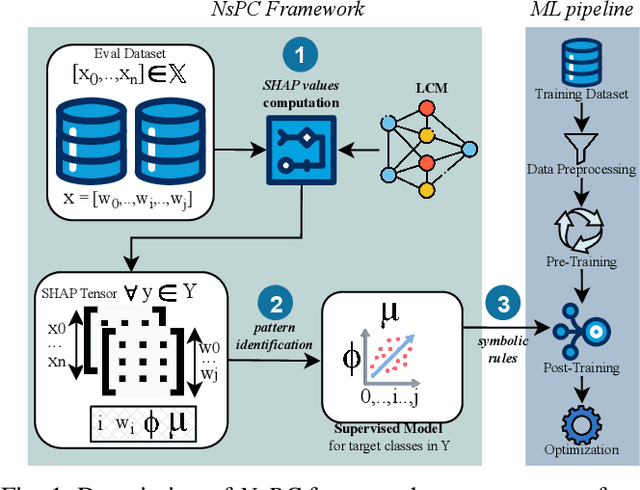
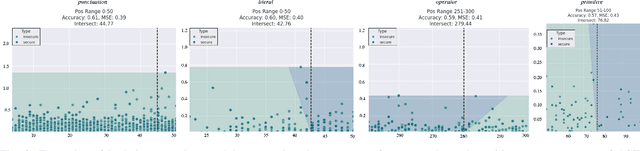
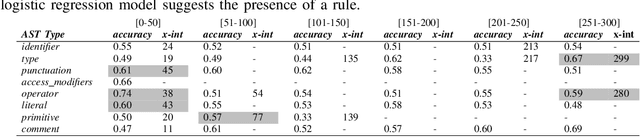
Recent advancements in Large Language Models (LLMs) have paved the way for Large Code Models (LCMs), enabling automation in complex software engineering tasks, such as code generation, software testing, and program comprehension, among others. Tools like GitHub Copilot and ChatGPT have shown substantial benefits in supporting developers across various practices. However, the ambition to scale these models to trillion-parameter sizes, exemplified by GPT-4, poses significant challenges that limit the usage of Artificial Intelligence (AI)-based systems powered by large Deep Learning (DL) models. These include rising computational demands for training and deployment and issues related to trustworthiness, bias, and interpretability. Such factors can make managing these models impractical for many organizations, while their "black-box'' nature undermines key aspects, including transparency and accountability. In this paper, we question the prevailing assumption that increasing model parameters is always the optimal path forward, provided there is sufficient new data to learn additional patterns. In particular, we advocate for a Neurosymbolic research direction that combines the strengths of existing DL techniques (e.g., LLMs) with traditional symbolic methods--renowned for their reliability, speed, and determinism. To this end, we outline the core features and present preliminary results for our envisioned approach, aimed at establishing the first Neurosymbolic Program Comprehension (NsPC) framework to aid in identifying defective code components.
The Rise and Fall of Software Engineering
Jun 14, 2024Over the last ten years, the realm of Artificial Intelligence (AI) has experienced an explosion of revolutionary breakthroughs, transforming what seemed like a far-off dream into a reality that is now deeply embedded in our everyday lives. AI's widespread impact is revolutionizing virtually all aspects of human life, and software engineering (SE) is no exception. As we explore this changing landscape, we are faced with questions about what the future holds for SE and how AI will reshape the roles, duties, and methodologies within the field. The introduction of these groundbreaking technologies highlights the inevitable shift towards a new paradigm, suggesting a future where AI's capabilities may redefine the boundaries of SE, potentially even more than human input. In this paper, we aim at outlining the key elements that, based on our expertise, are vital for the smooth integration of AI into SE, all while preserving the intrinsic human creativity that has been the driving force behind the field. First, we provide a brief description of SE and AI evolution. Afterward, we delve into the intricate interplay between AI-driven automation and human innovation, exploring how these two components can work together to advance SE practices to new methods and standards.
Towards Automatically Addressing Self-Admitted Technical Debt: How Far Are We?
Aug 17, 2023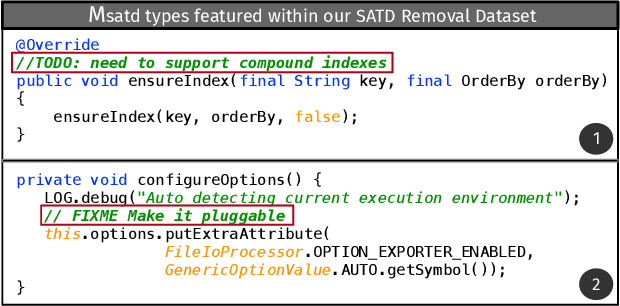
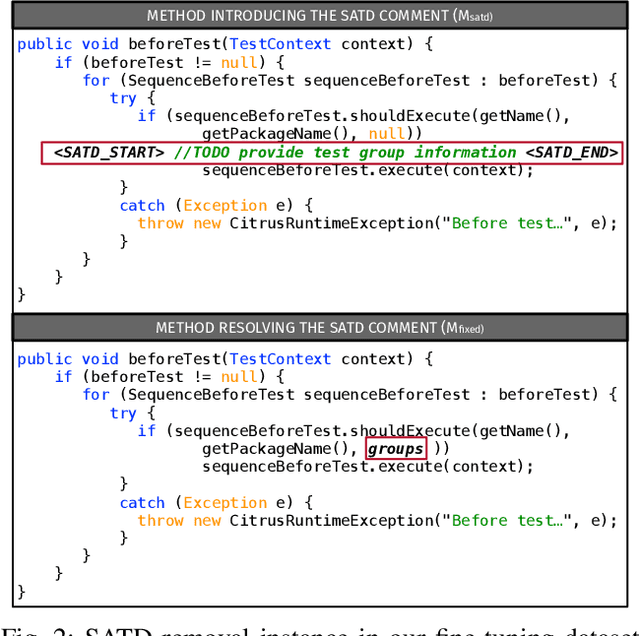
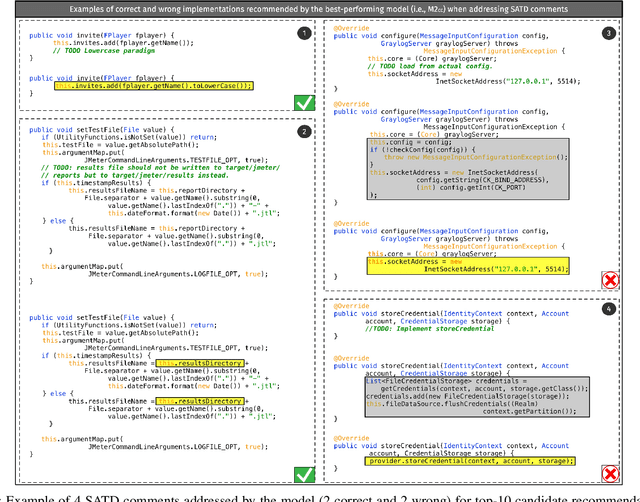
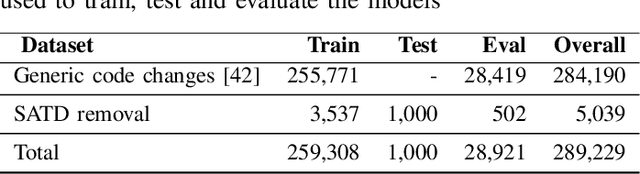
Upon evolving their software, organizations and individual developers have to spend a substantial effort to pay back technical debt, i.e., the fact that software is released in a shape not as good as it should be, e.g., in terms of functionality, reliability, or maintainability. This paper empirically investigates the extent to which technical debt can be automatically paid back by neural-based generative models, and in particular models exploiting different strategies for pre-training and fine-tuning. We start by extracting a dateset of 5,039 Self-Admitted Technical Debt (SATD) removals from 595 open-source projects. SATD refers to technical debt instances documented (e.g., via code comments) by developers. We use this dataset to experiment with seven different generative deep learning (DL) model configurations. Specifically, we compare transformers pre-trained and fine-tuned with different combinations of training objectives, including the fixing of generic code changes, SATD removals, and SATD-comment prompt tuning. Also, we investigate the applicability in this context of a recently-available Large Language Model (LLM)-based chat bot. Results of our study indicate that the automated repayment of SATD is a challenging task, with the best model we experimented with able to automatically fix ~2% to 8% of test instances, depending on the number of attempts it is allowed to make. Given the limited size of the fine-tuning dataset (~5k instances), the model's pre-training plays a fundamental role in boosting performance. Also, the ability to remove SATD steadily drops if the comment documenting the SATD is not provided as input to the model. Finally, we found general-purpose LLMs to not be a competitive approach for addressing SATD.