 Add to Chrome
 Add to Firefox
 Add to Edge
Learning Navigation Behaviors End-to-End with AutoRL
Feb 01, 2019
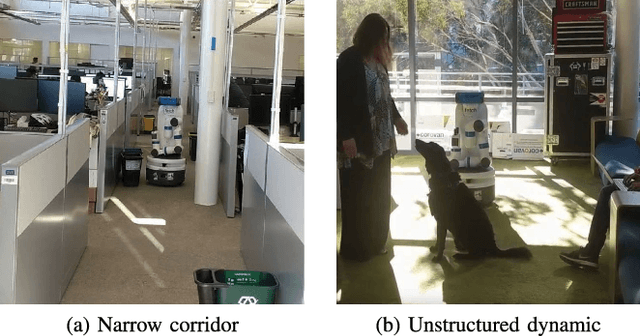

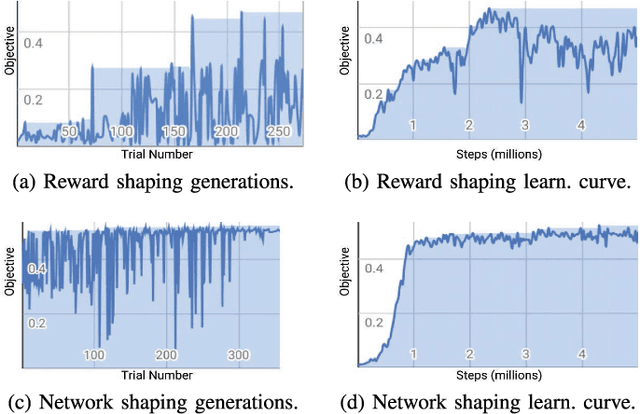
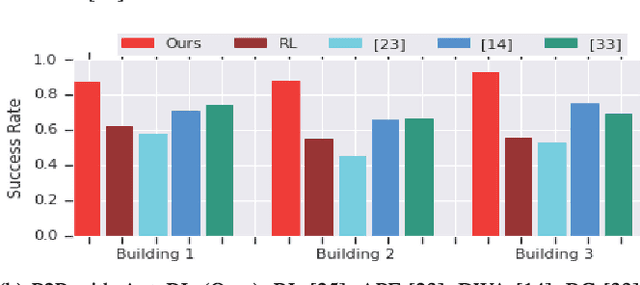
We learn end-to-end point-to-point and path-following navigation behaviors that avoid moving obstacles. These policies receive noisy lidar observations and output robot linear and angular velocities. The policies are trained in small, static environments with AutoRL, an evolutionary automation layer around Reinforcement Learning (RL) that searches for a deep RL reward and neural network architecture with large-scale hyper-parameter optimization. AutoRL first finds a reward that maximizes task completion, and then finds a neural network architecture that maximizes the cumulative of the found reward. Empirical evaluations, both in simulation and on-robot, show that AutoRL policies do not suffer from the catastrophic forgetfulness that plagues many other deep reinforcement learning algorithms, generalize to new environments and moving obstacles, are robust to sensor, actuator, and localization noise, and can serve as robust building blocks for larger navigation tasks. Our path-following and point-to-point policies are respectively 23% and 26% more successful than comparison methods across new environments. Video at: https://youtu.be/0UwkjpUEcbI

PRM-RL: Long-range Robotic Navigation Tasks by Combining Reinforcement Learning and Sampling-based Planning
May 16, 2018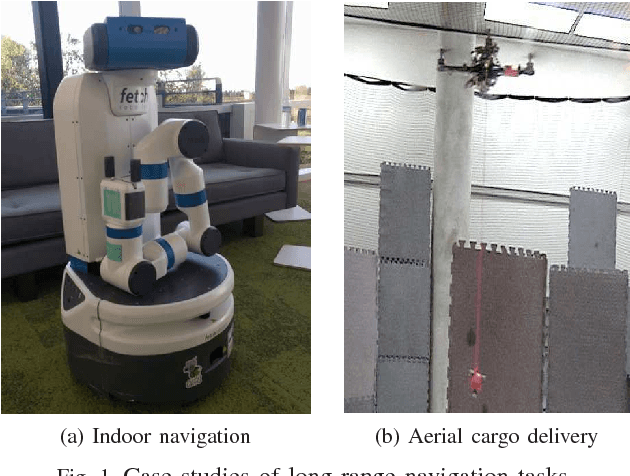
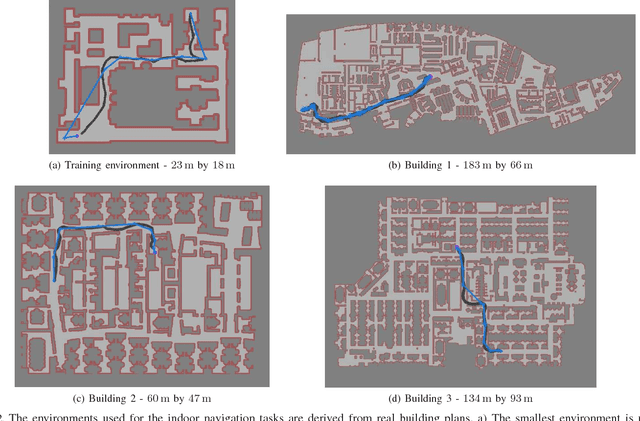

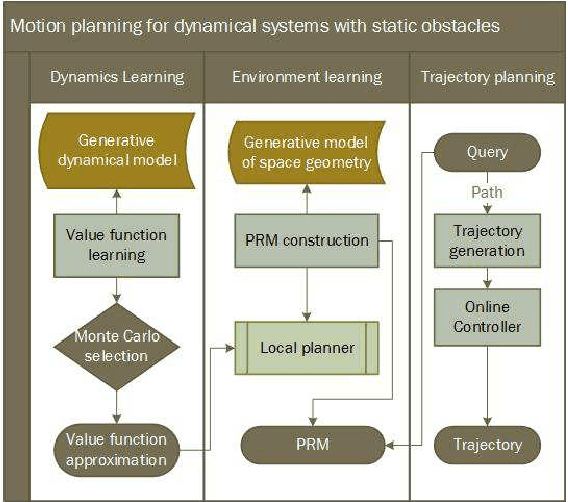
We present PRM-RL, a hierarchical method for long-range navigation task completion that combines sampling based path planning with reinforcement learning (RL). The RL agents learn short-range, point-to-point navigation policies that capture robot dynamics and task constraints without knowledge of the large-scale topology. Next, the sampling-based planners provide roadmaps which connect robot configurations that can be successfully navigated by the RL agent. The same RL agents are used to control the robot under the direction of the planning, enabling long-range navigation. We use the Probabilistic Roadmaps (PRMs) for the sampling-based planner. The RL agents are constructed using feature-based and deep neural net policies in continuous state and action spaces. We evaluate PRM-RL, both in simulation and on-robot, on two navigation tasks with non-trivial robot dynamics: end-to-end differential drive indoor navigation in office environments, and aerial cargo delivery in urban environments with load displacement constraints. Our results show improvement in task completion over both RL agents on their own and traditional sampling-based planners. In the indoor navigation task, PRM-RL successfully completes up to 215 m long trajectories under noisy sensor conditions, and the aerial cargo delivery completes flights over 1000 m without violating the task constraints in an environment 63 million times larger than used in training.
* 9 pages, 7 figures