 Add to Chrome
 Add to Firefox
 Add to Edge
GENIE: A Fine-Grained Measure for Novelty
Jun 11, 2026
Large Language Models have consistently demonstrated a lack of creativity and diversity across tasks. Prior work has focused on addressing whether models are capable of generating creative outputs. Here, we aim to consider novelty and investigate what makes model-generated content novel or not novel in a task-specific manner. We propose a fine-grained evaluation metric GENIE to measure the novelty of responses along task-specific features with respect to a population of responses. We show that unlike GENIE, holistic metrics struggle to capture the high-dimensionality of novelty and do not provide insight on which properties they target. Finally, we use GENIE to measure the effectiveness of mitigation methods that address creativity to better understand where these methods can improve novelty.

HERO'S JOURNEY: Testing Complex Rule Induction with Text Games
Jun 01, 2026We introduce HERO'S JOURNEY, a benchmark for rule induction in goal-directed episodic tasks, where agents must infer hidden rules from demonstrations and act on them through multi-step execution. HERO'S JOURNEY covers eight tasks across attribute and procedural induction families, each with four structural rule forms, controllable lexical grounding, and identifiability conditions. Evaluating state-of-the-art LLMs, we find that models show evidence of rule induction, but the ability is limited and uneven across tasks. Meanwhile, process execution adds an execution bottleneck for models, whereas surface semantics has minimal effect. Induction-specific steering methods improve performance on attribute tasks but show no reliable gains on procedural tasks, suggesting the gap in procedural induction remains an open challenge.
QUDsim: Quantifying Discourse Similarities in LLM-Generated Text
Apr 12, 2025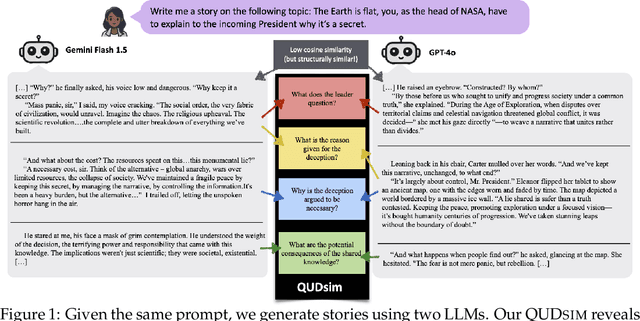

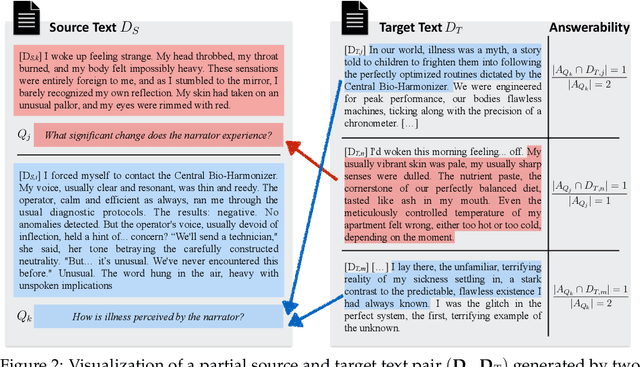
As large language models become increasingly capable at various writing tasks, their weakness at generating unique and creative content becomes a major liability. Although LLMs have the ability to generate text covering diverse topics, there is an overall sense of repetitiveness across texts that we aim to formalize and quantify via a similarity metric. The familiarity between documents arises from the persistence of underlying discourse structures. However, existing similarity metrics dependent on lexical overlap and syntactic patterns largely capture $\textit{content}$ overlap, thus making them unsuitable for detecting $\textit{structural}$ similarities. We introduce an abstraction based on linguistic theories in Questions Under Discussion (QUD) and question semantics to help quantify differences in discourse progression. We then use this framework to build $\textbf{QUDsim}$, a similarity metric that can detect discursive parallels between documents. Using QUDsim, we find that LLMs often reuse discourse structures (more so than humans) across samples, even when content differs. Furthermore, LLMs are not only repetitive and structurally uniform, but are also divergent from human authors in the types of structures they use.