 Add to Chrome
 Add to Firefox
 Add to Edge
PanLUNA: An Efficient and Robust Query-Unified Multimodal Model for Edge Biosignal Intelligence
Apr 05, 2026
Physiological foundation models (FMs) have shown promise for biosignal representation learning, yet most remain confined to a single modality such as EEG, ECG, or PPG, largely because paired multimodal datasets are scarce. In this paper, we present PanLUNA, a compact 5.4M-parameter pan-modal FM that jointly processes EEG, ECG, and PPG within a single shared encoder. Extending LUNA's channel-unification module, PanLUNA treats multimodal channels as entries in a unified query set augmented with sensor-type embeddings, enabling efficient cross-modal early fusion while remaining inherently robust to missing modalities at inference time. Despite its small footprint, PanLUNA matches or exceeds models up to 57$\times$ larger: 81.21% balanced accuracy on TUAB abnormal EEG detection and state-of-the-art 0.7416 balanced accuracy on HMC multimodal sleep staging. Quantization-aware training with INT8 weights recovers $\geq$96% of full-precision performance, and deployment on the GAP9 ultra-low-power RISC-V microcontroller for wearables achieves 325.6 ms latency and 18.8 mJ per 10-second, 12-lead ECG inference, and 1.206 s latency at 68.65 mJ for multimodal 5-channel sleep staging over 30-second epochs.

LuMamba: Latent Unified Mamba for Electrode Topology-Invariant and Efficient EEG Modeling
Mar 19, 2026Electroencephalography (EEG) enables non-invasive monitoring of brain activity across clinical and neurotechnology applications, yet building foundation models for EEG remains challenging due to \emph{differing electrode topologies} and \emph{computational scalability}, as Transformer architectures incur quadratic sequence complexity. As a joint solution, we propose \textbf{LuMamba} (\textbf{L}atent \textbf{U}nified \textbf{Mamba}), a self-supervised framework combining topology-invariant encodings with linear-complexity state-space modeling, using LUNA's learned-query cross-attention mechanism for channel unification~\cite{luna}, and FEMBA's bidirectional Mamba blocks for efficient temporal modeling~\cite{femba}. Within this architecture, we provide the first systematic investigation of the Latent-Euclidean Joint-Embedding Predictive Architecture (LeJEPA) for biosignal learning. Pre-trained on over 21,000 hours of unlabeled EEG from the TUEG corpus, LuMamba is evaluated on five downstream tasks spanning abnormality detection, artifact recognition, and mental condition classification across electrode configurations ranging from 16 to 26 channels. In the pre-training objective, masked reconstruction alone yields structured but less generalizable representations, while LeJEPA alone produces diffuse embeddings; combining both objectives achieves the most robust performance. With only 4.6M parameters, LuMamba attains 80.99\% balanced accuracy on TUAB and achieves state-of-art performance on Alzheimer's detection (0.97 AUPR), while requiring \textbf{377$\times$ fewer FLOPS} than state-of-art models at equivalent sequence lengths and scaling to \textbf{12$\times$ longer sequences} before reaching typical GPU memory limits. Code is available at https://github.com/pulp-bio/biofoundation
FEMBA: Efficient and Scalable EEG Analysis with a Bidirectional Mamba Foundation Model
Feb 10, 2025
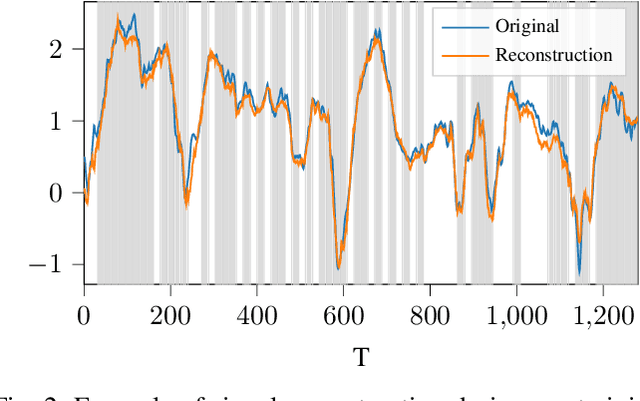


Accurate and efficient electroencephalography (EEG) analysis is essential for detecting seizures and artifacts in long-term monitoring, with applications spanning hospital diagnostics to wearable health devices. Robust EEG analytics have the potential to greatly improve patient care. However, traditional deep learning models, especially Transformer-based architectures, are hindered by their quadratic time and memory complexity, making them less suitable for resource-constrained environments. To address these challenges, we present FEMBA (Foundational EEG Mamba + Bidirectional Architecture), a novel self-supervised framework that establishes new efficiency benchmarks for EEG analysis through bidirectional state-space modeling. Unlike Transformer-based models, which incur quadratic time and memory complexity, FEMBA scales linearly with sequence length, enabling more scalable and efficient processing of extended EEG recordings. Trained on over 21,000 hours of unlabeled EEG and fine-tuned on three downstream tasks, FEMBA achieves competitive performance in comparison with transformer models, with significantly lower computational cost. Specifically, it reaches 81.82% balanced accuracy (0.8921 AUROC) on TUAB and 0.949 AUROC on TUAR, while a tiny 7.8M-parameter variant demonstrates viability for resource-constrained devices. These results pave the way for scalable, general-purpose EEG analytics in both clinical and highlight FEMBA as a promising candidate for wearable applications.