 Add to Chrome
 Add to Firefox
 Add to Edge
Beyond Static Leaderboards: Predictive Validity for the Evaluation of LLM Agents
Jun 18, 2026
Agent benchmarks are growing fast, but no single benchmark touches more than four or five of the dimensions that deployment exposes. This paper aggregates the largest coordinated deep-dive of one MCP-based industrial-agent benchmark to date: fourteen parallel implementation studies covering new asset classes (including a multi-modal visual extension), alternative orchestrations, retrieval strategies, reasoning modes, infrastructure optimizations, and evaluation-methodology probes. Consolidating those studies with seven prior agent benchmarks, we argue that aggregate-score leaderboards systematically underspecify deployed-agent evaluation. Rankings derived from aggregate scores do not transfer to out-of-distribution settings; recent public-to-hidden competition retrospectives provide direct empirical evidence of this rank instability. We propose ranking configurations by predictive validity, the correlation between in-sample and out-of-sample rank, rather than in-sample mean, and report a twelve-tier measurement apparatus that exposes the deployment-relevant dimensions HELM and its agent-era successors collapse. The position is operationalized through three falsifiable out-of-distribution criteria with explicit thresholds; existing evidence partly supports it but is too thin to confirm. We close with a pre-registered pilot design and a field-level vision for what the next generation of agentic benchmarks should report.

Deploying Vaccine Distribution Sites for Improved Accessibility and Equity to Support Pandemic Response
Feb 09, 2022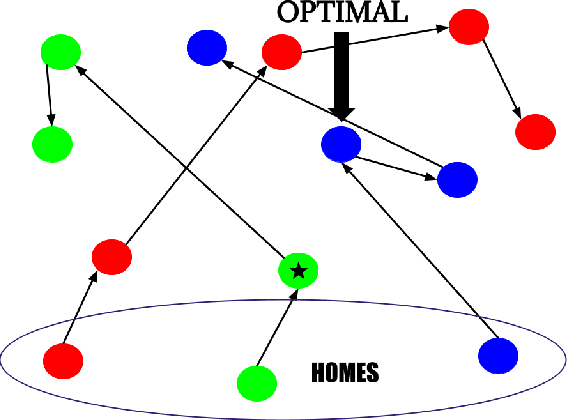

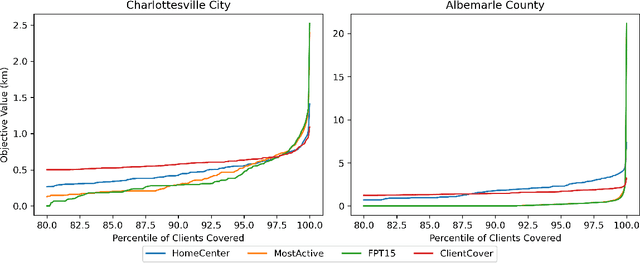
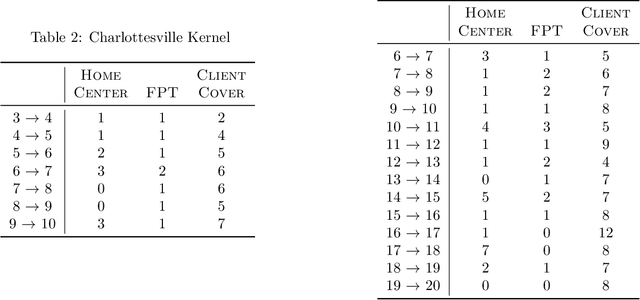
In response to COVID-19, many countries have mandated social distancing and banned large group gatherings in order to slow down the spread of SARS-CoV-2. These social interventions along with vaccines remain the best way forward to reduce the spread of SARS CoV-2. In order to increase vaccine accessibility, states such as Virginia have deployed mobile vaccination centers to distribute vaccines across the state. When choosing where to place these sites, there are two important factors to take into account: accessibility and equity. We formulate a combinatorial problem that captures these factors and then develop efficient algorithms with theoretical guarantees on both of these aspects. Furthermore, we study the inherent hardness of the problem, and demonstrate strong impossibility results. Finally, we run computational experiments on real-world data to show the efficacy of our methods.