 Add to Chrome
 Add to Firefox
 Add to Edge
From Specification to Execution: AI Assisted Scientific Workflow Management
Jun 16, 2026
Scientific workflow management systems (WMS) support scalable and reproducible execution of complex pipelines, but workflow design, implementation, and debugging remain largely manual and require significant expertise. Recent approaches using large language models (LLMs) show promise for workflow generation from natural language, but often rely on direct code synthesis, which limits transparency, reproducibility, and integration with workflow systems. We present an AI-assisted approach to scientific workflow management that combines specification-driven workflow generation, automated debugging, and distributed execution. The method introduces a structured specification phase that separates workflow intent, design, and implementation, allowing validation prior to code generation. We also develop an LLM-based debugging agent that diagnoses and resolves failures across multiple system layers. To support distributed execution and user interaction, we integrate Pegasus, a widely used WMS, with a Model Context Protocol (MCP) layer, providing a unified interface for workflow submission, monitoring, and control. We evaluate the approach using a federated learning workflow for medical imaging, chosen for its parallel, iterative, and dependency-intensive structure. The system generated and executed large-scale workflows with thousands of jobs, reduced debugging effort, and allowed non-expert users to construct workflows with expert-level design patterns. These results indicate that end-to-end AI-assisted workflow generation and execution is feasible, and point toward AI-driven platforms for managing the scientific workflow lifecycle.

From Sensors to Insight: Rapid, Edge-to-Core Application Development for Sensor-Driven Applications
May 04, 2026Scientists increasingly rely on sensor-based data, yet transforming raw streams into insights across the edge-to-cloud continuum remains difficult. Provisioning heterogeneous infrastructure and managing execution on emerging platforms like Data Processing Units typically requires cross-domain expertise, creating significant barriers to rapid prototyping. This paper introduces an experience-driven methodology for the rapid development of sensor-driven applications. By combining pattern-based workflow engineering with AI-assisted development-implemented via Pegasus on the FABRIC testbed - we utilize an existing Orcasound hydrophone workflow as a reusable template. We introduce a pattern-based engineering methodology to generate and refine workflows for air quality, earthquake, and soil moisture monitoring. Furthermore, we show how these abstract structures are extended to edge resources through modular configuration and placement. Our evaluation focuses on user productivity and practical lessons rather than peak performance. Through these case studies, we illustrate how AI-assisted, pattern-based development lowers the entry barrier for non-experts and enables iterative exploration of sensor-driven applications across distributed infrastructures.
Large Language Models for Anomaly Detection in Computational Workflows: from Supervised Fine-Tuning to In-Context Learning
Jul 24, 2024


Anomaly detection in computational workflows is critical for ensuring system reliability and security. However, traditional rule-based methods struggle to detect novel anomalies. This paper leverages large language models (LLMs) for workflow anomaly detection by exploiting their ability to learn complex data patterns. Two approaches are investigated: 1) supervised fine-tuning (SFT), where pre-trained LLMs are fine-tuned on labeled data for sentence classification to identify anomalies, and 2) in-context learning (ICL) where prompts containing task descriptions and examples guide LLMs in few-shot anomaly detection without fine-tuning. The paper evaluates the performance, efficiency, generalization of SFT models, and explores zero-shot and few-shot ICL prompts and interpretability enhancement via chain-of-thought prompting. Experiments across multiple workflow datasets demonstrate the promising potential of LLMs for effective anomaly detection in complex executions.
Self-supervised Learning for Anomaly Detection in Computational Workflows
Oct 02, 2023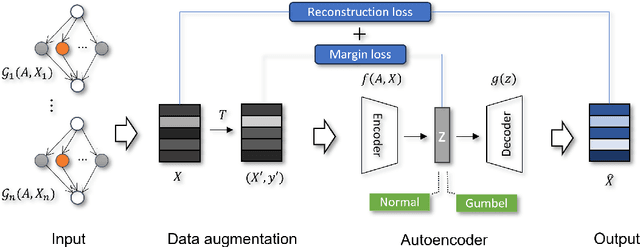


Anomaly detection is the task of identifying abnormal behavior of a system. Anomaly detection in computational workflows is of special interest because of its wide implications in various domains such as cybersecurity, finance, and social networks. However, anomaly detection in computational workflows~(often modeled as graphs) is a relatively unexplored problem and poses distinct challenges. For instance, when anomaly detection is performed on graph data, the complex interdependency of nodes and edges, the heterogeneity of node attributes, and edge types must be accounted for. Although the use of graph neural networks can help capture complex inter-dependencies, the scarcity of labeled anomalous examples from workflow executions is still a significant challenge. To address this problem, we introduce an autoencoder-driven self-supervised learning~(SSL) approach that learns a summary statistic from unlabeled workflow data and estimates the normal behavior of the computational workflow in the latent space. In this approach, we combine generative and contrastive learning objectives to detect outliers in the summary statistics. We demonstrate that by estimating the distribution of normal behavior in the latent space, we can outperform state-of-the-art anomaly detection methods on our benchmark datasets.