 Add to Chrome
 Add to Firefox
 Add to Edge
PrivSTRUCT: Untangling Data Purpose Compliance of Privacy Policies in Google Play Store
Apr 24, 2026
Existing research typically treats privacy policies as flat, uniform text, extracting information without regard for the document's logical hierarchy. Disregard for structural cues of section headings designed to guide the reader, often leads automated methods to entangle distinct data practices, particularly when linking sensitive data items to their specific purposes. To address this, we introduce PrivSTRUCT, a novel and systematic encoder and decoder combined framework that to untangle complex privacy disclosures. Benchmarking against the state-of-the-art tool PoliGrapher reveals that PrivSTRUCT robustly extracts more than x2 the number of data item and purpose excerpts while retaining developer-defined structural cues. By applying PrivSTRUCT to a large-scale dataset of 3,756 Android apps, we uncover a critical transparency gap: the probability of developers overstating a data purpose is 20.4% higher for first-party collection and 9.7% higher for third-party sharing when they rely on globally defined purposes rather than specific, locally scoped disclosures. Alarmingly, we find that sensitive third-party data flows such as sharing financial data for analytics are frequently diluted and entangled into generic or unrelated categories, highlighting a persistent failure in the current purpose disclosure landscape.

PrivPRISM: Automatically Detecting Discrepancies Between Google Play Data Safety Declarations and Developer Privacy Policies
Mar 10, 2026End-users seldom read verbose privacy policies, leading app stores like Google Play to mandate simplified data safety declarations as a user-friendly alternative. However, these self-declared disclosures often contradict the full privacy policies, deceiving users about actual data practices and violating regulatory requirements for consistency. To address this, we introduce PrivPRISM, a robust framework that combines encoder and decoder language models to systematically extract and compare fine-grained data practices from privacy policies and to compare against data safety declarations, enabling scalable detection of non-compliance. Evaluating 7,770 popular mobile games uncovers discrepancies in nearly 53% of cases, rising to 61% among 1,711 widely used generic apps. Additionally, static code analysis reveals possible under-disclosures, with privacy policies disclosing just 66.8% of potential accesses to sensitive data like location and financial information, versus only 36.4% in data safety declarations of mobile games. Our findings expose systemic issues, including widespread reuse of generic privacy policies, vague / contradictory statements, and hidden risks in high-profile apps with 100M+ downloads, underscoring the urgent need for automated enforcement to protect platform integrity and for end-users to be vigilant about sensitive data they disclose via popular apps.
Entailment-Driven Privacy Policy Classification with LLMs
Sep 25, 2024


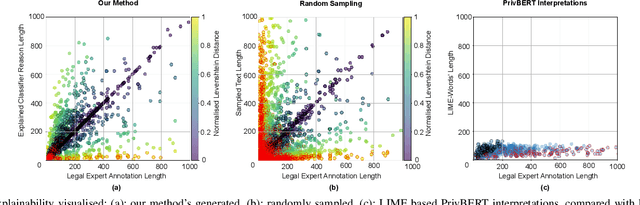
While many online services provide privacy policies for end users to read and understand what personal data are being collected, these documents are often lengthy and complicated. As a result, the vast majority of users do not read them at all, leading to data collection under uninformed consent. Several attempts have been made to make privacy policies more user friendly by summarising them, providing automatic annotations or labels for key sections, or by offering chat interfaces to ask specific questions. With recent advances in Large Language Models (LLMs), there is an opportunity to develop more effective tools to parse privacy policies and help users make informed decisions. In this paper, we propose an entailment-driven LLM based framework to classify paragraphs of privacy policies into meaningful labels that are easily understood by users. The results demonstrate that our framework outperforms traditional LLM methods, improving the F1 score in average by 11.2%. Additionally, our framework provides inherently explainable and meaningful predictions.