 Add to Chrome
 Add to Firefox
 Add to Edge
Bengali-Loop: Community Benchmarks for Long-Form Bangla ASR and Speaker Diarization
Feb 15, 2026
Bengali (Bangla) remains under-resourced in long-form speech technology despite its wide use. We present Bengali-Loop, two community benchmarks to address this gap: (1) a long-form ASR corpus of 191 recordings (158.6 hours, 792k words) from 11 YouTube channels, collected via a reproducible subtitle-extraction pipeline and human-in-the-loop transcript verification; and (2) a speaker diarization corpus of 24 recordings (22 hours, 5,744 annotated segments) with fully manual speaker-turn labels in CSV format. Both benchmarks target realistic multi-speaker, long-duration content (e.g., Bangla drama/natok). We establish baselines (Tugstugi: 34.07% WER; pyannote.audio: 40.08% DER) and provide standardized evaluation protocols (WER/CER, DER), annotation rules, and data formats to support reproducible benchmarking and future model development for Bangla long-form ASR and diarization.

Improving Neural Ranking Models with Traditional IR Methods
Aug 29, 2023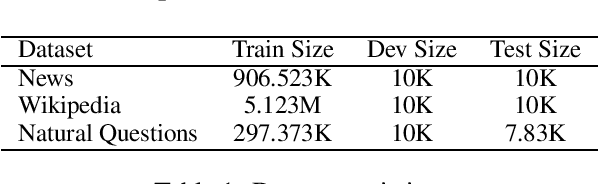
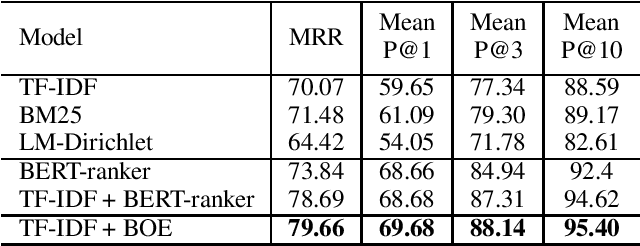
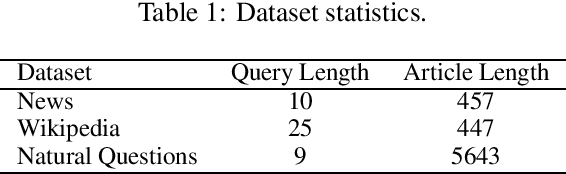

Neural ranking methods based on large transformer models have recently gained significant attention in the information retrieval community, and have been adopted by major commercial solutions. Nevertheless, they are computationally expensive to create, and require a great deal of labeled data for specialized corpora. In this paper, we explore a low resource alternative which is a bag-of-embedding model for document retrieval and find that it is competitive with large transformer models fine tuned on information retrieval tasks. Our results show that a simple combination of TF-IDF, a traditional keyword matching method, with a shallow embedding model provides a low cost path to compete well with the performance of complex neural ranking models on 3 datasets. Furthermore, adding TF-IDF measures improves the performance of large-scale fine tuned models on these tasks.
A Cross-Domain Evaluation of Approaches for Causal Knowledge Extraction
Aug 07, 2023


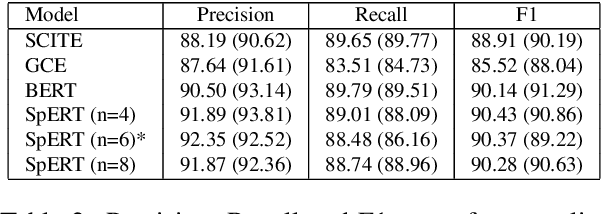
Causal knowledge extraction is the task of extracting relevant causes and effects from text by detecting the causal relation. Although this task is important for language understanding and knowledge discovery, recent works in this domain have largely focused on binary classification of a text segment as causal or non-causal. In this regard, we perform a thorough analysis of three sequence tagging models for causal knowledge extraction and compare it with a span based approach to causality extraction. Our experiments show that embeddings from pre-trained language models (e.g. BERT) provide a significant performance boost on this task compared to previous state-of-the-art models with complex architectures. We observe that span based models perform better than simple sequence tagging models based on BERT across all 4 data sets from diverse domains with different types of cause-effect phrases.
Word Sense Induction with Knowledge Distillation from BERT
Apr 20, 2023Pre-trained contextual language models are ubiquitously employed for language understanding tasks, but are unsuitable for resource-constrained systems. Noncontextual word embeddings are an efficient alternative in these settings. Such methods typically use one vector to encode multiple different meanings of a word, and incur errors due to polysemy. This paper proposes a two-stage method to distill multiple word senses from a pre-trained language model (BERT) by using attention over the senses of a word in a context and transferring this sense information to fit multi-sense embeddings in a skip-gram-like framework. We demonstrate an effective approach to training the sense disambiguation mechanism in our model with a distribution over word senses extracted from the output layer embeddings of BERT. Experiments on the contextual word similarity and sense induction tasks show that this method is superior to or competitive with state-of-the-art multi-sense embeddings on multiple benchmark data sets, and experiments with an embedding-based topic model (ETM) demonstrates the benefits of using this multi-sense embedding in a downstream application.
Position Masking for Improved Layout-Aware Document Understanding
Sep 01, 2021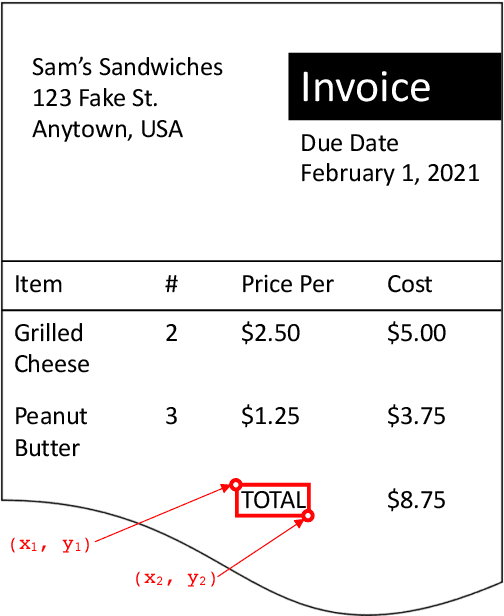
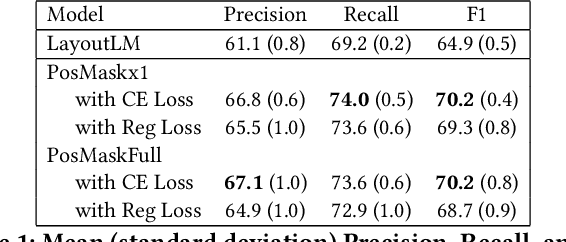
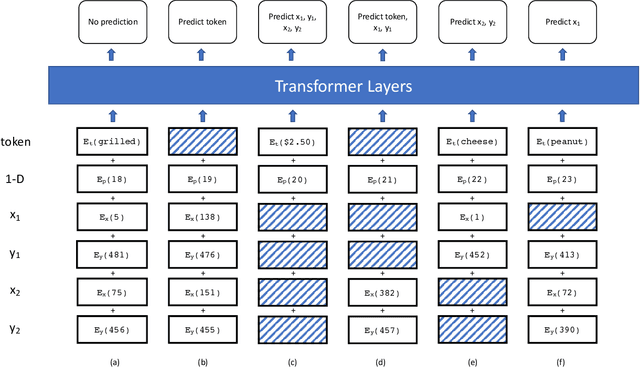
Natural language processing for document scans and PDFs has the potential to enormously improve the efficiency of business processes. Layout-aware word embeddings such as LayoutLM have shown promise for classification of and information extraction from such documents. This paper proposes a new pre-training task called that can improve performance of layout-aware word embeddings that incorporate 2-D position embeddings. We compare models pre-trained with only language masking against models pre-trained with both language masking and position masking, and we find that position masking improves performance by over 5% on a form understanding task.