 Add to Chrome
 Add to Firefox
 Add to Edge
AI CFD Scientist: Toward Open-Ended Computational Fluid Dynamics Discovery with Physics-Aware AI Agents
May 07, 2026
Recent LLM-based agents have closed substantial portions of the scientific discovery loop in software-only machine-learning research, in chemistry, and in biology. Extending the same loop to high-fidelity physical simulators is harder, because solver completion does not imply physical validity and many failure modes appear only in field-level imagery rather than in solver logs. We present AI CFD Scientist, an open-source AI scientist for computational fluid dynamics (CFD) that, to our knowledge, is the first to span literature-grounded ideation, validated execution, vision-based physics verification, source-code modification, and figure-grounded writing within a single inspectable workflow. Three coupled pathways cover parameter sweeps within a fixed solver, case-local C++ library compilation for new physical models, and open-ended hypothesis search against a reference comparator, all running on OpenFOAM through Foam-Agent. At the center of the framework is a vision-language physics-verification gate that inspects rendered flow fields before any result is accepted, rerun, or written into a manuscript. On five tasks under a shared GPT-5.5 backbone, AI CFD Scientist autonomously discovers a Spalart-Allmaras runtime correction that reduces lower-wall Cf RMSE against DNS by 7.89% on the periodic hill at Reh=5600; under matched LLM cost, two strong general AI-scientist baselines (ARIS, DeepScientist) execute partial CFD workflows but lack the domain-specific validity gates needed to convert runs into defensible scientific claims; and a controlled planted-failure ablation shows that the vision-language gate detects 14 of 16 silent failures missed by solver-level checks. Code, prompts, and run artifacts are released at https://github.com/csml-rpi/cfd-scientist.

MoEEdit: Efficient and Routing-Stable Knowledge Editing for Mixture-of-Experts LLMs
Feb 11, 2026Knowledge editing (KE) enables precise modifications to factual content in large language models (LLMs). Existing KE methods are largely designed for dense architectures, limiting their applicability to the increasingly prevalent sparse Mixture-of-Experts (MoE) models that underpin modern scalable LLMs. Although MoEs offer strong efficiency and capacity scaling, naively adapting dense-model editors is both computationally costly and prone to routing distribution shifts that undermine stability and consistency. To address these challenges, we introduce MoEEdit, the first routing-stable framework for parameter-modifying knowledge editing in MoE LLMs. Our method reparameterizes expert updates via per-expert null-space projections that keep router inputs invariant and thereby suppress routing shifts. The resulting block-structured optimization is solved efficiently with a block coordinate descent (BCD) solver. Experiments show that MoEEdit attains state-of-the-art efficacy and generalization while preserving high specificity and routing stability, with superior compute and memory efficiency. These results establish a robust foundation for scalable, precise knowledge editing in sparse LLMs and underscore the importance of routing-stable interventions.
GRIP: Algorithm-Agnostic Machine Unlearning for Mixture-of-Experts via Geometric Router Constraints
Jan 23, 2026Machine unlearning (MU) for large language models has become critical for AI safety, yet existing methods fail to generalize to Mixture-of-Experts (MoE) architectures. We identify that traditional unlearning methods exploit MoE's architectural vulnerability: they manipulate routers to redirect queries away from knowledgeable experts rather than erasing knowledge, causing a loss of model utility and superficial forgetting. We propose Geometric Routing Invariance Preservation (GRIP), an algorithm-agnostic framework for unlearning for MoE. Our core contribution is a geometric constraint, implemented by projecting router gradient updates into an expert-specific null-space. Crucially, this decouples routing stability from parameter rigidity: while discrete expert selections remain stable for retained knowledge, the continuous router parameters remain plastic within the null space, allowing the model to undergo necessary internal reconfiguration to satisfy unlearning objectives. This forces the unlearning optimization to erase knowledge directly from expert parameters rather than exploiting the superficial router manipulation shortcut. GRIP functions as an adapter, constraining router parameter updates without modifying the underlying unlearning algorithm. Extensive experiments on large-scale MoE models demonstrate that our adapter eliminates expert selection shift (achieving over 95% routing stability) across all tested unlearning methods while preserving their utility. By preventing existing algorithms from exploiting MoE model's router vulnerability, GRIP adapts existing unlearning research from dense architectures to MoEs.
Personalized Predictions of Glioblastoma Infiltration: Mathematical Models, Physics-Informed Neural Networks and Multimodal Scans
Nov 28, 2023

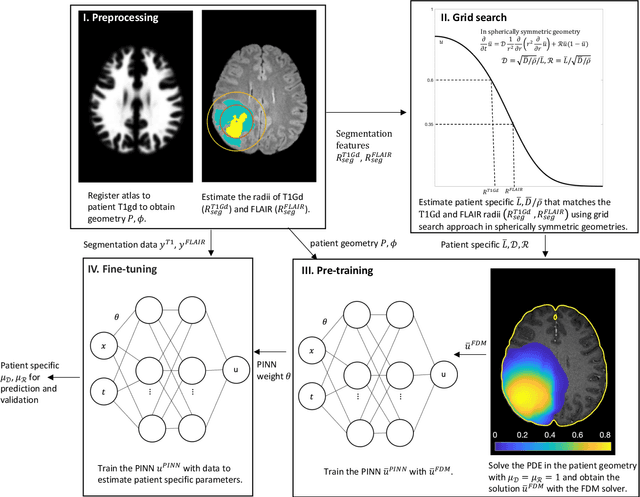

Predicting the infiltration of Glioblastoma (GBM) from medical MRI scans is crucial for understanding tumor growth dynamics and designing personalized radiotherapy treatment plans.Mathematical models of GBM growth can complement the data in the prediction of spatial distributions of tumor cells. However, this requires estimating patient-specific parameters of the model from clinical data, which is a challenging inverse problem due to limited temporal data and the limited time between imaging and diagnosis. This work proposes a method that uses Physics-Informed Neural Networks (PINNs) to estimate patient-specific parameters of a reaction-diffusion PDE model of GBM growth from a single 3D structural MRI snapshot. PINNs embed both the data and the PDE into a loss function, thus integrating theory and data. Key innovations include the identification and estimation of characteristic non-dimensional parameters, a pre-training step that utilizes the non-dimensional parameters and a fine-tuning step to determine the patient specific parameters. Additionally, the diffuse domain method is employed to handle the complex brain geometry within the PINN framework. Our method is validated both on synthetic and patient datasets, and shows promise for real-time parametric inference in the clinical setting for personalized GBM treatment.