 Add to Chrome
 Add to Firefox
 Add to Edge
KVAE: Family of Tokenizers for Multimodal Generative Models
Aug 06, 2026
Latent diffusion modeling (LDM), a prominent paradigm, utilizes tokenizers to map input signal to compressed representation. This dependency positions tokenizer as an integral part of generation process itself, since it affects learning speed, quality of synthesized samples and lay foundation for later applications. This report presents series of KVAE tokenizers for audio, image and video, all designed for subsequent text-conditioned generation: KVAE-Audio, a continuous full-band 48 kHz tokenizer with a 50 Hz latent of 64 channels; KVAE-3D -- two causal video tokenizers for 4x16x16 and 4x8x8 compression; KVAE-2D, an image model, compressing input by factor of 8 with 32 channels. We demonstrate that reconstruction (PSNR, LPIPS, PESQ, etc.) and generation results on objective (Frechet Distance, CLIP score, CLAP score, etc.) and subjective (side-by-side evaluation) metrics matches or surpasses frontier opensource tokenizers, such as VAEs from Wan-2.2, HunyuanVideo-1.5, FLUX.2, MovieGen, StableAudio and MMAudio. Considering difficulty of development, we share with community training details, model selection method and ablation on design choices. The code is publicly available at https://github.com/kandinskylab/kvae and https://github.com/kandinskylab/kvae-audio.

Kandinsky 5.0: A Family of Foundation Models for Image and Video Generation
Nov 19, 2025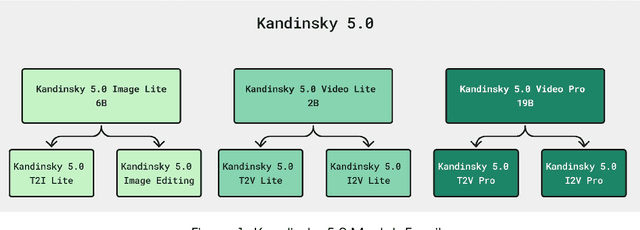
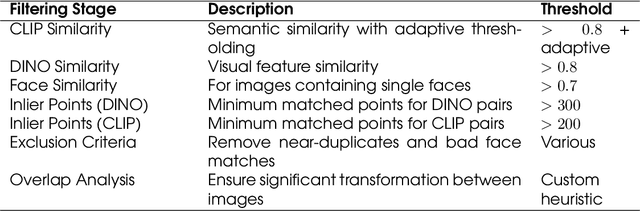
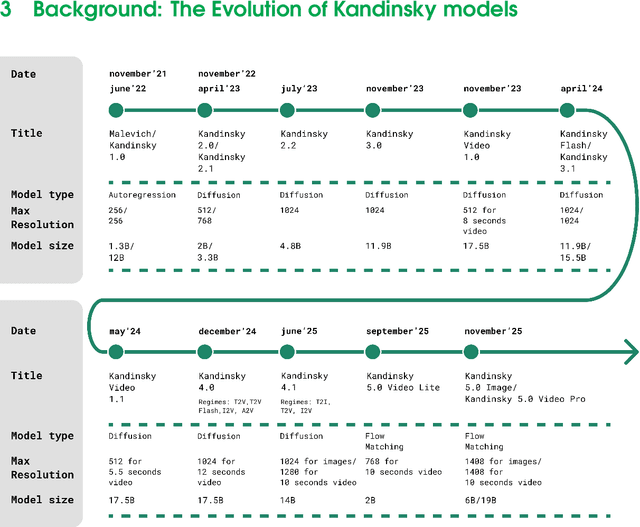
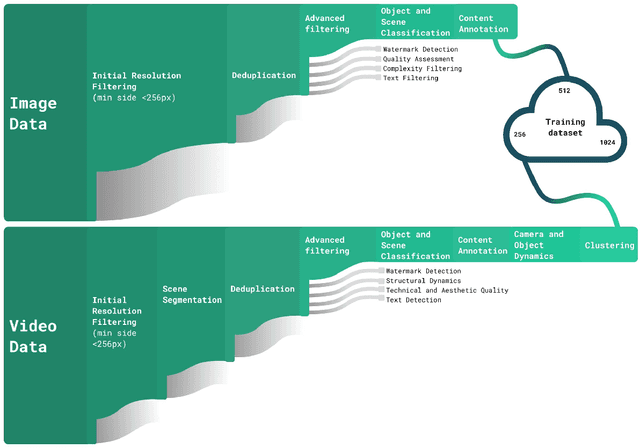
This report introduces Kandinsky 5.0, a family of state-of-the-art foundation models for high-resolution image and 10-second video synthesis. The framework comprises three core line-up of models: Kandinsky 5.0 Image Lite - a line-up of 6B parameter image generation models, Kandinsky 5.0 Video Lite - a fast and lightweight 2B parameter text-to-video and image-to-video models, and Kandinsky 5.0 Video Pro - 19B parameter models that achieves superior video generation quality. We provide a comprehensive review of the data curation lifecycle - including collection, processing, filtering and clustering - for the multi-stage training pipeline that involves extensive pre-training and incorporates quality-enhancement techniques such as self-supervised fine-tuning (SFT) and reinforcement learning (RL)-based post-training. We also present novel architectural, training, and inference optimizations that enable Kandinsky 5.0 to achieve high generation speeds and state-of-the-art performance across various tasks, as demonstrated by human evaluation. As a large-scale, publicly available generative framework, Kandinsky 5.0 leverages the full potential of its pre-training and subsequent stages to be adapted for a wide range of generative applications. We hope that this report, together with the release of our open-source code and training checkpoints, will substantially advance the development and accessibility of high-quality generative models for the research community.