 Add to Chrome
 Add to Firefox
 Add to Edge
Fast Asymptotically Optimal Kinodynamic Planning via Vectorization
Jul 04, 2026
Sampling-based motion planners have been shown to be effective for systems with complex kinodynamic constraints and high dimensionality. However, these algorithms struggle to achieve real-time performance, leading to recent efforts to parallelize planning. While GPU-accelerated planners have achieved significant speedups, existing approaches require specialized CUDA programming that limits accessibility and portability. We present Parallel Asymptotically Optimal Kinodynamic RRT (PAKR), a massively parallel kinodynamic planner leveraging JAX and the XLA compiler to achieve GPU acceleration through standard Python tooling. By combining our parallel planner with the AO-x meta-algorithm, we achieve asymptotic optimality through fast iterative replanning. We provide a theoretical analysis of probabilistic completeness, analyze the effects of batch size and branching factor on convergence, and demonstrate scalability to complex dynamics using the MuJoCo-XLA simulator. Experiments show competitive runtimes with state-of-the-art GPU planners and superior solution quality.

Vibe Spaces for Creatively Connecting and Expressing Visual Concepts
Dec 16, 2025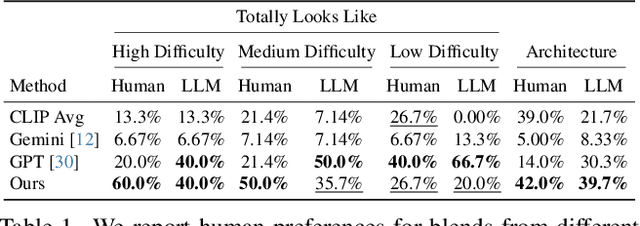
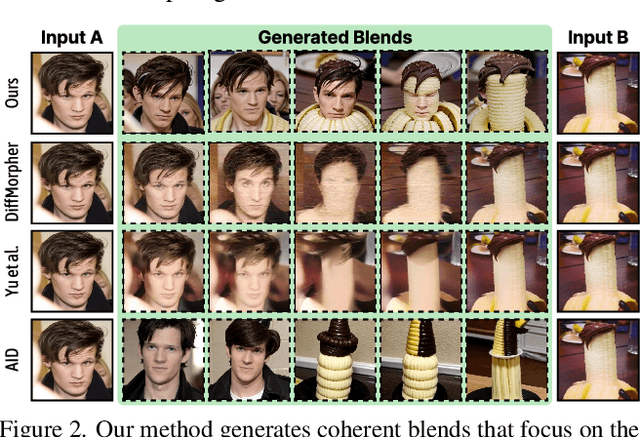
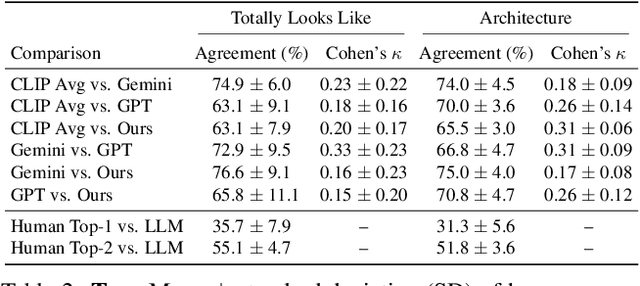
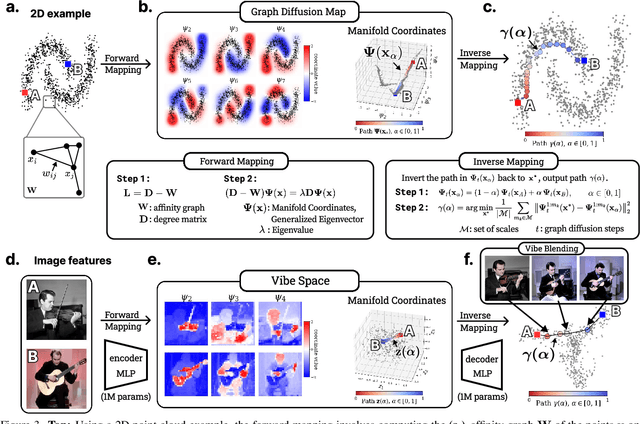
Creating new visual concepts often requires connecting distinct ideas through their most relevant shared attributes -- their vibe. We introduce Vibe Blending, a novel task for generating coherent and meaningful hybrids that reveals these shared attributes between images. Achieving such blends is challenging for current methods, which struggle to identify and traverse nonlinear paths linking distant concepts in latent space. We propose Vibe Space, a hierarchical graph manifold that learns low-dimensional geodesics in feature spaces like CLIP, enabling smooth and semantically consistent transitions between concepts. To evaluate creative quality, we design a cognitively inspired framework combining human judgments, LLM reasoning, and a geometric path-based difficulty score. We find that Vibe Space produces blends that humans consistently rate as more creative and coherent than current methods.
In Defense of Structural Symbolic Representation for Video Event-Relation Prediction
Jan 06, 2023Understanding event relationships in videos requires a model to understand the underlying structures of events, i.e., the event type, the associated argument roles, and corresponding entities) along with factual knowledge needed for reasoning. Structural symbolic representation (SSR) based methods directly take event types and associated argument roles/entities as inputs to perform reasoning. However, the state-of-the-art video event-relation prediction system shows the necessity of using continuous feature vectors from input videos; existing methods based solely on SSR inputs fail completely, event when given oracle event types and argument roles. In this paper, we conduct an extensive empirical analysis to answer the following questions: 1) why SSR-based method failed; 2) how to understand the evaluation setting of video event relation prediction properly; 3) how to uncover the potential of SSR-based methods. We first identify the failure of previous SSR-based video event prediction models to be caused by sub-optimal training settings. Surprisingly, we find that a simple SSR-based model with tuned hyperparameters can actually yield a 20\% absolute improvement in macro-accuracy over the state-of-the-art model. Then through qualitative and quantitative analysis, we show how evaluation that takes only video as inputs is currently unfeasible, and the reliance on oracle event information to obtain an accurate evaluation. Based on these findings, we propose to further contextualize the SSR-based model to an Event-Sequence Model and equip it with more factual knowledge through a simple yet effective way of reformulating external visual commonsense knowledge bases into an event-relation prediction pretraining dataset. The resultant new state-of-the-art model eventually establishes a 25\% Macro-accuracy performance boost.