 Add to Chrome
 Add to Firefox
 Add to Edge
Vibe Spaces for Creatively Connecting and Expressing Visual Concepts
Dec 16, 2025
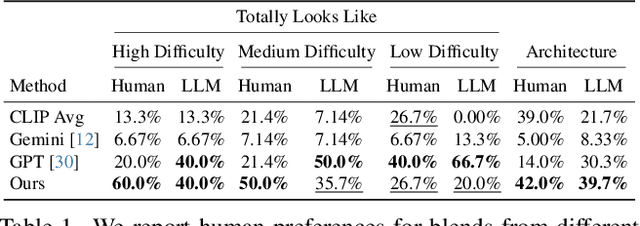
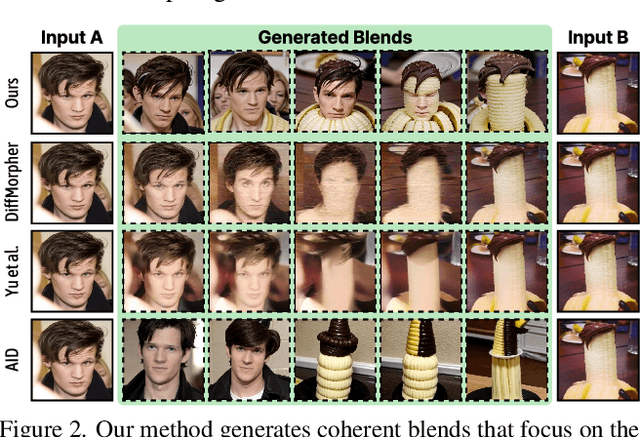
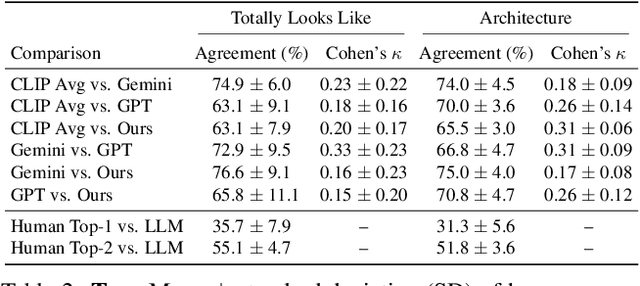
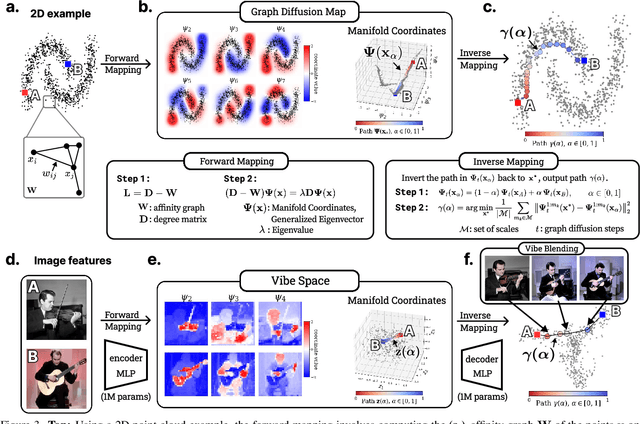
Creating new visual concepts often requires connecting distinct ideas through their most relevant shared attributes -- their vibe. We introduce Vibe Blending, a novel task for generating coherent and meaningful hybrids that reveals these shared attributes between images. Achieving such blends is challenging for current methods, which struggle to identify and traverse nonlinear paths linking distant concepts in latent space. We propose Vibe Space, a hierarchical graph manifold that learns low-dimensional geodesics in feature spaces like CLIP, enabling smooth and semantically consistent transitions between concepts. To evaluate creative quality, we design a cognitively inspired framework combining human judgments, LLM reasoning, and a geometric path-based difficulty score. We find that Vibe Space produces blends that humans consistently rate as more creative and coherent than current methods.

"I Know It When I See It": Mood Spaces for Connecting and Expressing Visual Concepts
Apr 21, 2025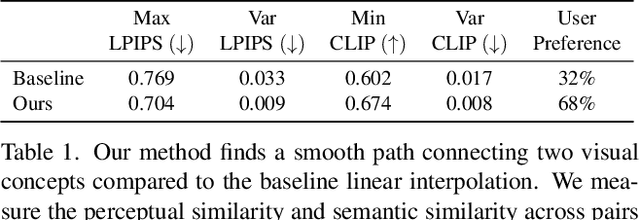
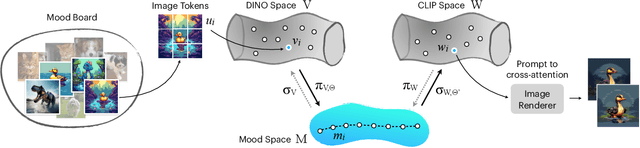
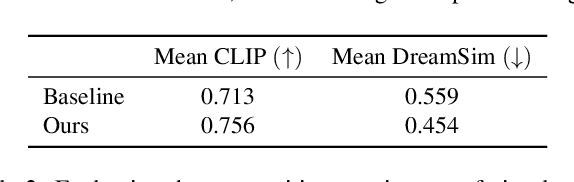
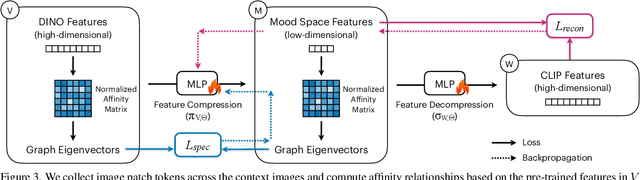
Expressing complex concepts is easy when they can be labeled or quantified, but many ideas are hard to define yet instantly recognizable. We propose a Mood Board, where users convey abstract concepts with examples that hint at the intended direction of attribute changes. We compute an underlying Mood Space that 1) factors out irrelevant features and 2) finds the connections between images, thus bringing relevant concepts closer. We invent a fibration computation to compress/decompress pre-trained features into/from a compact space, 50-100x smaller. The main innovation is learning to mimic the pairwise affinity relationship of the image tokens across exemplars. To focus on the coarse-to-fine hierarchical structures in the Mood Space, we compute the top eigenvector structure from the affinity matrix and define a loss in the eigenvector space. The resulting Mood Space is locally linear and compact, allowing image-level operations, such as object averaging, visual analogy, and pose transfer, to be performed as a simple vector operation in Mood Space. Our learning is efficient in computation without any fine-tuning, needs only a few (2-20) exemplars, and takes less than a minute to learn.