 Add to Chrome
 Add to Firefox
 Add to Edge
Enhanced Neural Video Representation Compression across Extreme Complexity and Quality Scales
Jun 26, 2026
Implicit neural representations (INRs) have recently emerged as a promising approach to video compression, delivering competitive rate-distortion performance alongside rapid decoding. However, existing neural video codecs struggle to balance complexity and scalability. Lightweight models often suffer from degraded compression performance when scaled to different bitrate/quality levels, whereas high-performance models exhibit limited scalability, as their model complexity typically increases with quality. This lack of a unified architecture capable of maintaining consistent complexity across a wide range of bitrates severely limits their diverse real-world deployment. To address these challenges, we introduce NVRC++, a novel INR-based video codec that utilizes a lightweight INR with multiple high-resolution feature grids, providing high scalability at any given complexity level. This is paired with an optimization framework that enables efficient overfitting on high-resolution grids for long video sequences, thereby exploiting spatio-temporal redundancies without prohibitive computational or memory overhead. Additionally, an advanced entropy model is designed for efficiently compressing the high-dimensional grid parameters. As a result, NVRC++ provides four complexity levels (from 7kMACs/pixel to 360kMACs/pixel), each spanning wide bitrate and quality ranges while supporting real-time decoding. The experimental results show that NVRC++ offers a much faster decoding speed (up to 7.6x) compared to the SOTA INR-based video codec, NVRC, while delivering comparable performance.

NVRC: Neural Video Representation Compression
Sep 11, 2024Recent advances in implicit neural representation (INR)-based video coding have demonstrated its potential to compete with both conventional and other learning-based approaches. With INR methods, a neural network is trained to overfit a video sequence, with its parameters compressed to obtain a compact representation of the video content. However, although promising results have been achieved, the best INR-based methods are still out-performed by the latest standard codecs, such as VVC VTM, partially due to the simple model compression techniques employed. In this paper, rather than focusing on representation architectures as in many existing works, we propose a novel INR-based video compression framework, Neural Video Representation Compression (NVRC), targeting compression of the representation. Based on the novel entropy coding and quantization models proposed, NVRC, for the first time, is able to optimize an INR-based video codec in a fully end-to-end manner. To further minimize the additional bitrate overhead introduced by the entropy models, we have also proposed a new model compression framework for coding all the network, quantization and entropy model parameters hierarchically. Our experiments show that NVRC outperforms many conventional and learning-based benchmark codecs, with a 24% average coding gain over VVC VTM (Random Access) on the UVG dataset, measured in PSNR. As far as we are aware, this is the first time an INR-based video codec achieving such performance. The implementation of NVRC will be released at www.github.com.
Immersive Video Compression using Implicit Neural Representations
Feb 02, 2024Recent work on implicit neural representations (INRs) has evidenced their potential for efficiently representing and encoding conventional video content. In this paper we, for the first time, extend their application to immersive (multi-view) videos, by proposing MV-HiNeRV, a new INR-based immersive video codec. MV-HiNeRV is an enhanced version of a state-of-the-art INR-based video codec, HiNeRV, which was developed for single-view video compression. We have modified the model to learn a different group of feature grids for each view, and share the learnt network parameters among all views. This enables the model to effectively exploit the spatio-temporal and the inter-view redundancy that exists within multi-view videos. The proposed codec was used to compress multi-view texture and depth video sequences in the MPEG Immersive Video (MIV) Common Test Conditions, and tested against the MIV Test model (TMIV) that uses the VVenC video codec. The results demonstrate the superior performance of MV-HiNeRV, with significant coding gains (up to 72.33%) over TMIV. The implementation of MV-HiNeRV will be published for further development and evaluation.
HiNeRV: Video Compression with Hierarchical Encoding based Neural Representation
Jun 16, 2023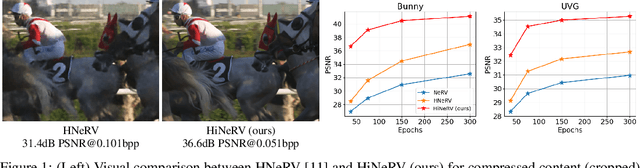
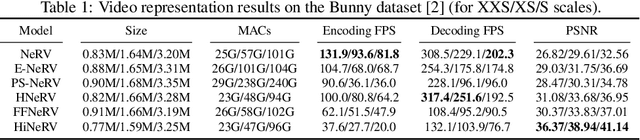
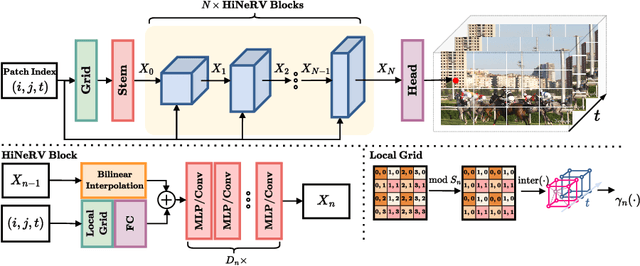
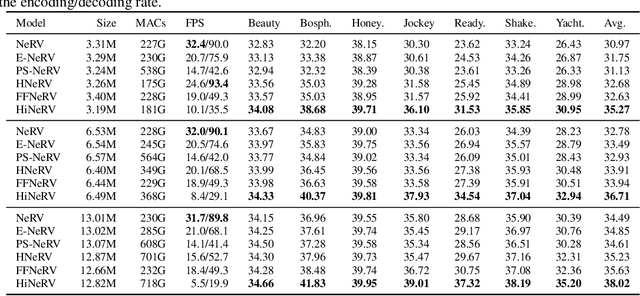
Learning-based video compression is currently one of the most popular research topics, offering the potential to compete with conventional standard video codecs. In this context, Implicit Neural Representations (INRs) have previously been used to represent and compress image and video content, demonstrating relatively high decoding speed compared to other methods. However, existing INR-based methods have failed to deliver rate quality performance comparable with the state of the art in video compression. This is mainly due to the simplicity of the employed network architectures, which limit their representation capability. In this paper, we propose HiNeRV, an INR that combines bilinear interpolation with novel hierarchical positional encoding. This structure employs depth-wise convolutional and MLP layers to build a deep and wide network architecture with much higher capacity. We further build a video codec based on HiNeRV and a refined pipeline for training, pruning and quantization that can better preserve HiNeRV's performance during lossy model compression. The proposed method has been evaluated on both UVG and MCL-JCV datasets for video compression, demonstrating significant improvement over all existing INRs baselines and competitive performance when compared to learning-based codecs (72.3% overall bit rate saving over HNeRV and 43.4% over DCVC on the UVG dataset, measured in PSNR).