 Add to Chrome
 Add to Firefox
 Add to Edge
Graph Attention Networks with Physical Constraints for Anomaly Detection
Jan 18, 2026
Water distribution systems (WDSs) face increasing cyber-physical risks, which make reliable anomaly detection essential. Many data-driven models ignore network topology and are hard to interpret, while model-based ones depend strongly on parameter accuracy. This work proposes a hydraulic-aware graph attention network using normalized conservation law violations as features. It combines mass and energy balance residuals with graph attention and bidirectional LSTM to learn spatio-temporal patterns. A multi-scale module aggregates detection scores from node to network level. On the BATADAL dataset, it reaches $F1=0.979$, showing $3.3$pp gain and high robustness under $15\%$ parameter noise.

Conformal Prediction-Driven Adaptive Sampling for Digital Twins of Water Distribution Networks
Nov 06, 2025Digital Twins (DTs) for Water Distribution Networks (WDNs) require accurate state estimation with limited sensors. Uniform sampling often wastes resources across nodes with different uncertainty. We propose an adaptive framework combining LSTM forecasting and Conformal Prediction (CP) to estimate node-wise uncertainty and focus sensing on the most uncertain points. Marginal CP is used for its low computational cost, suitable for real-time DTs. Experiments on Hanoi, Net3, and CTOWN show 33-34% lower demand error than uniform sampling at 40% coverage and maintain 89.4-90.2% empirical coverage with only 5-10% extra computation.
The Dark Side of Digital Twins: Adversarial Attacks on AI-Driven Water Forecasting
Apr 28, 2025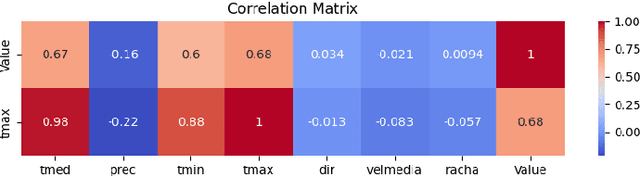
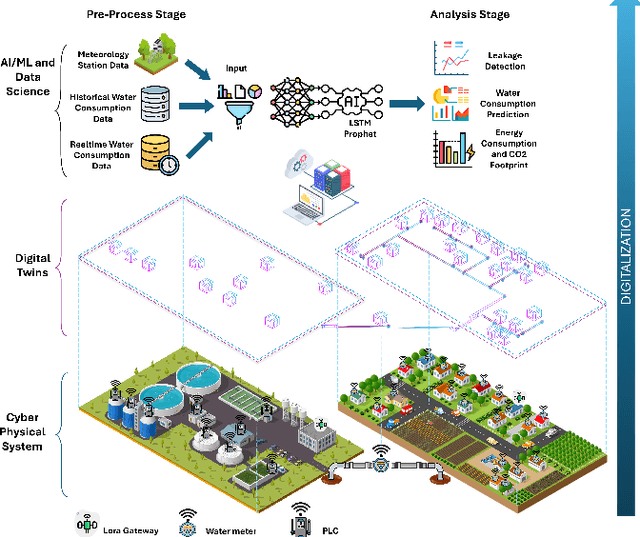
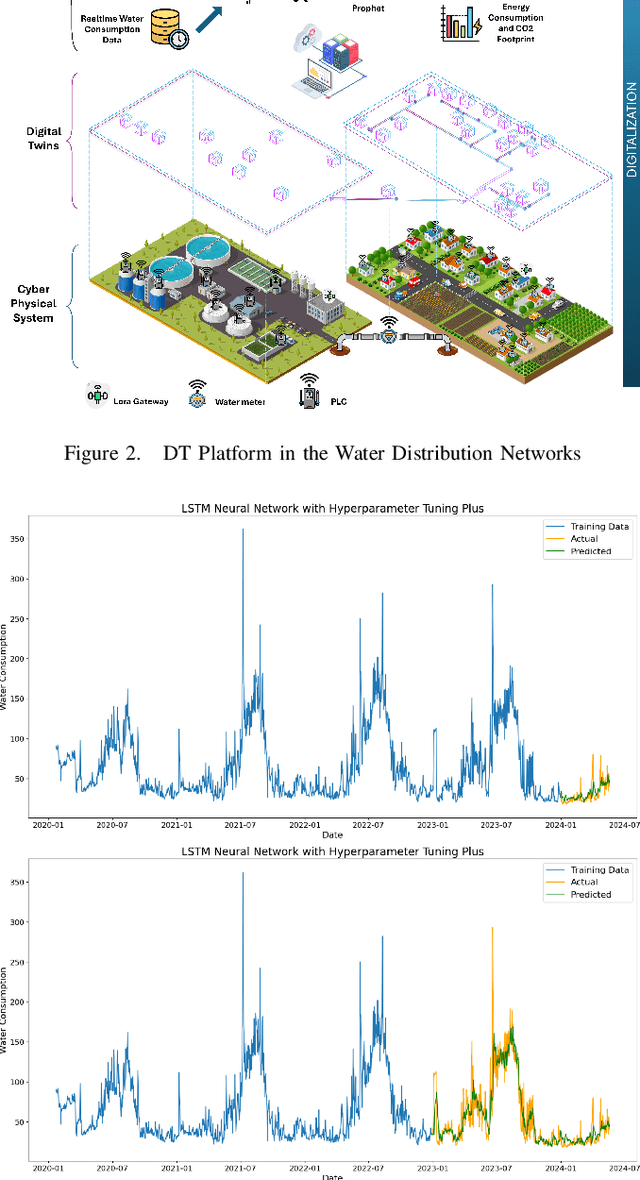
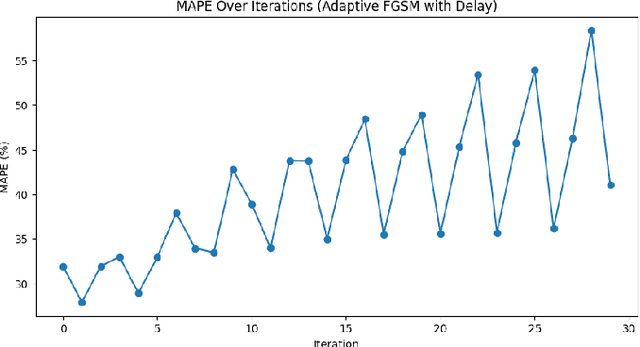
Digital twins (DTs) are improving water distribution systems by using real-time data, analytics, and prediction models to optimize operations. This paper presents a DT platform designed for a Spanish water supply network, utilizing Long Short-Term Memory (LSTM) networks to predict water consumption. However, machine learning models are vulnerable to adversarial attacks, such as the Fast Gradient Sign Method (FGSM) and Projected Gradient Descent (PGD). These attacks manipulate critical model parameters, injecting subtle distortions that degrade forecasting accuracy. To further exploit these vulnerabilities, we introduce a Learning Automata (LA) and Random LA-based approach that dynamically adjusts perturbations, making adversarial attacks more difficult to detect. Experimental results show that this approach significantly impacts prediction reliability, causing the Mean Absolute Percentage Error (MAPE) to rise from 26% to over 35%. Moreover, adaptive attack strategies amplify this effect, highlighting cybersecurity risks in AI-driven DTs. These findings emphasize the urgent need for robust defenses, including adversarial training, anomaly detection, and secure data pipelines.
Smart Water Security with AI and Blockchain-Enhanced Digital Twins
Apr 28, 2025Water distribution systems in rural areas face serious challenges such as a lack of real-time monitoring, vulnerability to cyberattacks, and unreliable data handling. This paper presents an integrated framework that combines LoRaWAN-based data acquisition, a machine learning-driven Intrusion Detection System (IDS), and a blockchain-enabled Digital Twin (BC-DT) platform for secure and transparent water management. The IDS filters anomalous or spoofed data using a Long Short-Term Memory (LSTM) Autoencoder and Isolation Forest before validated data is logged via smart contracts on a private Ethereum blockchain using Proof of Authority (PoA) consensus. The verified data feeds into a real-time DT model supporting leak detection, consumption forecasting, and predictive maintenance. Experimental results demonstrate that the system achieves over 80 transactions per second (TPS) with under 2 seconds of latency while remaining cost-effective and scalable for up to 1,000 smart meters. This work demonstrates a practical and secure architecture for decentralized water infrastructure in under-connected rural environments.