 Add to Chrome
 Add to Firefox
 Add to Edge
Symphony for Medical Coding: A Next-Generation Agentic System for Scalable and Explainable Medical Coding
Mar 31, 2026
Medical coding translates free-text clinical documentation into standardized codes drawn from classification systems that contain tens of thousands of entries and are updated annually. It is central to billing, clinical research, and quality reporting, yet remains largely manual, slow, and error-prone. Existing automated approaches learn to predict a fixed set of codes from labeled data, thereby preventing adaptation to new codes or different coding systems without retraining on different data. They also provide no explanation for their predictions, limiting trust in safety-critical settings. We introduce Symphony for Medical Coding, a system that approaches the task the way expert human coders do: by reasoning over the clinical narrative with direct access to the coding guidelines. This design allows Symphony to operate across any coding system and to provide span-level evidence linking each predicted code to the text that supports it. We evaluate on two public benchmarks and three real-world datasets spanning inpatient, outpatient, emergency, and subspecialty settings across the United States and the United Kingdom. Symphony achieves state-of-the-art results across all settings, establishing itself as a flexible, deployment-ready foundation for automated clinical coding.

FactsR: A Safer Method for Producing High Quality Healthcare Documentation
May 15, 2025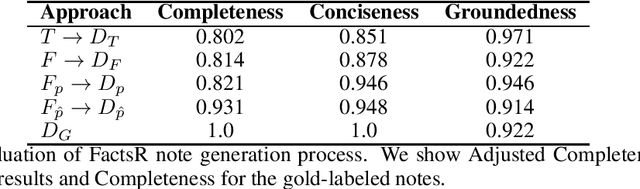
There are now a multitude of AI-scribing solutions for healthcare promising the utilization of large language models for ambient documentation. However, these AI scribes still rely on one-shot, or few-shot prompts for generating notes after the consultation has ended, employing little to no reasoning. This risks long notes with an increase in hallucinations, misrepresentation of the intent of the clinician, and reliance on the proofreading of the clinician to catch errors. A dangerous combination for patient safety if vigilance is compromised by workload and fatigue. In this paper, we introduce a method for extracting salient clinical information in real-time alongside the healthcare consultation, denoted Facts, and use that information recursively to generate the final note. The FactsR method results in more accurate and concise notes by placing the clinician-in-the-loop of note generation, while opening up new use cases within real-time decision support.