 Add to Chrome
 Add to Firefox
 Add to Edge
Multi-Modal Cognitive Maps based on Neural Networks trained on Successor Representations
Dec 22, 2023
Cognitive maps are a proposed concept on how the brain efficiently organizes memories and retrieves context out of them. The entorhinal-hippocampal complex is heavily involved in episodic and relational memory processing, as well as spatial navigation and is thought to built cognitive maps via place and grid cells. To make use of the promising properties of cognitive maps, we set up a multi-modal neural network using successor representations which is able to model place cell dynamics and cognitive map representations. Here, we use multi-modal inputs consisting of images and word embeddings. The network learns the similarities between novel inputs and the training database and therefore the representation of the cognitive map successfully. Subsequently, the prediction of the network can be used to infer from one modality to another with over $90\%$ accuracy. The proposed method could therefore be a building block to improve current AI systems for better understanding of the environment and the different modalities in which objects appear. The association of specific modalities with certain encounters can therefore lead to context awareness in novel situations when similar encounters with less information occur and additional information can be inferred from the learned cognitive map. Cognitive maps, as represented by the entorhinal-hippocampal complex in the brain, organize and retrieve context from memories, suggesting that large language models (LLMs) like ChatGPT could harness similar architectures to function as a high-level processing center, akin to how the hippocampus operates within the cortex hierarchy. Finally, by utilizing multi-modal inputs, LLMs can potentially bridge the gap between different forms of data (like images and words), paving the way for context-awareness and grounding of abstract concepts through learned associations, addressing the grounding problem in AI.

OCTDL: Optical Coherence Tomography Dataset for Image-Based Deep Learning Methods
Dec 13, 2023Optical coherence tomography (OCT) is a non-invasive imaging technique with extensive clinical applications in ophthalmology. OCT enables the visualization of the retinal layers, playing a vital role in the early detection and monitoring of retinal diseases. OCT uses the principle of light wave interference to create detailed images of the retinal microstructures, making it a valuable tool for diagnosing ocular conditions. This work presents an open-access OCT dataset (OCTDL) comprising over 1600 high-resolution OCT images labeled according to disease group and retinal pathology. The dataset consists of OCT records of patients with Age-related Macular Degeneration (AMD), Diabetic Macular Edema (DME), Epiretinal Membrane (ERM), Retinal Artery Occlusion (RAO), Retinal Vein Occlusion (RVO), and Vitreomacular Interface Disease (VID). The images were acquired with an Optovue Avanti RTVue XR using raster scanning protocols with dynamic scan length and image resolution. Each retinal b-scan was acquired by centering on the fovea and interpreted and cataloged by an experienced retinal specialist. In this work, we applied Deep Learning classification techniques to this new open-access dataset.
SniffyArt: The Dataset of Smelling Persons
Nov 20, 2023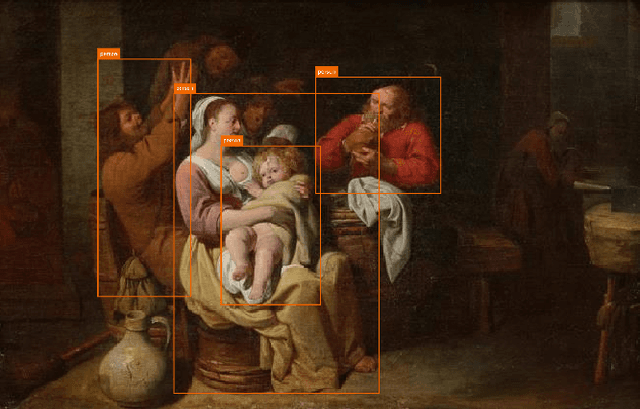
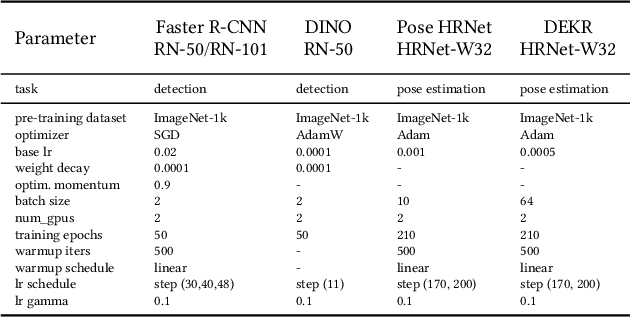
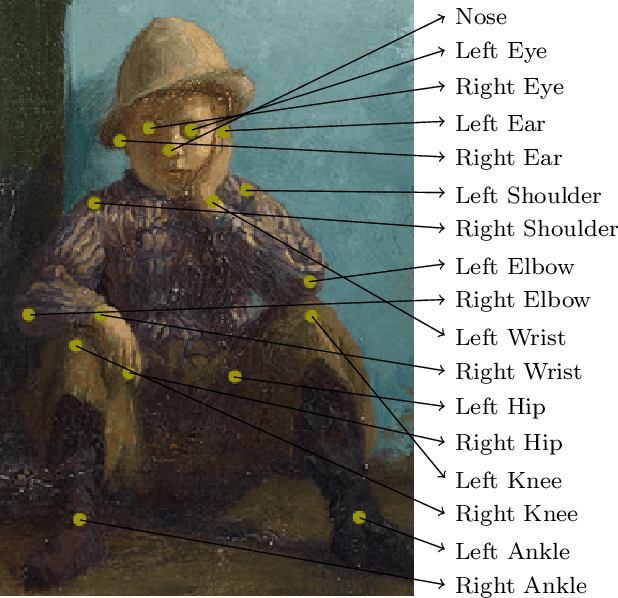

Smell gestures play a crucial role in the investigation of past smells in the visual arts yet their automated recognition poses significant challenges. This paper introduces the SniffyArt dataset, consisting of 1941 individuals represented in 441 historical artworks. Each person is annotated with a tightly fitting bounding box, 17 pose keypoints, and a gesture label. By integrating these annotations, the dataset enables the development of hybrid classification approaches for smell gesture recognition. The datasets high-quality human pose estimation keypoints are achieved through the merging of five separate sets of keypoint annotations per person. The paper also presents a baseline analysis, evaluating the performance of representative algorithms for detection, keypoint estimation, and classification tasks, showcasing the potential of combining keypoint estimation with smell gesture classification. The SniffyArt dataset lays a solid foundation for future research and the exploration of multi-task approaches leveraging pose keypoints and person boxes to advance human gesture and olfactory dimension analysis in historical artworks.
* 10 pages, 8 figures
A Survey of Incremental Transfer Learning: Combining Peer-to-Peer Federated Learning and Domain Incremental Learning for Multicenter Collaboration
Sep 29, 2023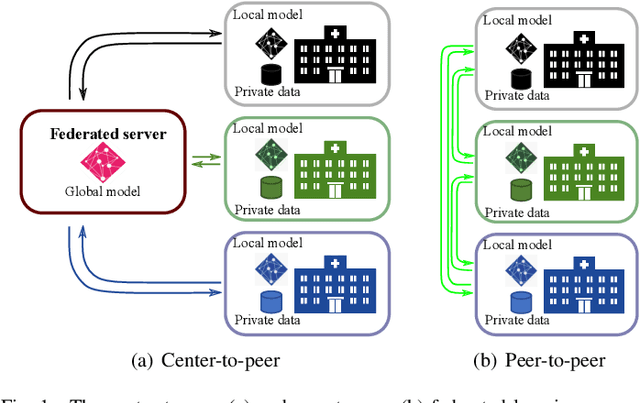
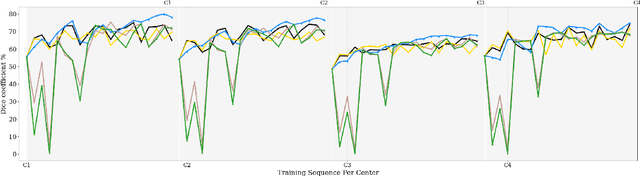

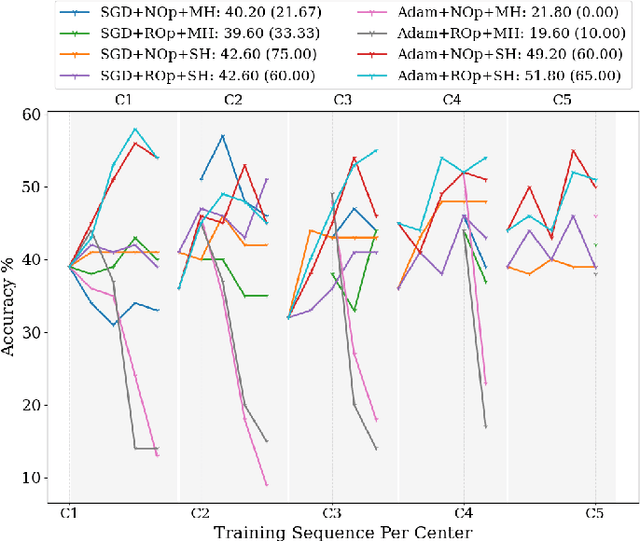
Due to data privacy constraints, data sharing among multiple clinical centers is restricted, which impedes the development of high performance deep learning models from multicenter collaboration. Naive weight transfer methods share intermediate model weights without raw data and hence can bypass data privacy restrictions. However, performance drops are typically observed when the model is transferred from one center to the next because of the forgetting problem. Incremental transfer learning, which combines peer-to-peer federated learning and domain incremental learning, can overcome the data privacy issue and meanwhile preserve model performance by using continual learning techniques. In this work, a conventional domain/task incremental learning framework is adapted for incremental transfer learning. A comprehensive survey on the efficacy of different regularization-based continual learning methods for multicenter collaboration is performed. The influences of data heterogeneity, classifier head setting, network optimizer, model initialization, center order, and weight transfer type have been investigated thoroughly. Our framework is publicly accessible to the research community for further development.
Conceptual Cognitive Maps Formation with Neural Successor Networks and Word Embeddings
Jul 04, 2023The human brain possesses the extraordinary capability to contextualize the information it receives from our environment. The entorhinal-hippocampal plays a critical role in this function, as it is deeply engaged in memory processing and constructing cognitive maps using place and grid cells. Comprehending and leveraging this ability could significantly augment the field of artificial intelligence. The multi-scale successor representation serves as a good model for the functionality of place and grid cells and has already shown promise in this role. Here, we introduce a model that employs successor representations and neural networks, along with word embedding vectors, to construct a cognitive map of three separate concepts. The network adeptly learns two different scaled maps and situates new information in proximity to related pre-existing representations. The dispersion of information across the cognitive map varies according to its scale - either being heavily concentrated, resulting in the formation of the three concepts, or spread evenly throughout the map. We suggest that our model could potentially improve current AI models by providing multi-modal context information to any input, based on a similarity metric for the input and pre-existing knowledge representations.
Deep Learning for Cancer Prognosis Prediction Using Portrait Photos by StyleGAN Embedding
Jun 28, 2023

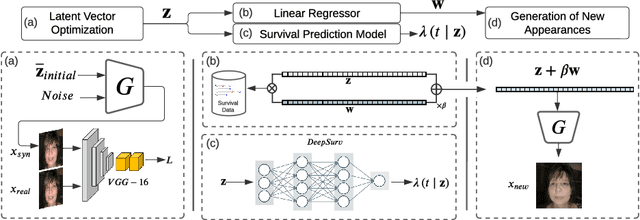
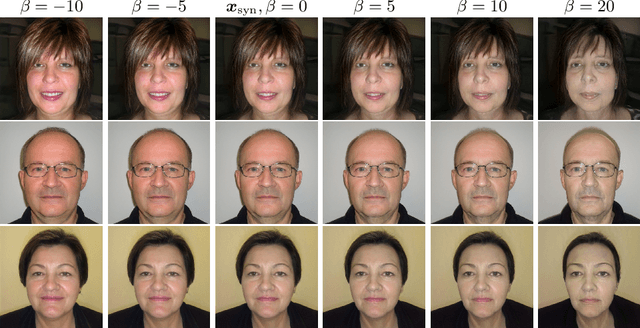
Survival prediction for cancer patients is critical for optimal treatment selection and patient management. Current patient survival prediction methods typically extract survival information from patients' clinical record data or biological and imaging data. In practice, experienced clinicians can have a preliminary assessment of patients' health status based on patients' observable physical appearances, which are mainly facial features. However, such assessment is highly subjective. In this work, the efficacy of objectively capturing and using prognostic information contained in conventional portrait photographs using deep learning for survival predication purposes is investigated for the first time. A pre-trained StyleGAN2 model is fine-tuned on a custom dataset of our cancer patients' photos to empower its generator with generative ability suitable for patients' photos. The StyleGAN2 is then used to embed the photographs to its highly expressive latent space. Utilizing the state-of-the-art survival analysis models and based on StyleGAN's latent space photo embeddings, this approach achieved a C-index of 0.677, which is notably higher than chance and evidencing the prognostic value embedded in simple 2D facial images. In addition, thanks to StyleGAN's interpretable latent space, our survival prediction model can be validated for relying on essential facial features, eliminating any biases from extraneous information like clothing or background. Moreover, a health attribute is obtained from regression coefficients, which has important potential value for patient care.
A Vessel-Segmentation-Based CycleGAN for Unpaired Multi-modal Retinal Image Synthesis
Jun 05, 2023Unpaired image-to-image translation of retinal images can efficiently increase the training dataset for deep-learning-based multi-modal retinal registration methods. Our method integrates a vessel segmentation network into the image-to-image translation task by extending the CycleGAN framework. The segmentation network is inserted prior to a UNet vision transformer generator network and serves as a shared representation between both domains. We reformulate the original identity loss to learn the direct mapping between the vessel segmentation and the real image. Additionally, we add a segmentation loss term to ensure shared vessel locations between fake and real images. In the experiments, our method shows a visually realistic look and preserves the vessel structures, which is a prerequisite for generating multi-modal training data for image registration.
* Accepted to BVM 2023
Federated learning for secure development of AI models for Parkinson's disease detection using speech from different languages
May 18, 2023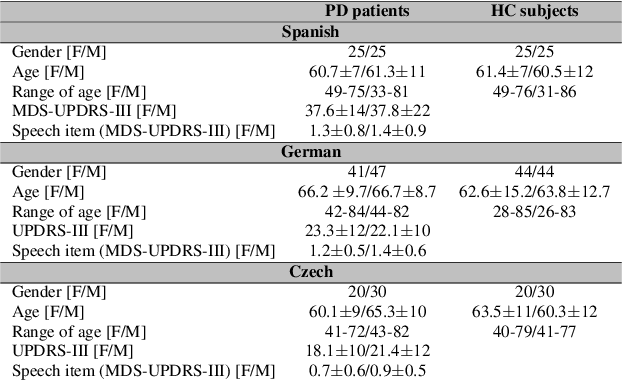
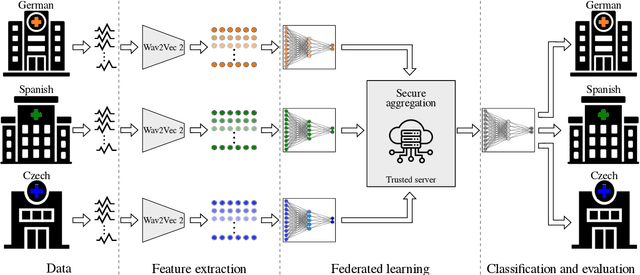
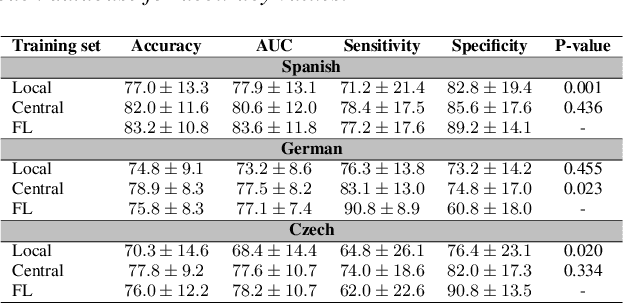
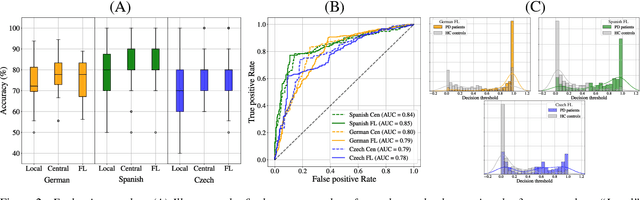
Parkinson's disease (PD) is a neurological disorder impacting a person's speech. Among automatic PD assessment methods, deep learning models have gained particular interest. Recently, the community has explored cross-pathology and cross-language models which can improve diagnostic accuracy even further. However, strict patient data privacy regulations largely prevent institutions from sharing patient speech data with each other. In this paper, we employ federated learning (FL) for PD detection using speech signals from 3 real-world language corpora of German, Spanish, and Czech, each from a separate institution. Our results indicate that the FL model outperforms all the local models in terms of diagnostic accuracy, while not performing very differently from the model based on centrally combined training sets, with the advantage of not requiring any data sharing among collaborators. This will simplify inter-institutional collaborations, resulting in enhancement of patient outcomes.
Deep Multi-Frame Filtering for Hearing Aids
May 14, 2023Multi-frame algorithms for single-channel speech enhancement are able to take advantage from short-time correlations within the speech signal. Deep filtering (DF) recently demonstrated its capabilities for low-latency scenarios like hearing aids with its complex multi-frame (MF) filter. Alternatively, the complex filter can be estimated via an MF minimum variance distortionless response (MVDR), or MF Wiener filter (WF). Previous studies have shown that incorporating algorithm domain knowledge using an MVDR filter might be beneficial compared to the direct filter estimation via DF. In this work, we compare the usage of various multi-frame filters such as DF, MF-MVDR, or MF-WF for HAs. We assess different covariance estimation methods for both MF-MVDR and MF-WF and objectively demonstrate an improved performance compared to direct DF estimation, significantly outperforming related work while improving the runtime performance.
DeepFilterNet: Perceptually Motivated Real-Time Speech Enhancement
May 14, 2023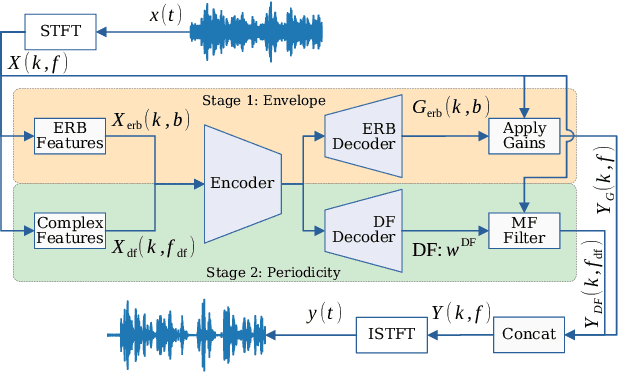
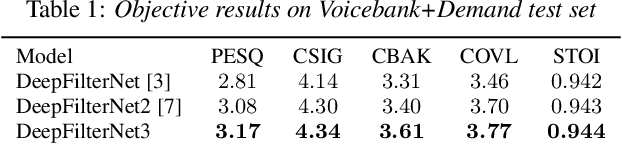
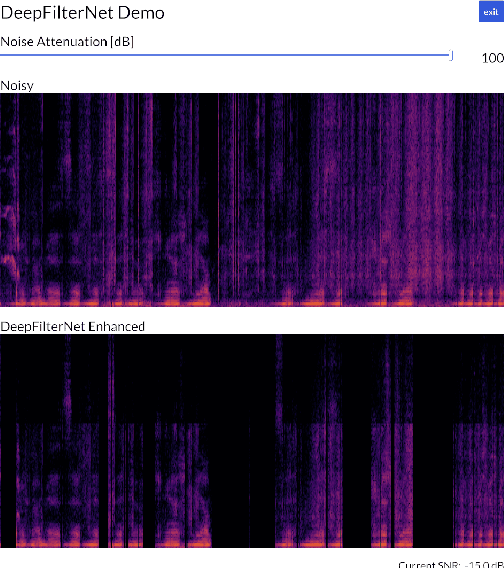
Multi-frame algorithms for single-channel speech enhancement are able to take advantage from short-time correlations within the speech signal. Deep Filtering (DF) was proposed to directly estimate a complex filter in frequency domain to take advantage of these correlations. In this work, we present a real-time speech enhancement demo using DeepFilterNet. DeepFilterNet's efficiency is enabled by exploiting domain knowledge of speech production and psychoacoustic perception. Our model is able to match state-of-the-art speech enhancement benchmarks while achieving a real-time-factor of 0.19 on a single threaded notebook CPU. The framework as well as pretrained weights have been published under an open source license.