 Add to Chrome
 Add to Firefox
 Add to Edge
Supporting Autonomous Process Execution within a Multi-Perspective Constraint Frame via Numeric Planning
Jul 18, 2026
AI-Augmented Business Process Management Systems (ABPMS) enhance traditional BPMS by leveraging advanced AI techniques to define, execute, and monitor complex process structures. Within this landscape, Framed Autonomy denotes the capability of a system to autonomously advance the execution of a Business Process (BP) instance while strictly adhering to a predefined frame, i.e., a set of constraints that may span multiple perspectives. Existing research on framed autonomy has predominantly focused on control-flow constraints, either declarative or procedural, and typically relies on their transformation into automata-based representations. In this study, we extend this line of work by introducing a novel tool for what-if analysis that augments the process frame with multi-perspective constraints, including data-aware and temporal conditions. Given a partial process execution, the proposed approach exploits this enriched frame to recommend optimal continuations in compliance with the underlying process specifications. We additionally report an empirical evaluation demonstrating the scalability and effectiveness of the technique, thereby highlighting its potential for supporting autonomous and constraint-aware decision making in ABPMS.

Agentic Business Process Management: A Research Manifesto
Mar 19, 2026This paper presents a manifesto that articulates the conceptual foundations of Agentic Business Process Management (APM), an extension of Business Process Management (BPM) for governing autonomous agents executing processes in organizations. From a management perspective, APM represents a paradigm shift from the traditional process view of the business process, driven by the realization of process awareness and an agent-oriented abstraction, where software and human agents act as primary functional entities that perceive, reason, and act within explicit process frames. This perspective marks a shift from traditional, automation-oriented BPM toward systems in which autonomy is constrained, aligned, and made operational through process awareness. We introduce the core abstractions and architectural elements required to realize APM systems and elaborate on four key capabilities that such APM agents must support: framed autonomy, explainability, conversational actionability, and self-modification. These capabilities jointly ensure that agents' goals are aligned with organizational goals and that agents behave in a framed yet proactive manner in pursuing those goals. We discuss the extent to which the capabilities can be realized and identify research challenges whose resolution requires further advances in BPM, AI, and multi-agent systems. The manifesto thus serves as a roadmap for bridging these communities and for guiding the development of APM systems in practice.
Augmented Business Process Management Systems: A Research Manifesto
Feb 03, 2022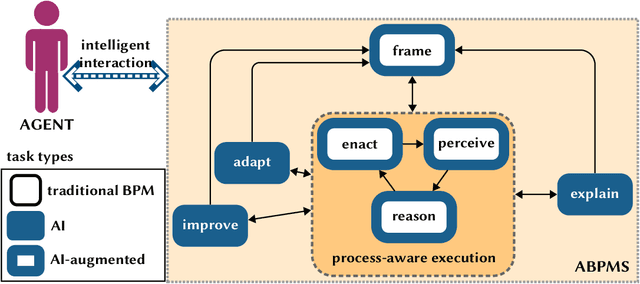
Augmented Business Process Management Systems (ABPMSs) are an emerging class of process-aware information systems that draws upon trustworthy AI technology. An ABPMS enhances the execution of business processes with the aim of making these processes more adaptable, proactive, explainable, and context-sensitive. This manifesto presents a vision for ABPMSs and discusses research challenges that need to be surmounted to realize this vision. To this end, we define the concept of ABPMS, we outline the lifecycle of processes within an ABPMS, we discuss core characteristics of an ABPMS, and we derive a set of challenges to realize systems with these characteristics.
Towards Intelligent Robotic Process Automation for BPMers
Jan 03, 2020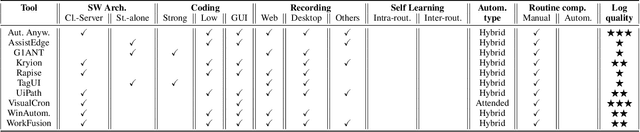
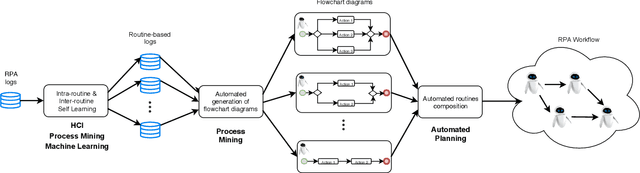
Robotic Process Automation (RPA) is a fast-emerging automation technology that sits between the fields of Business Process Management (BPM) and Artificial Intelligence (AI), and allows organizations to automate high volume routines. RPA tools are able to capture the execution of such routines previously performed by a human users on the interface of a computer system, and then emulate their enactment in place of the user by means of a software robot. Nowadays, in the BPM domain, only simple, predictable business processes involving routine work can be automated by RPA tools in situations where there is no room for interpretation, while more sophisticated work is still left to human experts. In this paper, starting from an in-depth experimentation of the RPA tools available on the market, we provide a classification framework to categorize them on the basis of some key dimensions. Then, based on this analysis, we derive four research challenges and discuss prospective approaches necessary to inject intelligence into current RPA technology, in order to achieve more widespread adoption of RPA in the BPM domain.
SmartPM: Automatic Adaptation of Dynamic Processes at Run-Time
Oct 12, 2018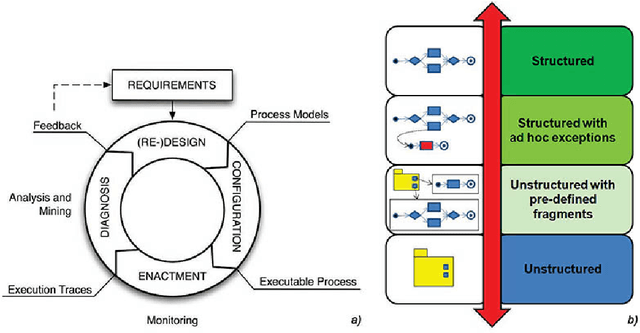
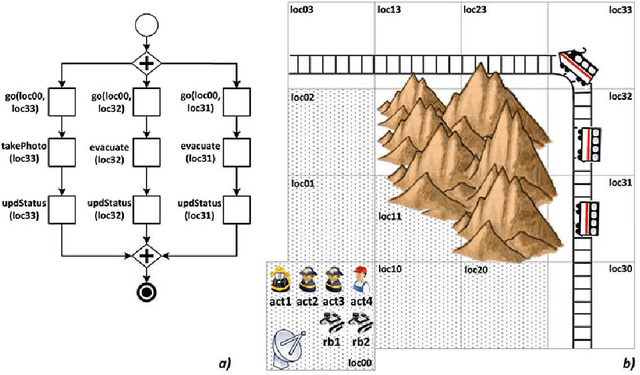
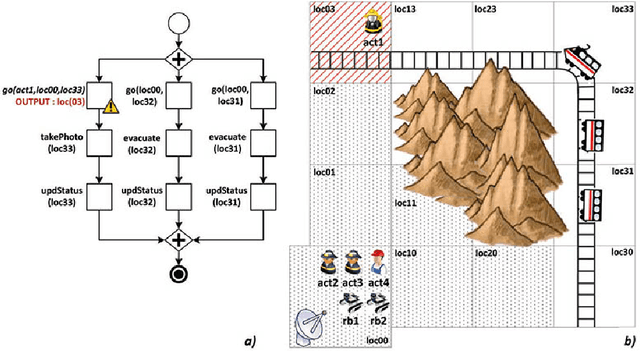
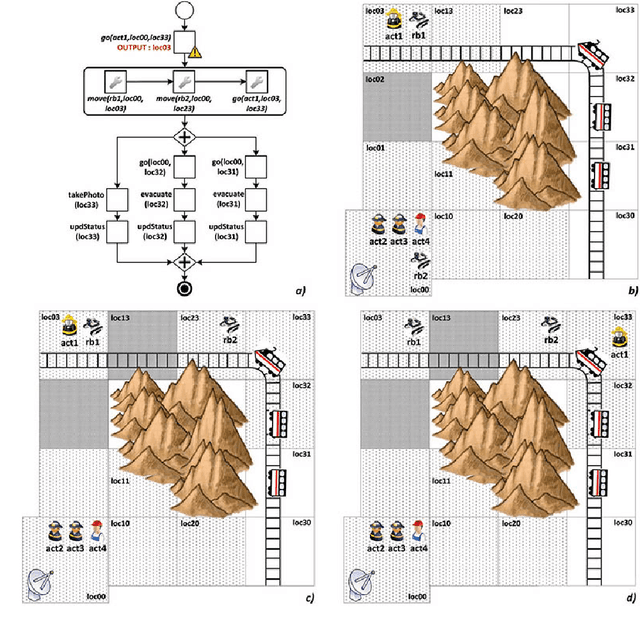
The research activity outlined in this PhD thesis is devoted to define a general approach, a concrete architecture and a prototype Process Management System (PMS) for the automated adaptation of dynamic processes at run-time, on the basis of a declarative specification of process tasks and relying on well-established reasoning about actions and planning techniques. The purpose is to demonstrate that the combination of procedural and imperative models with declarative elements, along with the exploitation of techniques from the field of artificial intelligence (AI), such as Situation Calculus, IndiGolog and automated planning, can increase the ability of existing PMSs of supporting dynamic processes. To this end, a prototype PMS named SmartPM, which is specifically tailored for supporting collaborative work of process participants during pervasive scenarios, has been developed. The adaptation mechanism deployed on SmartPM is based on execution monitoring for detecting failures at run-time, which does not require the definition of the adaptation strategy in the process itself (as most of the current approaches do), and on automatic planning techniques for the synthesis of the recovery procedure.
What Automated Planning can do for Business Process Management
Oct 20, 2017
Business Process Management (BPM) is a central element of today organizations. Despite over the years its main focus has been the support of processes in highly controlled domains, nowadays many domains of interest to the BPM community are characterized by ever-changing requirements, unpredictable environments and increasing amounts of data that influence the execution of process instances. Under such dynamic conditions, BPM systems must increase their level of automation to provide the reactivity and flexibility necessary for process management. On the other hand, the Artificial Intelligence (AI) community has concentrated its efforts on investigating dynamic domains that involve active control of computational entities and physical devices (e.g., robots, software agents, etc.). In this context, Automated Planning, which is one of the oldest areas in AI, is conceived as a model-based approach to synthesize autonomous behaviours in automated way from a model. In this paper, we discuss how automated planning techniques can be leveraged to enable new levels of automation and support for business processing, and we show some concrete examples of their successful application to the different stages of the BPM life cycle.