 Add to Chrome
 Add to Firefox
 Add to Edge
Supporting Autonomous Process Execution within a Multi-Perspective Constraint Frame via Numeric Planning
Jul 18, 2026
AI-Augmented Business Process Management Systems (ABPMS) enhance traditional BPMS by leveraging advanced AI techniques to define, execute, and monitor complex process structures. Within this landscape, Framed Autonomy denotes the capability of a system to autonomously advance the execution of a Business Process (BP) instance while strictly adhering to a predefined frame, i.e., a set of constraints that may span multiple perspectives. Existing research on framed autonomy has predominantly focused on control-flow constraints, either declarative or procedural, and typically relies on their transformation into automata-based representations. In this study, we extend this line of work by introducing a novel tool for what-if analysis that augments the process frame with multi-perspective constraints, including data-aware and temporal conditions. Given a partial process execution, the proposed approach exploits this enriched frame to recommend optimal continuations in compliance with the underlying process specifications. We additionally report an empirical evaluation demonstrating the scalability and effectiveness of the technique, thereby highlighting its potential for supporting autonomous and constraint-aware decision making in ABPMS.

On the Hybrid Nature of ABPMS Process Frames and its Implications on Automated Process Discovery
Apr 24, 2026A core component of any AI-Augmented Business Process Management System (ABPMS) is the process frame, which gives the system process-awareness and defines the boundaries in which the system must operate. Compared to traditional process models, the process frame should, in principle, provide a somewhat more permissive representation of the managed processes, such that the (semi) autonomous behavior of an ABPMS, referred to as framed autonomy, could emerge. At the same time, it is not limited to a single linguistic or symbolic formalism and may incorporate heterogeneous knowledge ranging from predefined procedures to commonsense rules and best practices. In this paper, we conceptualize the notion of an ABPMS process frame as a hybrid business process representation, consisting of semi-concurrently executed procedural and declarative process models. We rely on our earlier works to outline the execution semantics of this type of process frame, arguing in favor of adopting the open-world assumption of the declarative paradigm also for procedural process models. The latter leads to a constraint-like interpretation, where each procedural model is considered to constrain the activities within that model, without imposing explicit execution requirements nor limitations on activities that may be present in other models. This is analogous to existing declarative languages, such as Declare, where each constraint has a direct effect only on the specific activities being constrained. Given this similarity, we propose mapping subsets of discovered declarative constraints into equivalent semi-concurrently executed procedural fragments, thus laying the foundation for a corresponding process (frame) discovery approach.
Monitoring Hybrid Process Specifications with Conflict Management: The Automata-theoretic Approach
Nov 25, 2021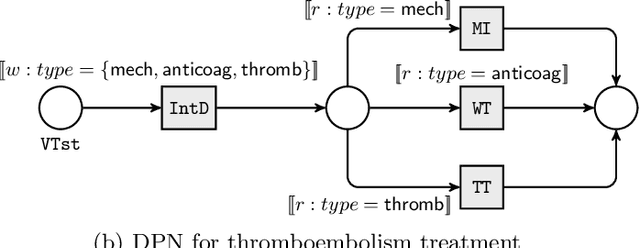
Business process monitoring approaches have thus far mainly focused on monitoring the execution of a process with respect to a single process model. However, in some cases it is necessary to consider multiple process specifications simultaneously. In addition, these specifications can be procedural, declarative, or a combination of both. For example, in the medical domain, a clinical guideline describing the treatment of a specific disease cannot account for all possible co-factors that can coexist for a specific patient and therefore additional constraints may need to be considered. In some cases, these constraints may be incompatible with clinical guidelines, therefore requiring the violation of either the guidelines or the constraints. In this paper, we propose a solution for monitoring the interplay of hybrid process specifications expressed as a combination of (data-aware) Petri nets and temporal logic rules. During the process execution, if these specifications are in conflict with each other, it is possible to violate some of them. The monitoring system is equipped with a violation cost model according to which the system can recommend the next course of actions in a way that would either avoid possible violations or minimize the total cost of violations.