 Add to Chrome
 Add to Firefox
 Add to Edge
ConceptTracer: Interactive Analysis of Concept Saliency and Selectivity in Neural Representations
Apr 08, 2026
Neural networks deliver impressive predictive performance across a variety of tasks, but they are often opaque in their decision-making processes. Despite a growing interest in mechanistic interpretability, tools for systematically exploring the representations learned by neural networks in general, and tabular foundation models in particular, remain limited. In this work, we introduce ConceptTracer, an interactive application for analyzing neural representations through the lens of human-interpretable concepts. ConceptTracer integrates two information-theoretic measures that quantify concept saliency and selectivity, enabling researchers and practitioners to identify neurons that respond strongly to individual concepts. We demonstrate the utility of ConceptTracer on representations learned by TabPFN and show that our approach facilitates the discovery of interpretable neurons. Together, these capabilities provide a practical framework for investigating how neural networks like TabPFN encode concept-level information. ConceptTracer is available at https://github.com/ml-lab-htw/concept-tracer.

Extensions of stability selection using subsamples of observations and covariates
Aug 08, 2015


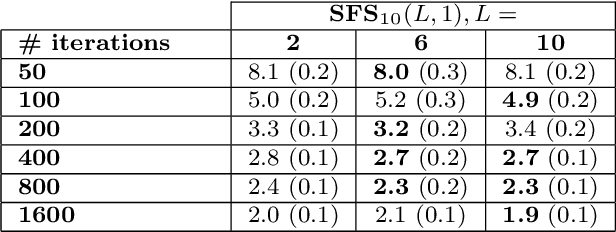
We introduce extensions of stability selection, a method to stabilise variable selection methods introduced by Meinshausen and B\"uhlmann (J R Stat Soc 72:417-473, 2010). We propose to apply a base selection method repeatedly to random observation subsamples and covariate subsets under scrutiny, and to select covariates based on their selection frequency. We analyse the effects and benefits of these extensions. Our analysis generalizes the theoretical results of Meinshausen and B\"uhlmann (J R Stat Soc 72:417-473, 2010) from the case of half-samples to subsamples of arbitrary size. We study, in a theoretical manner, the effect of taking random covariate subsets using a simplified score model. Finally we validate these extensions on numerical experiments on both synthetic and real datasets, and compare the obtained results in detail to the original stability selection method.
* accepted for publication in Statistics and Computing