 Add to Chrome
 Add to Firefox
 Add to Edge
Towards Brain MRI Foundation Models for the Clinic: Findings from the FOMO25 Challenge
Apr 13, 2026
Clinical deployment of automated brain MRI analysis faces a fundamental challenge: clinical data is heterogeneous and noisy, and high-quality labels are prohibitively costly to obtain. Self-supervised learning (SSL) can address this by leveraging the vast amounts of unlabeled data produced in clinical workflows to train robust \textit{foundation models} that adapt out-of-domain with minimal supervision. However, the development of foundation models for brain MRI has been limited by small pretraining datasets and in-domain benchmarking focused on high-quality, research-grade data. To address this gap, we organized the FOMO25 challenge as a satellite event at MICCAI 2025. FOMO25 provided participants with a large pretraining dataset, FOMO60K, and evaluated models on data sourced directly from clinical workflows in few-shot and out-of-domain settings. Tasks covered infarct classification, meningioma segmentation, and brain age regression, and considered both models trained on FOMO60K (method track) and any data (open track). Nineteen foundation models from sixteen teams were evaluated using a standardized containerized pipeline. Results show that (a) self-supervised pretraining improves generalization on clinical data under domain shift, with the strongest models trained \textit{out-of-domain} surpassing supervised baselines trained \textit{in-domain}. (b) No single pretraining objective benefits all tasks: MAE favors segmentation, hybrid reconstruction-contrastive objectives favor classification, and (c) strong performance was achieved by small pretrained models, and improvements from scaling model size and training duration did not yield reliable benefits.

MIMIR: Deep Regression for Automated Analysis of UK Biobank Body MRI
Jun 22, 2021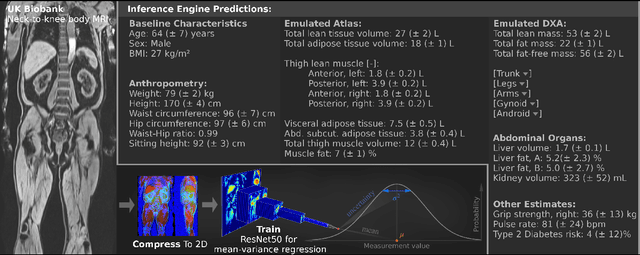
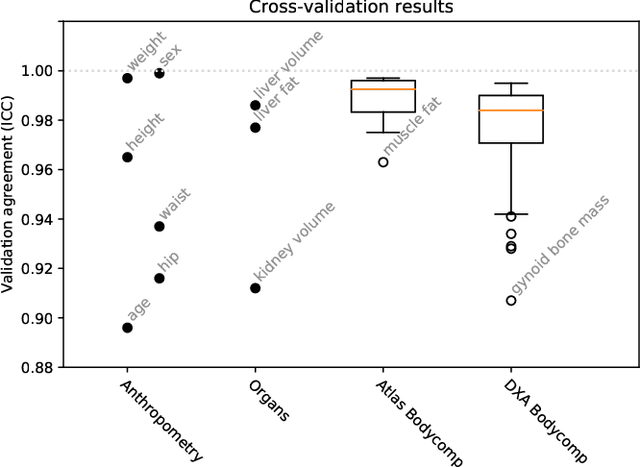
UK Biobank (UKB) is conducting a large-scale study of more than half a million volunteers, collecting health-related information on genetics, lifestyle, blood biochemistry, and more. Medical imaging furthermore targets 100,000 subjects, with 70,000 follow-up sessions, enabling measurements of organs, muscle, and body composition. With up to 170,000 mounting MR images, various methodologies are accordingly engaged in large-scale image analysis. This work presents an experimental inference engine that can automatically predict a comprehensive profile of subject metadata from UKB neck-to-knee body MRI. In cross-validation, it accurately inferred baseline characteristics such as age, height, weight, and sex, but also emulated measurements of body composition by DXA, organ volumes, and abstract properties like grip strength, pulse rate, and type 2 diabetic status (AUC: 0.866). The proposed system can automatically analyze thousands of subjects within hours and provide individual confidence intervals. The underlying methodology is based on convolutional neural networks for image-based mean-variance regression on two-dimensional representations of the MRI data. This work aims to make the proposed system available for free to researchers, who can use it to obtain fast and fully-automated estimates of 72 different measurements immediately upon release of new UK Biobank image data.