 Add to Chrome
 Add to Firefox
 Add to Edge
Composite Shape Modeling via Latent Space Factorization
Jan 09, 2019
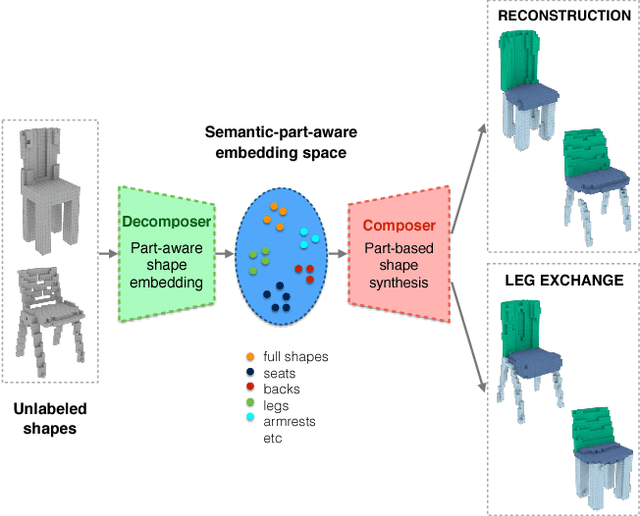
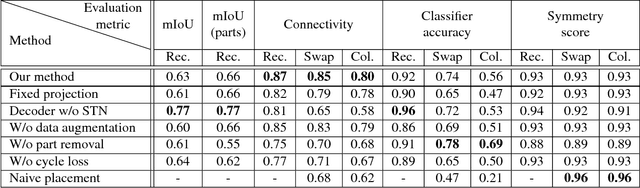
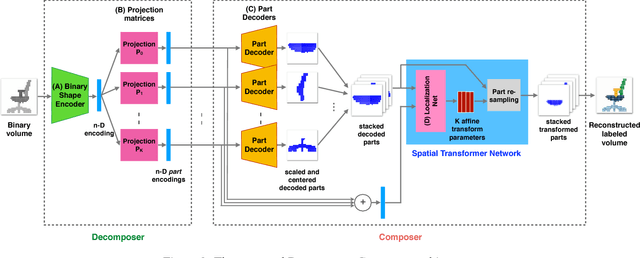
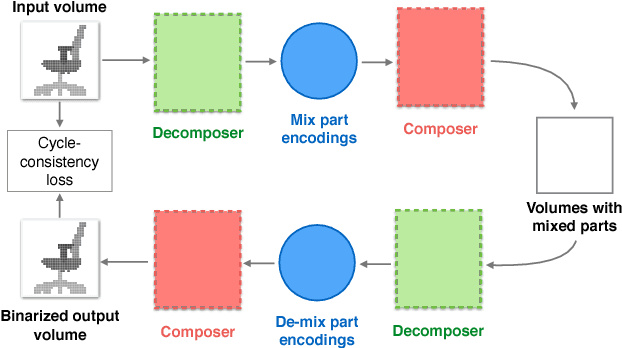
We present a novel neural network architecture, termed Decomposer-Composer, for semantic structure-aware 3D shape modeling. Our method utilizes an auto-encoder-based pipeline, and produces a novel factorized shape embedding space, where the semantic structure of the shape collection translates into a data-dependent sub-space factorization, and where shape composition and decomposition become simple linear operations on the embedding coordinates. We further propose to model shape assembly using an explicit learned part deformation module, which utilizes a 3D spatial transformer network to perform an in-network volumetric grid deformation, and which allows us to train the whole system end-to-end. The resulting network allows us to perform part-level shape manipulation, unattainable by existing approaches. Our extensive ablation study, comparison to baseline methods and qualitative analysis demonstrate the improved performance of the proposed method.

Supervised Fitting of Geometric Primitives to 3D Point Clouds
Nov 22, 2018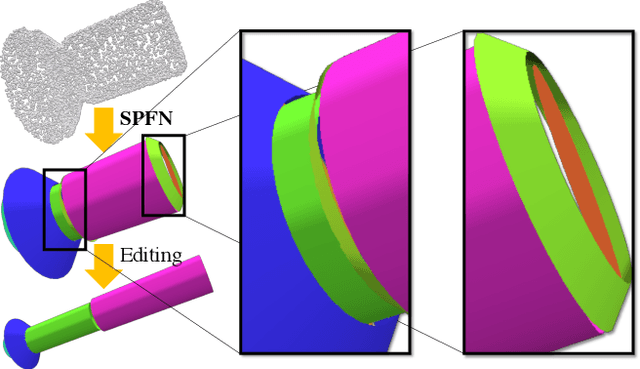
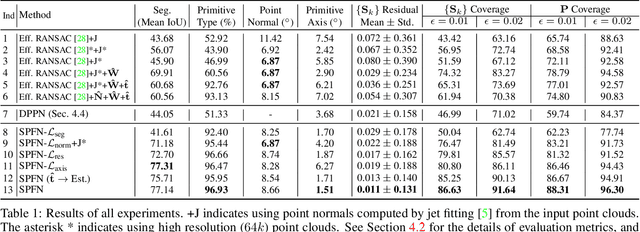
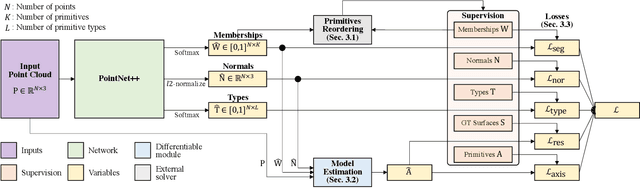
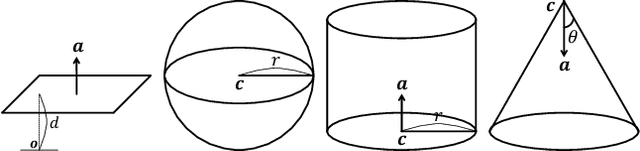
Fitting geometric primitives to 3D point cloud data bridges a gap between low-level digitized 3D data and high-level structural information on the underlying 3D shapes. As such, it enables many downstream applications in 3D data processing. For a long time, RANSAC-based methods have been the gold standard for such primitive fitting problems, but they require careful per-input parameter tuning and thus do not scale well for large datasets with diverse shapes. In this work, we introduce Supervised Primitive Fitting Network (SPFN), an end-to-end neural network that can robustly detect a varying number of primitives at different scales without any user control. The network is supervised using ground truth primitive surfaces and primitive membership for the input points. Instead of directly predicting the primitives, our architecture first predicts per-point properties and then uses a differential model estimation module to compute the primitive type and parameters. We evaluate our approach on a novel benchmark of ANSI 3D mechanical component models and demonstrate a significant improvement over both the state-of-the-art RANSAC-based methods and the direct neural prediction.