 Add to Chrome
 Add to Firefox
 Add to Edge
How Do VLMs Behave When Blind or Misled? Behavioral Evaluation of VLMs on Scientific Figures
Aug 13, 2026
Existing vision-language model (VLM) benchmarks emphasize perception and reasoning accuracy (how well VLMs describe and reason about what they see in an image), with limited attention to behavioral reliability under uncertainty (how they behave when visual evidence is missing or misleading). We introduce SciFigBench, a diagnostic VLM benchmark for scientific figure understanding that jointly evaluates perception, reasoning, and behavioral reliability under uncertainty. It contains 250 figures with high-quality human annotations across three evaluation aspects, totaling 600+ hours of annotation effort. We further extend these figures via image transformations, reasoning questions, resistance probes, caption-bias probes, and confirmed selective-blur targets, producing over 34,000 evaluation setups for stress testing. We further propose the Admittance-Resistance-Inductance (A-R-I) framework to evaluate whether models acknowledge insufficient evidence, resist misleading context, and infer cautiously from partial information. Our results reveal substantial behavioral differences among models. GPT-5.2 achieves the highest description quality (MQM 91.6) with strong reasoning accuracy (78.4%), yet hallucinates unreadable content in 96% of cases, whereas Gemini 3.1 Pro, a comparably capable model (MQM 90.2, reasoning 81.0%), admits uncertainty in 71% of such cases and achieves the strongest resistance score (0.91). These findings show that high perception and reasoning accuracy alone do not guarantee behavioral reliability, a dimension critical for deployment in scientific workflows.

Unsupervised Approach to Evaluate Sentence-Level Fluency: Do We Really Need Reference?
Dec 03, 2023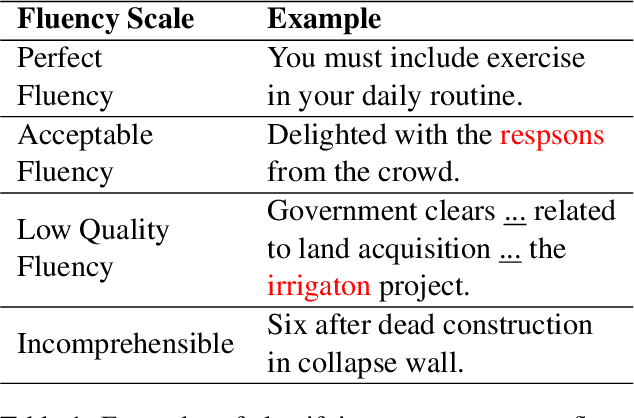
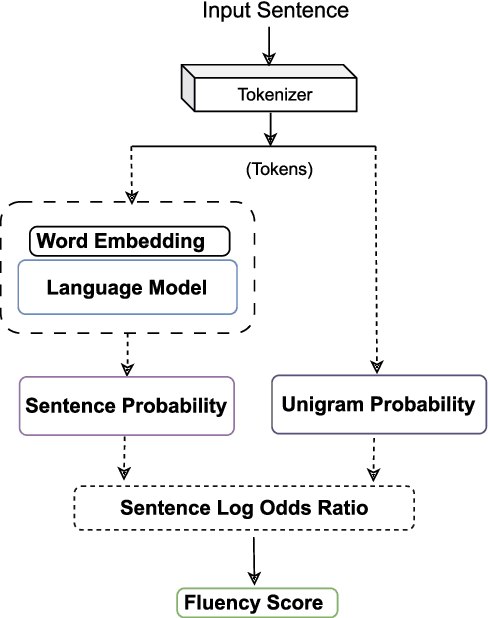


Fluency is a crucial goal of all Natural Language Generation (NLG) systems. Widely used automatic evaluation metrics fall short in capturing the fluency of machine-generated text. Assessing the fluency of NLG systems poses a challenge since these models are not limited to simply reusing words from the input but may also generate abstractions. Existing reference-based fluency evaluations, such as word overlap measures, often exhibit weak correlations with human judgments. This paper adapts an existing unsupervised technique for measuring text fluency without the need for any reference. Our approach leverages various word embeddings and trains language models using Recurrent Neural Network (RNN) architectures. We also experiment with other available multilingual Language Models (LMs). To assess the performance of the models, we conduct a comparative analysis across 10 Indic languages, correlating the obtained fluency scores with human judgments. Our code and human-annotated benchmark test-set for fluency is available at https://github.com/AnanyaCoder/TextFluencyForIndicLanaguges.