 Add to Chrome
 Add to Firefox
 Add to Edge
When Reasoning Traces Become Performative: Step-Level Evidence that Chain-of-Thought Is an Imperfect Oversight Channel
May 12, 2026
Chain-of-thought (CoT) traces are increasingly used both to improve language model capability and to audit model behavior, implicitly assuming that the visible trace remains synchronized with the computation that determines the answer. We test this assumption with a step-level Detect-Classify-Compare framework built around an answer-commitment proxy that is cross-validated with Patchscopes, tuned-lens probes, and causal direction ablation. Across nine models and seven reasoning benchmarks, latent commitment and explicit answer arrival align on only 61.9% of steps on average. The dominant mismatch pattern is confabulated continuation: 58.0% of detected mismatch events occur after the answer-commitment proxy has already stabilized while the trace continues producing deliberative-looking text, and a vacuousness analysis shows that the committed answer does not change during these steps. In architecture-matched Qwen2.5/DeepSeek-R1-Distill comparisons, the reasoning pipeline changes failure composition more than aggregate alignment, most clearly at 32B where confabulated steps decrease as contradictory states increase. Lower step-level alignment is also associated with larger CoT utility, suggesting that the settings that benefit most from CoT are often the least temporally faithful. Paired truncation and a complementary donor-corruption test further indicate that much post-commitment text is not load-bearing for the final answer. These findings suggest that CoT can remain useful while still being an unreliable report of when the answer was formed.

AquaIntellect: A Semantic Self-learning Framework for Underwater Internet of Things Connectivity
May 12, 2024The emerging paradigm of Non-Conventional Internet of Things (NC IoT), which is focused on the usefulness of information as opposed to the notion of high volume data collection and transmission, will be an important and dominant part of human life in the near future. This paper proposes a novel semantic-based approach for addressing the unique challenges posed by underwater NC IoT. We present an intelligent sensing strategy for exploring the semantics of the underwater environment by judiciously selecting the data to transmit, thereby minimizing redundancy for utmost relevant data transmission. We introduce an evolutionary function for the selection of the semantic-empowered messages relevant to the specific task within a minimum Age of Information (AoI), a freshness metric of the collected information, and for monitoring the underwater environment for performance optimization. A DNN-empowered Bayesian integrated with an adaptive surrogate model optimization will determine the optimal placement strategy of the sensors and the uncertainty level of the underwater landscape. An Adaptive Expected Improvement (AEI) mechanism is introduced to predict the optimal arrival rate for enabling a synchronized data sensing and transmission ecosystem, ensuring efficiency and timeliness. Simulation results show that the proposed solution outperforms conventional approaches.
AdaptNet: Rethinking Sensing and Communication for a Seamless Internet of Drones Experience
May 12, 2024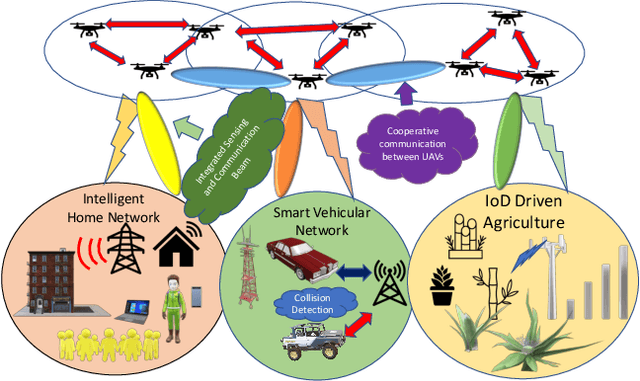
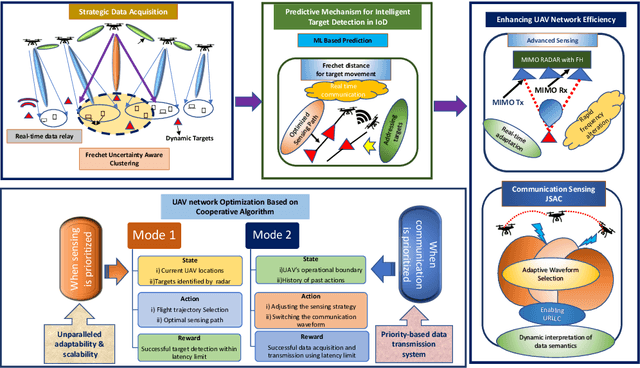
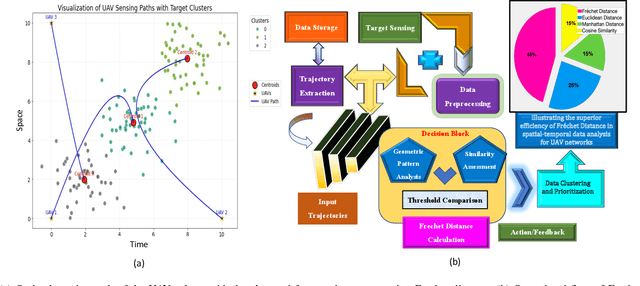
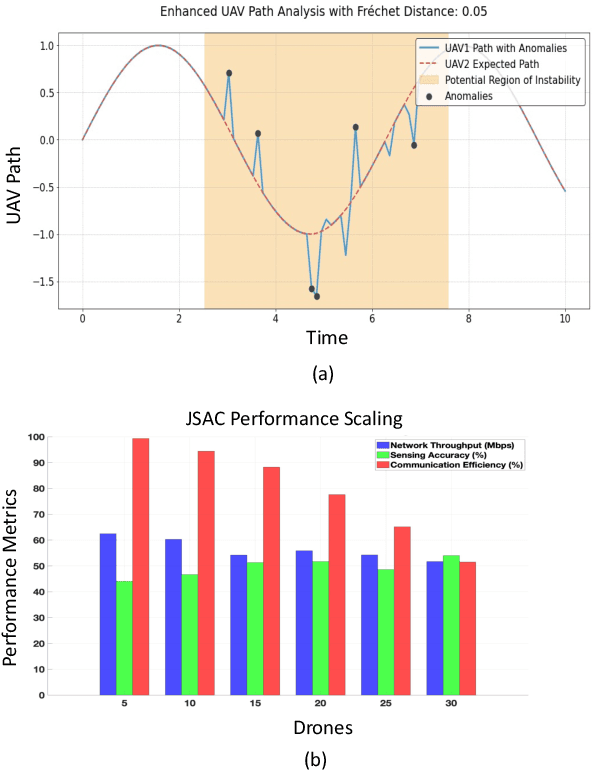
In the evolving era of Unmanned Aerial Vehicles (UAVs), the emphasis has moved from mere data collection to strategically obtaining timely and relevant data within the Internet of Drones (IoDs) ecosystem. However, the unpredictable conditions in dynamic IoDs pose safety challenges for drones. Addressing this, our approach introduces a multi-UAV framework using spatial-temporal clustering and the Frechet distance for enhancing reliability. Seamlessly coupled with Integrated Sensing and Communication (ISAC), it enhances the precision and agility of UAV networks. Our Multi-Agent Reinforcement Learning (MARL) mechanism ensures UAVs adapt strategies through ongoing environmental interactions and enhancing intelligent sensing. This focus ensures operational safety and efficiency, considering data capture and transmission viability. By evaluating the relevance of the sensed information, we can communicate only the most crucial data variations beyond a set threshold and optimize bandwidth usage. Our methodology transforms the UAV domain, transitioning drones from data gatherers to adept information orchestrators, establishing a benchmark for efficiency and adaptability in modern aerial systems.