 Add to Chrome
 Add to Firefox
 Add to Edge
MUSE: Multi-Tenant Model Serving With Seamless Model Updates
Feb 12, 2026
In binary classification systems, decision thresholds translate model scores into actions. Choosing suitable thresholds relies on the specific distribution of the underlying model scores but also on the specific business decisions of each client using that model. However, retraining models inevitably shifts score distributions, invalidating existing thresholds. In multi-tenant Score-as-a-Service environments, where decision boundaries reside in client-managed infrastructure, this creates a severe bottleneck: recalibration requires coordinating threshold updates across hundreds of clients, consuming excessive human hours and leading to model stagnation. We introduce MUSE, a model serving framework that enables seamless model updates by decoupling model scores from client decision boundaries. Designed for multi-tenancy, MUSE optimizes infrastructure re-use by sharing models via dynamic intent-based routing, combined with a two-level score transformation that maps model outputs to a stable, reference distribution. Deployed at scale by Feedzai, MUSE processes over a thousand events per second, and over 55 billion events in the last 12 months, across several dozens of tenants, while maintaining high-availability and low-latency guarantees. By reducing model lead time from weeks to minutes, MUSE promotes model resilience against shifting attacks, saving millions of dollars in fraud losses and operational costs.

RIFF: Inducing Rules for Fraud Detection from Decision Trees
Aug 23, 2024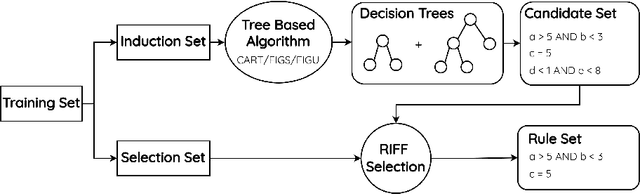
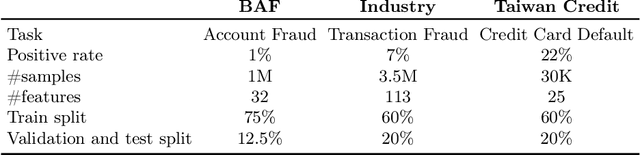
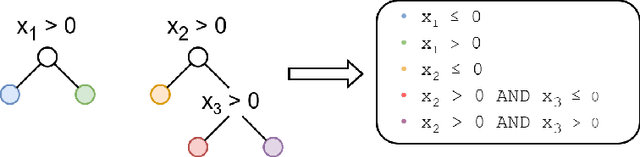
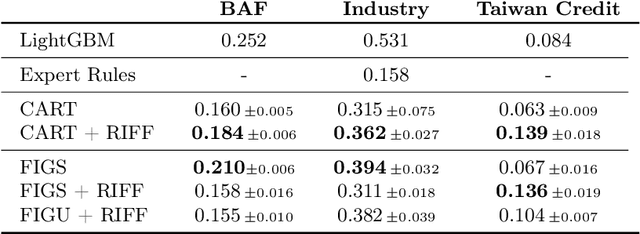
Financial fraud is the cause of multi-billion dollar losses annually. Traditionally, fraud detection systems rely on rules due to their transparency and interpretability, key features in domains where decisions need to be explained. However, rule systems require significant input from domain experts to create and tune, an issue that rule induction algorithms attempt to mitigate by inferring rules directly from data. We explore the application of these algorithms to fraud detection, where rule systems are constrained to have a low false positive rate (FPR) or alert rate, by proposing RIFF, a rule induction algorithm that distills a low FPR rule set directly from decision trees. Our experiments show that the induced rules are often able to maintain or improve performance of the original models for low FPR tasks, while substantially reducing their complexity and outperforming rules hand-tuned by experts.
Interleaved Sequence RNNs for Fraud Detection
Feb 14, 2020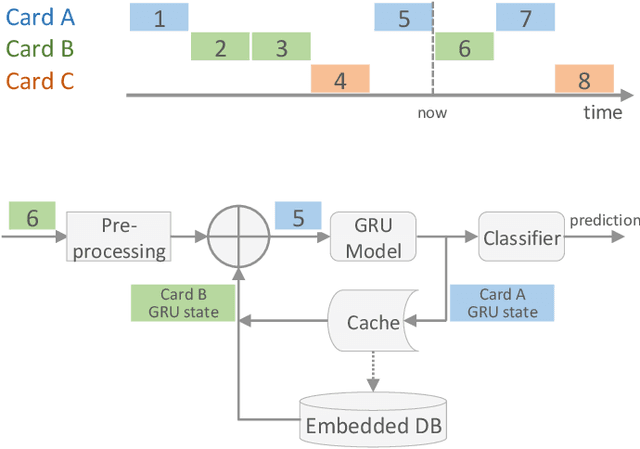
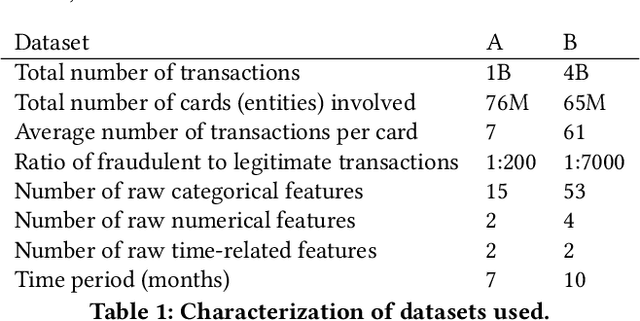
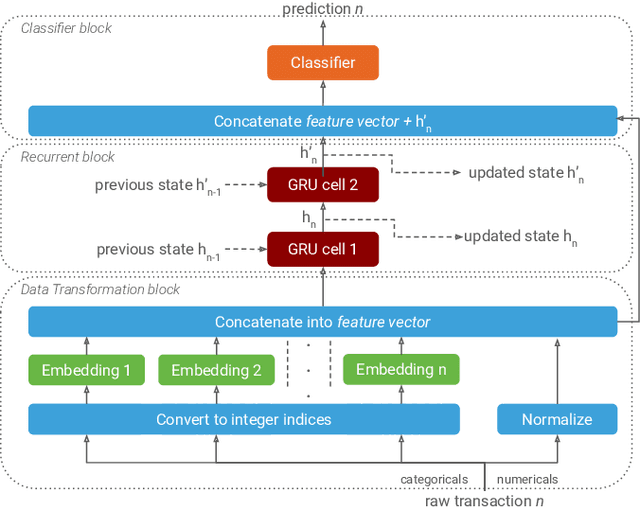
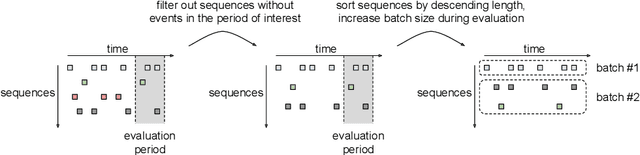
Payment card fraud causes multibillion dollar losses for banks and merchants worldwide, often fueling complex criminal activities. To address this, many real-time fraud detection systems use tree-based models, demanding complex feature engineering systems to efficiently enrich transactions with historical data while complying with millisecond-level latencies. In this work, we do not require those expensive features by using recurrent neural networks and treating payments as an interleaved sequence, where the history of each card is an unbounded, irregular sub-sequence. We present a complete RNN framework to detect fraud in real-time, proposing an efficient ML pipeline from preprocessing to deployment. We show that these feature-free, multi-sequence RNNs outperform state-of-the-art models saving millions of dollars in fraud detection and using fewer computational resources.
Transaction Logic with (Complex) Events
May 15, 2014This work deals with the problem of combining reactive features, such as the ability to respond to events and define complex events, with the execution of transactions over general Knowledge Bases (KBs). With this as goal, we build on Transaction Logic (TR), a logic precisely designed to model and execute transactions in KBs defined by arbitrary logic theories. In it, transactions are written in a logic-programming style, by combining primitive update operations over a general KB, with the usual logic programming connectives and some additional connectives e.g. to express sequence of actions. While TR is a natural choice to deal with transactions, it remains the question whether TR can be used to express complex events, but also to deal simultaneously with the detection of complex events and the execution of transactions. In this paper we show that the former is possible while the latter is not. For that, we start by illustrating how TR can express complex events, and in particular, how SNOOP event expressions can be translated in the logic. Afterwards, we show why TR fails to deal with the two issues together, and to solve the intended problem propose Transaction Logic with Events, its syntax, model theory and executional semantics. The achieved solution is a non-monotonic extension of TR, which guarantees that every complex event detected in a transaction is necessarily responded.
A Goal-Directed Implementation of Query Answering for Hybrid MKNF Knowledge Bases
Nov 01, 2012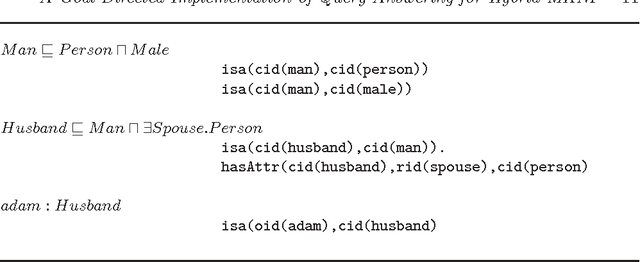
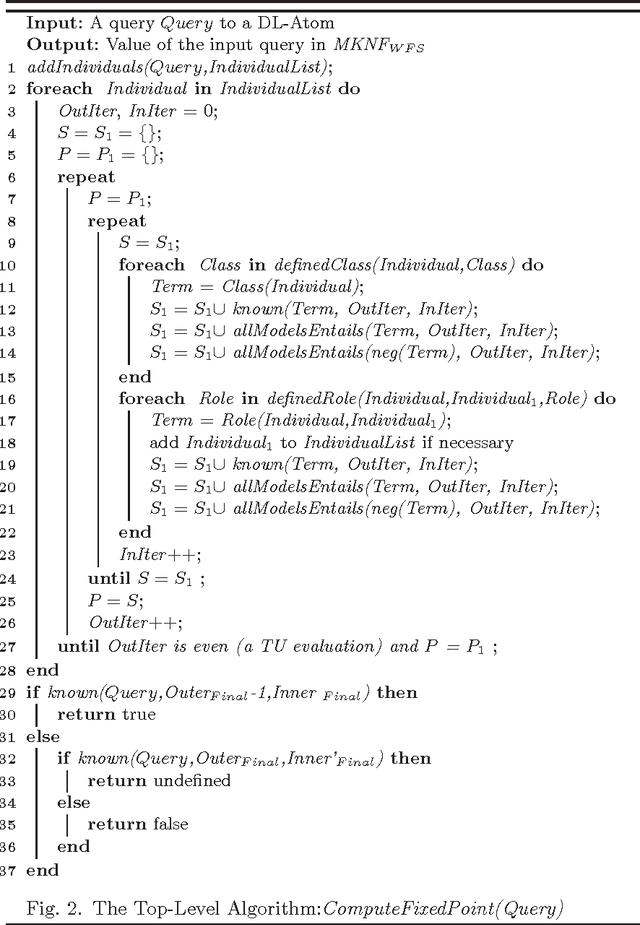
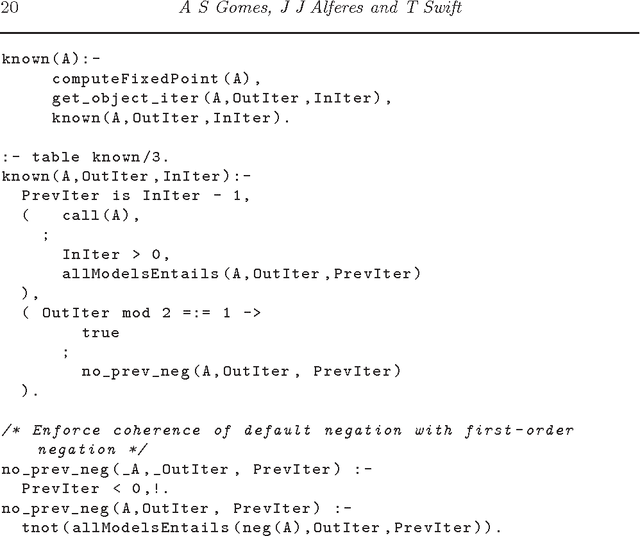
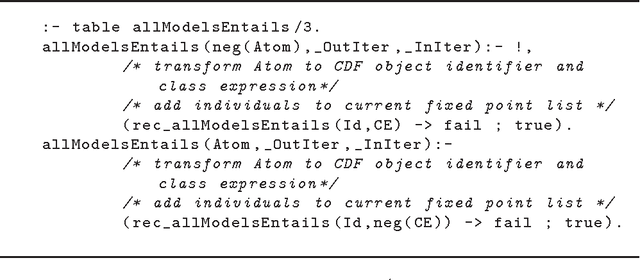
Ontologies and rules are usually loosely coupled in knowledge representation formalisms. In fact, ontologies use open-world reasoning while the leading semantics for rules use non-monotonic, closed-world reasoning. One exception is the tightly-coupled framework of Minimal Knowledge and Negation as Failure (MKNF), which allows statements about individuals to be jointly derived via entailment from an ontology and inferences from rules. Nonetheless, the practical usefulness of MKNF has not always been clear, although recent work has formalized a general resolution-based method for querying MKNF when rules are taken to have the well-founded semantics, and the ontology is modeled by a general oracle. That work leaves open what algorithms should be used to relate the entailments of the ontology and the inferences of rules. In this paper we provide such algorithms, and describe the implementation of a query-driven system, CDF-Rules, for hybrid knowledge bases combining both (non-monotonic) rules under the well-founded semantics and a (monotonic) ontology, represented by a CDF Type-1 (ALQ) theory. To appear in Theory and Practice of Logic Programming (TPLP)