 Add to Chrome
 Add to Firefox
 Add to Edge
The Prosocial Ranking Challenge: Reducing Polarization on Social Media without Sacrificing Engagement
Mar 20, 2026
We report the first direct comparisons of multiple alternative social media algorithms on multiple platforms on outcomes of societal interest. We used a browser extension to modify which posts were shown to desktop social media users, randomly assigning 9,386 users to a control group or one of five alternative ranking algorithms which simultaneously altered content across three platforms for six months during the US 2024 presidential election. This reduced our preregistered index of affective polarization by an average of 0.03 standard deviations (p < 0.05), including a 1.5 degree decrease in differences between the 100 point inparty and outparty feeling thermometers. We saw reductions in active use time for Facebook (-0.37 min/day) and Reddit (-0.2 min/day), but an increase of 0.32 min/day (p < 0.01) for X/Twitter. We saw an increase in reports of negative social media experiences but found no effects on well-being, news knowledge, outgroup empathy, perceptions of and support for partisan violence. This implies that bridging content can improve some societal outcomes without necessarily conflicting with the engagement-driven business model of social media.

Mitigating Racial Biases in Toxic Language Detection with an Equity-Based Ensemble Framework
Sep 27, 2021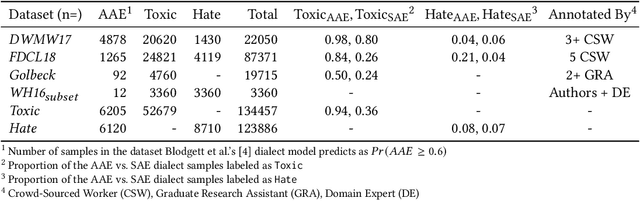
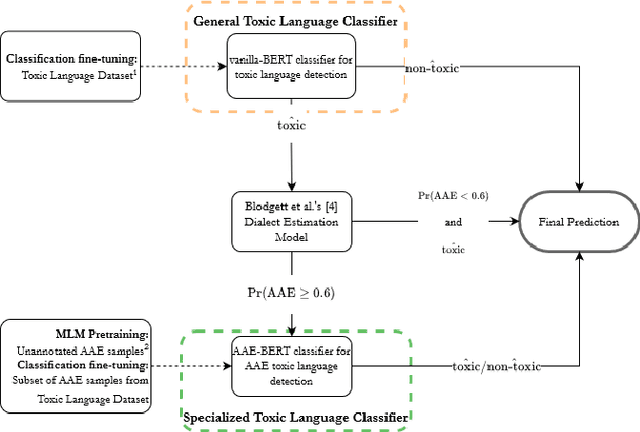
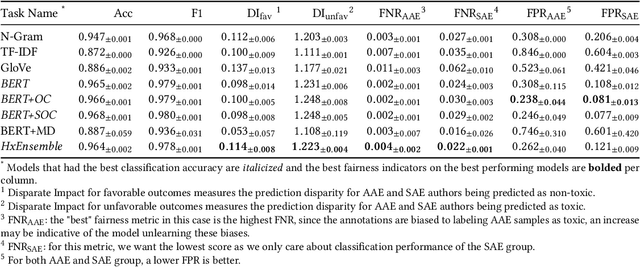
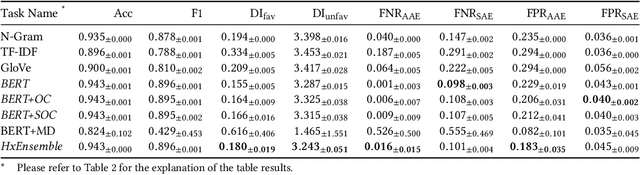
Recent research has demonstrated how racial biases against users who write African American English exists in popular toxic language datasets. While previous work has focused on a single fairness criteria, we propose to use additional descriptive fairness metrics to better understand the source of these biases. We demonstrate that different benchmark classifiers, as well as two in-process bias-remediation techniques, propagate racial biases even in a larger corpus. We then propose a novel ensemble-framework that uses a specialized classifier that is fine-tuned to the African American English dialect. We show that our proposed framework substantially reduces the racial biases that the model learns from these datasets. We demonstrate how the ensemble framework improves fairness metrics across all sample datasets with minimal impact on the classification performance, and provide empirical evidence in its ability to unlearn the annotation biases towards authors who use African American English. ** Please note that this work may contain examples of offensive words and phrases.