 Add to Chrome
 Add to Firefox
 Add to Edge
Evaluation Cards: An Interpretive Layer for AI Evaluation Reporting
Jun 09, 2026
AI evaluation results are produced at scale but reported inconsistently across leaderboards, model cards, benchmark papers, and company blogs. The cost is interpretive: readers cannot reliably compare results across sources, identify what a report omits, or trace an aggregate claim to its underlying evidence. Recent efforts address isolated components but leave three gaps: they cover only narrow slices of the evaluation lifecycle and do not compose into a single interpretable record; they specify static representations that do not differentiate the questions different stakeholders bring to the same evidence; and they remain proposals on paper, lacking the extraction infrastructure required for adoption at scale. We present \EvalCards{}, an operational reporting layer that composes benchmark metadata, evaluation run data, and model metadata into a unified record. We (1) derive a reporting schema from a structured review of 52 papers and 10 stakeholder interviews, (2) implement four interpretive signals (reproducibility, documentation completeness, provenance and risk, and score comparability), rendered through reader modes calibrated to research and non-research audiences, and (3) deploy a monitoring tool that applies \EvalCards{} across 5,816 models, 635 benchmarks, and 101,843 results, surfacing systematic gaps in current reporting practice.

Recognizing Bangla Grammar using Predictive Parser
Jan 10, 2012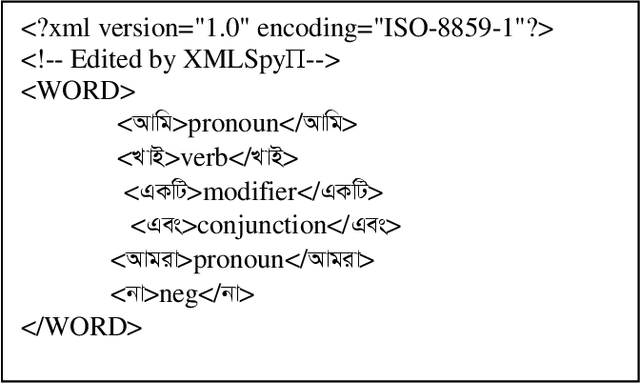
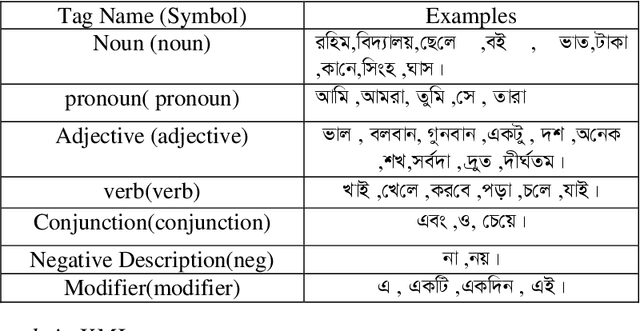
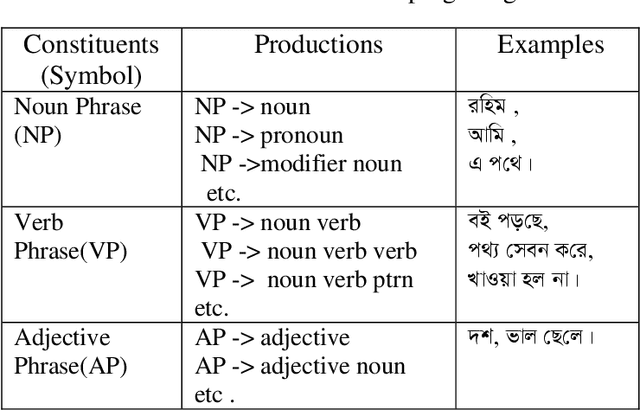
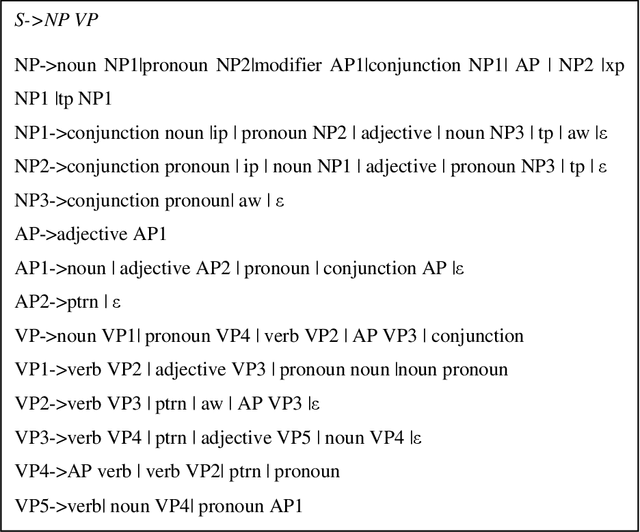
We describe a Context Free Grammar (CFG) for Bangla language and hence we propose a Bangla parser based on the grammar. Our approach is very much general to apply in Bangla Sentences and the method is well accepted for parsing a language of a grammar. The proposed parser is a predictive parser and we construct the parse table for recognizing Bangla grammar. Using the parse table we recognize syntactical mistakes of Bangla sentences when there is no entry for a terminal in the parse table. If a natural language can be successfully parsed then grammar checking from this language becomes possible. The proposed scheme is based on Top down parsing method and we have avoided the left recursion of the CFG using the idea of left factoring.