 Add to Chrome
 Add to Firefox
 Add to Edge
KUET at StanceNakba Shared Task: StanceMoE: Mixture-of-Experts Architecture for Stance Detection
Apr 01, 2026
Actor-level stance detection aims to determine an author expressed position toward specific geopolitical actors mentioned or implicated in a text. Although transformer-based models have achieved relatively good performance in stance classification, they typically rely on unified representations that may not sufficiently capture heterogeneous linguistic signals, such as contrastive discourse structures, framing cues, and salient lexical indicators. This motivates the need for adaptive architectures that explicitly model diverse stance-expressive patterns. In this paper, we propose StanceMoE, a context-enhanced Mixture-of-Experts (MoE) architecture built upon a fine-tuned BERT encoder for actor-level stance detection. Our model integrates six expert modules designed to capture complementary linguistic signals, including global semantic orientation, salient lexical cues, clause-level focus, phrase-level patterns, framing indicators, and contrast-driven discourse shifts. A context-aware gating mechanism dynamically weights expert contributions, enabling adaptive routing based on input characteristics. Experiments are conducted on the StanceNakba 2026 Subtask A dataset, comprising 1,401 annotated English texts where the target actor is implicit in the text. StanceMoE achieves a macro-F1 score of 94.26%, outperforming traditional baselines, and alternative BERT-based variants.

Recognizing Bangla Grammar using Predictive Parser
Jan 10, 2012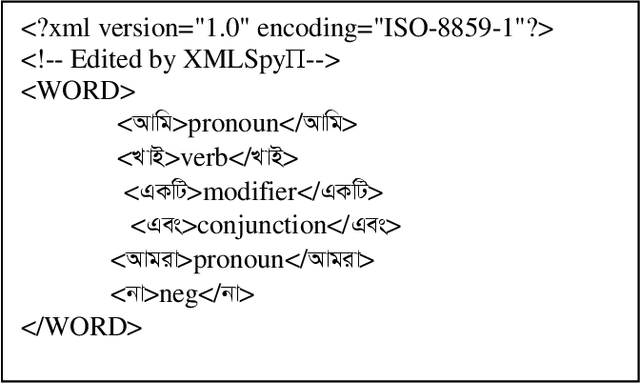
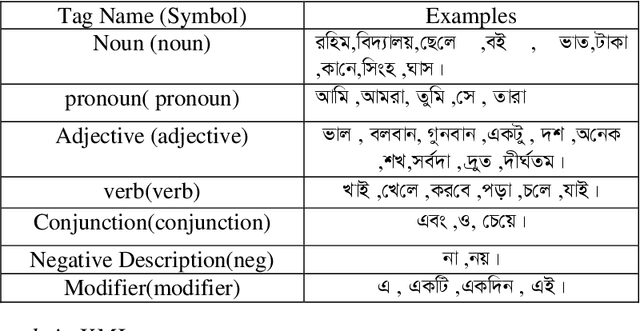
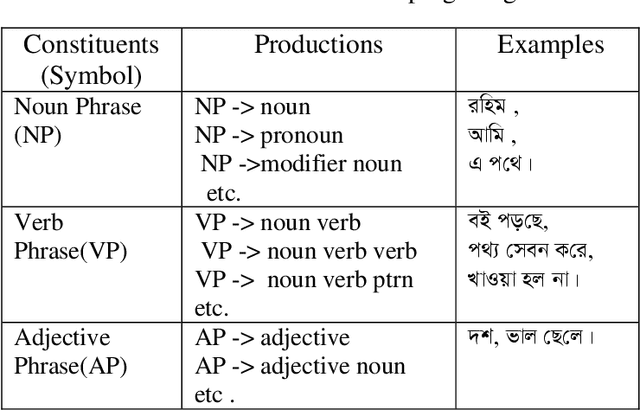
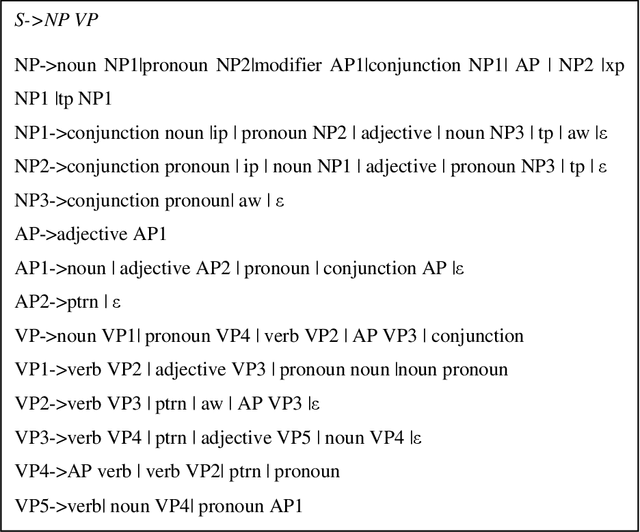
We describe a Context Free Grammar (CFG) for Bangla language and hence we propose a Bangla parser based on the grammar. Our approach is very much general to apply in Bangla Sentences and the method is well accepted for parsing a language of a grammar. The proposed parser is a predictive parser and we construct the parse table for recognizing Bangla grammar. Using the parse table we recognize syntactical mistakes of Bangla sentences when there is no entry for a terminal in the parse table. If a natural language can be successfully parsed then grammar checking from this language becomes possible. The proposed scheme is based on Top down parsing method and we have avoided the left recursion of the CFG using the idea of left factoring.