 Add to Chrome
 Add to Firefox
 Add to Edge
Most Convolutional Networks Suffer from Small Adversarial Perturbations
Feb 03, 2026
The existence of adversarial examples is relatively understood for random fully connected neural networks, but much less so for convolutional neural networks (CNNs). The recent work [Daniely, 2025] establishes that adversarial examples can be found in CNNs, in some non-optimal distance from the input. We extend over this work and prove that adversarial examples in random CNNs with input dimension $d$ can be found already in $\ell_2$-distance of order $\lVert x \rVert /\sqrt{d}$ from the input $x$, which is essentially the nearest possible. We also show that such adversarial small perturbations can be found using a single step of gradient descent. To derive our results we use Fourier decomposition to efficiently bound the singular values of a random linear convolutional operator, which is the main ingredient of a CNN layer. This bound might be of independent interest.

Deep Networks Learn Deep Hierarchical Models
Jan 01, 2026We consider supervised learning with $n$ labels and show that layerwise SGD on residual networks can efficiently learn a class of hierarchical models. This model class assumes the existence of an (unknown) label hierarchy $L_1 \subseteq L_2 \subseteq \dots \subseteq L_r = [n]$, where labels in $L_1$ are simple functions of the input, while for $i > 1$, labels in $L_i$ are simple functions of simpler labels. Our class surpasses models that were previously shown to be learnable by deep learning algorithms, in the sense that it reaches the depth limit of efficient learnability. That is, there are models in this class that require polynomial depth to express, whereas previous models can be computed by log-depth circuits. Furthermore, we suggest that learnability of such hierarchical models might eventually form a basis for understanding deep learning. Beyond their natural fit for domains where deep learning excels, we argue that the mere existence of human ``teachers" supports the hypothesis that hierarchical structures are inherently available. By providing granular labels, teachers effectively reveal ``hints'' or ``snippets'' of the internal algorithms used by the brain. We formalize this intuition, showing that in a simplified model where a teacher is partially aware of their internal logic, a hierarchical structure emerges that facilitates efficient learnability.
Existence of Adversarial Examples for Random Convolutional Networks via Isoperimetric Inequalities on $\mathbb{so}(d)$
Jun 14, 2025We show that adversarial examples exist for various random convolutional networks, and furthermore, that this is a relatively simple consequence of the isoperimetric inequality on the special orthogonal group $\mathbb{so}(d)$. This extends and simplifies a recent line of work which shows similar results for random fully connected networks.
Online Learning of Neural Networks
May 14, 2025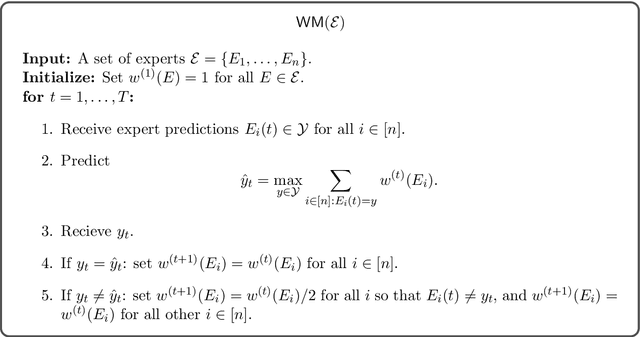
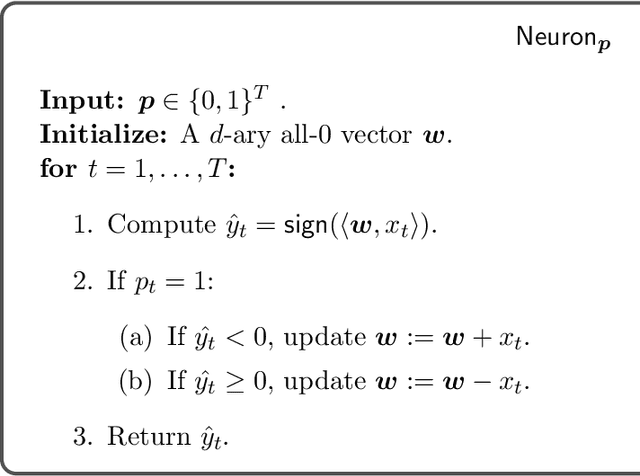
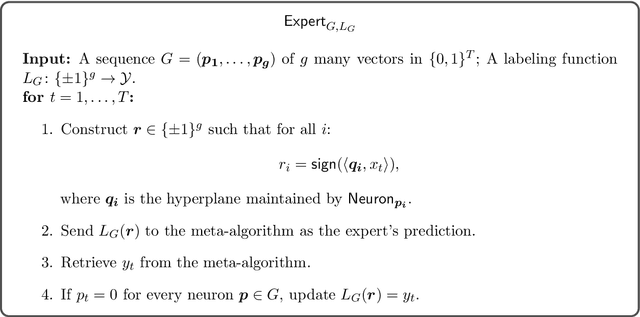
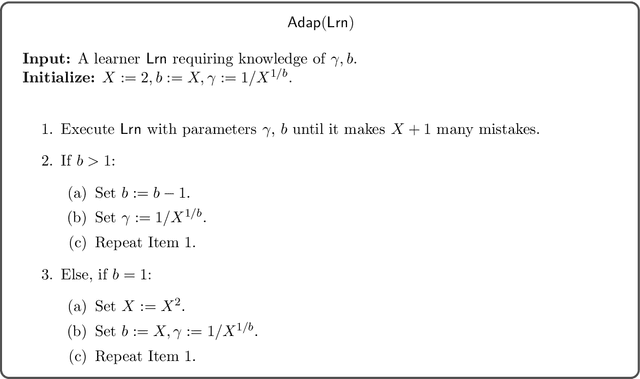
We study online learning of feedforward neural networks with the sign activation function that implement functions from the unit ball in $\mathbb{R}^d$ to a finite label set $\{1, \ldots, Y\}$. First, we characterize a margin condition that is sufficient and in some cases necessary for online learnability of a neural network: Every neuron in the first hidden layer classifies all instances with some margin $\gamma$ bounded away from zero. Quantitatively, we prove that for any net, the optimal mistake bound is at most approximately $\mathtt{TS}(d,\gamma)$, which is the $(d,\gamma)$-totally-separable-packing number, a more restricted variation of the standard $(d,\gamma)$-packing number. We complement this result by constructing a net on which any learner makes $\mathtt{TS}(d,\gamma)$ many mistakes. We also give a quantitative lower bound of approximately $\mathtt{TS}(d,\gamma) \geq \max\{1/(\gamma \sqrt{d})^d, d\}$ when $\gamma \geq 1/2$, implying that for some nets and input sequences every learner will err for $\exp(d)$ many times, and that a dimension-free mistake bound is almost always impossible. To remedy this inevitable dependence on $d$, it is natural to seek additional natural restrictions to be placed on the network, so that the dependence on $d$ is removed. We study two such restrictions. The first is the multi-index model, in which the function computed by the net depends only on $k \ll d$ orthonormal directions. We prove a mistake bound of approximately $(1.5/\gamma)^{k + 2}$ in this model. The second is the extended margin assumption. In this setting, we assume that all neurons (in all layers) in the network classify every ingoing input from previous layer with margin $\gamma$ bounded away from zero. In this model, we prove a mistake bound of approximately $(\log Y)/ \gamma^{O(L)}$, where L is the depth of the network.
RedEx: Beyond Fixed Representation Methods via Convex Optimization
Jan 15, 2024Optimizing Neural networks is a difficult task which is still not well understood. On the other hand, fixed representation methods such as kernels and random features have provable optimization guarantees but inferior performance due to their inherent inability to learn the representations. In this paper, we aim at bridging this gap by presenting a novel architecture called RedEx (Reduced Expander Extractor) that is as expressive as neural networks and can also be trained in a layer-wise fashion via a convex program with semi-definite constraints and optimization guarantees. We also show that RedEx provably surpasses fixed representation methods, in the sense that it can efficiently learn a family of target functions which fixed representation methods cannot.
Locally Optimal Descent for Dynamic Stepsize Scheduling
Nov 23, 2023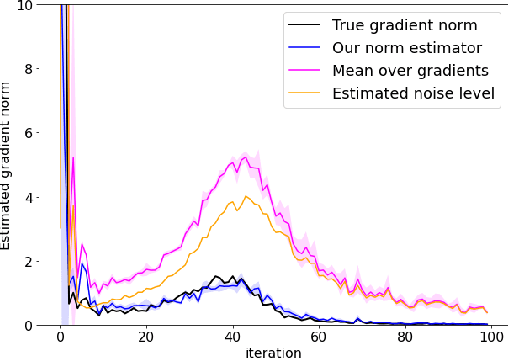

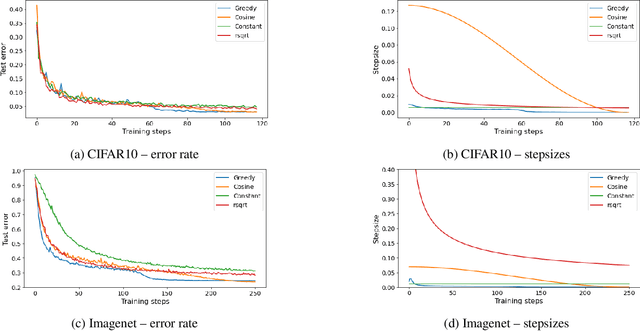

We introduce a novel dynamic learning-rate scheduling scheme grounded in theory with the goal of simplifying the manual and time-consuming tuning of schedules in practice. Our approach is based on estimating the locally-optimal stepsize, guaranteeing maximal descent in the direction of the stochastic gradient of the current step. We first establish theoretical convergence bounds for our method within the context of smooth non-convex stochastic optimization, matching state-of-the-art bounds while only assuming knowledge of the smoothness parameter. We then present a practical implementation of our algorithm and conduct systematic experiments across diverse datasets and optimization algorithms, comparing our scheme with existing state-of-the-art learning-rate schedulers. Our findings indicate that our method needs minimal tuning when compared to existing approaches, removing the need for auxiliary manual schedules and warm-up phases and achieving comparable performance with drastically reduced parameter tuning.
Multiclass Boosting: Simple and Intuitive Weak Learning Criteria
Jul 02, 2023We study a generalization of boosting to the multiclass setting. We introduce a weak learning condition for multiclass classification that captures the original notion of weak learnability as being "slightly better than random guessing". We give a simple and efficient boosting algorithm, that does not require realizability assumptions and its sample and oracle complexity bounds are independent of the number of classes. In addition, we utilize our new boosting technique in several theoretical applications within the context of List PAC Learning. First, we establish an equivalence to weak PAC learning. Furthermore, we present a new result on boosting for list learners, as well as provide a novel proof for the characterization of multiclass PAC learning and List PAC learning. Notably, our technique gives rise to a simplified analysis, and also implies an improved error bound for large list sizes, compared to previous results.
Most Neural Networks Are Almost Learnable
May 30, 2023We present a PTAS for learning random constant-depth networks. We show that for any fixed $\epsilon>0$ and depth $i$, there is a poly-time algorithm that for any distribution on $\sqrt{d} \cdot \mathbb{S}^{d-1}$ learns random Xavier networks of depth $i$, up to an additive error of $\epsilon$. The algorithm runs in time and sample complexity of $(\bar{d})^{\mathrm{poly}(\epsilon^{-1})}$, where $\bar d$ is the size of the network. For some cases of sigmoid and ReLU-like activations the bound can be improved to $(\bar{d})^{\mathrm{polylog}(\epsilon^{-1})}$, resulting in a quasi-poly-time algorithm for learning constant depth random networks.
Efficiently Learning Neural Networks: What Assumptions May Suffice?
Feb 15, 2023Understanding when neural networks can be learned efficiently is a fundamental question in learning theory. Existing hardness results suggest that assumptions on both the input distribution and the network's weights are necessary for obtaining efficient algorithms. Moreover, it was previously shown that depth-$2$ networks can be efficiently learned under the assumptions that the input distribution is Gaussian, and the weight matrix is non-degenerate. In this work, we study whether such assumptions may suffice for learning deeper networks and prove negative results. We show that learning depth-$3$ ReLU networks under the Gaussian input distribution is hard even in the smoothed-analysis framework, where a random noise is added to the network's parameters. It implies that learning depth-$3$ ReLU networks under the Gaussian distribution is hard even if the weight matrices are non-degenerate. Moreover, we consider depth-$2$ networks, and show hardness of learning in the smoothed-analysis framework, where both the network parameters and the input distribution are smoothed. Our hardness results are under a well-studied assumption on the existence of local pseudorandom generators.
On the Sample Complexity of Two-Layer Networks: Lipschitz vs. Element-Wise Lipschitz Activation
Nov 29, 2022We investigate the sample complexity of bounded two-layer neural networks using different activation functions. In particular, we consider the class \[ \mathcal{H} = \left\{\textbf{x}\mapsto \langle \textbf{v}, \sigma \circ W\textbf{x} + \textbf{b} \rangle : \textbf{b}\in\mathbb{R}^d, W \in \mathbb{R}^{T\times d}, \textbf{v} \in \mathbb{R}^{T}\right\} \] where the spectral norm of $W$ and $\textbf{v}$ is bounded by $O(1)$, the Frobenius norm of $W$ is bounded from its initialization by $R > 0$, and $\sigma$ is a Lipschitz activation function. We prove that if $\sigma$ is element-wise, then the sample complexity of $\mathcal{H}$ is width independent and that this complexity is tight. Moreover, we show that the element-wise property of $\sigma$ is essential for width-independent bound, in the sense that there exist non-element-wise activation functions whose sample complexity is provably width-dependent. For the upper bound, we use the recent approach for norm-based bounds named Approximate Description Length (ADL) by arXiv:1910.05697. We further develop new techniques and tools for this approach, that will hopefully inspire future works.